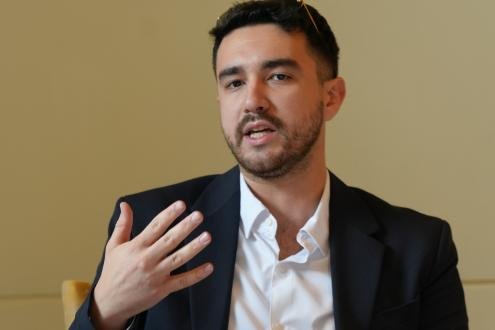
As the artificial intelligence (AI) arms race gathers pace, wealth managers across Asia are shifting from curiosity to capability. At a recent closed-door roundtable hosted by Hubbis and DataDasher in Hong Kong, Alex Kearns, Founder and CEO of DataDasher, explored the operational tipping points where AI is moving from novelty to necessity.
For years, AI in private wealth was viewed as a promise, an evolving technology with distant potential. But as 2026 unfolds, a growing cohort of wealth managers is rethinking this stance. According to Kearns, the industry is at a critical juncture.
“We’re no longer in the exploratory phase,” Kearns told senior leaders from across Hong Kong’s private wealth ecosystem. “The question is no longer if firms will use AI, it’s how they’ll do it, and how fast they can integrate it into real-world workflows.”
Based in San Francisco and recently expanding into Asia via a new Hong Kong subsidiary, DataDasher focuses exclusively on the private wealth and asset management vertical. Its platform connects with existing systems, Customer Relationship Management (CRM), meeting platforms, portfolio data, and embeds AI agents directly into the workflows of advisors, allowing firms to reclaim as much as 10 to 15 hours per advisor per week.
Key Takeaways
- AI Adoption Is Accelerating Across APAC: While the US has led early deployments, adoption in Asia is picking up speed, particularly in Hong Kong and Singapore.
- Workflow-Integrated AI Is the New Frontier: Vertical tools tailored to wealth managers, rather than generic chatbots, are now driving measurable productivity gains.
- Data Privacy and Compliance Are Non-Negotiable: Tools must meet regulatory standards and offer full data isolation, especially in regulated markets like Hong Kong.
- Copilot Is Not an AI Strategy: While useful for basic tasks, generalist tools cannot replace verticalised solutions designed for wealth workflows.
- The True Return on Investment (ROI) Is in Time Reclaimed: Meeting prep, follow-up, documentation, and CRM updates can be automated, freeing advisors to focus on clients.
From Hype to Habits: The Shift to Vertical AI
As generative AI continues to dominate headlines, the real impact in wealth management is emerging in the quiet transformation of daily operations. Kearns believes the transition is already underway.
“The first wave was about experimentation, playing around with ChatGPT or CoPilot,” he said. “Now we’re seeing agentic AI embedded directly into advisor workflows, with tangible results.”
In contrast to general-purpose tools, vertical AI solutions, designed specifically for private wealth management, connect with systems already in use, such as client relationship management platforms and portfolio databases. These tools are capable not only of summarising meetings and generating follow-ups, but also of understanding financial terminology, tracking commitments, and improving compliance oversight.
“AI is no longer just about generating text,” Kearns noted. “It’s executing tasks that previously required hours of administrative work.”
The Hidden Tax: Advisor Admin and Missed Opportunities
Kearns pointed to one of the industry’s most persistent pain points: time lost to repetitive administration. From meeting preparation to post-call documentation, many of the tasks that define an advisor’s day are still handled manually, and inconsistently.
“There’s a hidden tax on productivity,” Kearns argued. “Meeting prep, note-taking, CRM updates, compliance memos, these can be automated. What’s been missing is the fine-tuned AI layer that understands what advisors actually do.”
In the US, DataDasher has already partnered with leading wealth firms and validated the time-savings. One global wealth manager has reported productivity gains equivalent to 10–15 hours per week per advisor. The firm’s internal analytics showed improvements not only in efficiency, but also in execution consistency and follow-through.
“Firms that get this right are turning AI into operational infrastructure, not just a shiny object,” Kearns added.
Beyond Generic Tools: Why Verticalisation Matters
While many firms in the region have begun exploring generalist AI tools like Microsoft CoPilot, Kearns cautioned against viewing such tools as a comprehensive strategy.
“CoPilot is helpful, for summarising emails or generating first drafts. But it’s horizontal,” he explained. “It’s not designed for the regulated workflows of private wealth managers. It doesn’t connect to your CRM, your client histories, or your portfolio systems.”
By contrast, vertical platforms such as DataDasher are built around a wealth manager’s daily routines. They understand compliance requirements, audit trails, and documentation standards. More importantly, they integrate directly with existing systems, enabling automation without disrupting the tech stack.
“Your AI tools need to speak the language of wealth management,” Kearns emphasised. “Generic tools can’t do that.”
Trust, Privacy, and Regulatory Guardrails
A recurring theme throughout the luncheon was trust, both in the technology and in how data is handled. Kearns addressed concerns about sensitive information, particularly in highly regulated markets like Hong Kong.
“Consumer-grade tools aren’t built for compliance,” he warned. “You shouldn’t be putting personal identifiable information or client data into ChatGPT.”
To address this, DataDasher deploys its AI in private, siloed environments, hosted on enterprise-grade cloud infrastructure like Microsoft Azure or Amazon Web Services. No customer data is used to train models, and all information remains within the client’s own ecosystem.
“Data isolation is essential,” Kearns said. “We’ve designed our platform to align with the highest security and privacy standards including SOC 2 and GDPR, with ISO 27001 certification underway. That’s not optional in this industry.”
The ROI Equation: Measuring Impact in Hours, Not Hype
Rather than relying on soft metrics, Kearns encouraged firms to approach AI with the same rigour they would apply to any investment. His recommendation: start with a simple ROI calculation.
“Take the number of hours saved per week, multiply that by 48 working weeks, and multiply again by your blended hourly rate,” he explained. “Then subtract your licensing cost. You’ll find the ROI is straightforward, and often realised in weeks, not years.”
With pricing starting at USD120 per advisor per month, Kearns believes the cost equation is clear. “If you’re saving 12 hours per week, the value becomes obvious very quickly.”
Use Cases in Action: From Note-Taking to Client Retention
During the session, Kearns walked attendees through practical use cases, from note automation to semantic search across client histories. One feature, meeting follow-ups tailored to the actual conversation, was particularly well-received.
“Every meeting has seven or more outputs,” he said. “Meeting notes, CRM updates, follow-ups, task tracking, pre-meeting prep for the next session, all generated automatically and reviewed in minutes.”
DataDasher’s platform also supports multi-language environments, including Cantonese and Mandarin, and is optimised for both in-person and remote meetings.
“This isn’t about replacing the advisor,” Kearns clarified. “It’s about enabling them to do more of what matters, serving clients, not typing notes.”
The Buy-vs-Build Decision: Think Carefully
As the session drew to a close, Kearns was asked about the risks of adopting startup tools versus building AI capabilities in-house. His view was clear: don’t underestimate the hidden costs of custom development.
“Building proprietary AI sounds attractive, until you have to maintain it, scale it, and keep up with model improvements,” he said. “Most firms don’t have the internal resources or speed to do this well.”
Kearns pointed to the example of large institutions that abandoned bespoke platforms in favour of custom-configured enterprise tools. “Even Morgan Stanley moved to Salesforce after building its own CRM. The lesson is: choose flexible partners, not fragile systems.”
A New Baseline for Client Expectations
Perhaps the most important shift Kearns identified is in the mindset of the client. As AI-enhanced service becomes more common, expectations around responsiveness, personalisation, and consistency are rising.
“Clients are already experiencing AI elsewhere, whether in consumer tech, retail, or communications,” he said. “They’re bringing those expectations into wealth management.”
For wealth firms, the message is clear: update your tech stack, or risk being left behind.
“Bad tech is no longer just inefficient,” Kearns concluded. “It’s a liability. Your stack can either help you win clients, or lose them.”