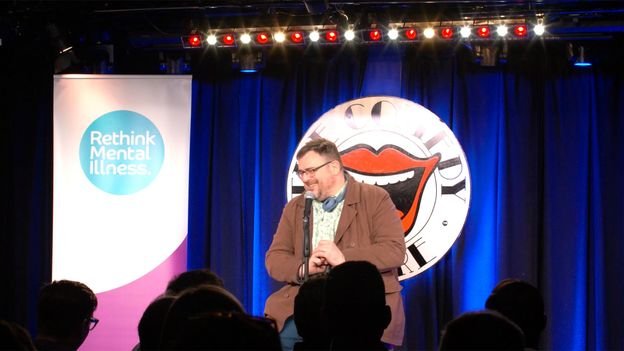
That kind of self-discovery and group-bonding was unexpected for Ryan Moore, a football coach and former player who had struggled with addiction and been diagnosed with narcissistic personality disorder. After four years of therapy, Moore decided to give Belcher’s comedy-on-referral course a try. On his first day, he wasn’t sold. “I was the youngest guy there and I looked around and wondered if this was beneath me,” he admits. But then, as the men started talking about their traumas, his mindset shifted. “It was like an arrow had gone through every single person’s heart and I realised we’re all sort of the same.”
Moore says the comedy prescription has been better for his mental health than any other kind of therapy or pill. And more than just comedic skills and coping mechanisms, he’s made friends he otherwise wouldn’t have. “It’s really special to have that connection with guys I would never meet or speak to in a pub.”
Moore says the group has also helped him shift his perspective on himself. “There’s this victimhood mentality where you carry [your pain] around on your shoulders and it weighs you down every single day,” he says. “But here, we can get that feeling off our chest and have a laugh at the things that have happened to us.”
In a report analysing Belcher’s comedy-on-referral programme for men, co-author Lisa Sheldon, a consultant, clinical psychologist and a leader within the West London NHS Trust, also recognised this group dynamic. Among other benefits, she says, it involves “talking publicly about what it means to be human and being open about what goes on inside of us, whilst at the same time dispelling myths and establishing shared truths and connection”.
The report also says using humour as a therapeutic tool, rather than framing the course as therapy, helped to “facilitate a lighter perspective on past traumas, thus lessening the burden of anxiety and fear”.
Belcher agrees that the lighter framework was key. “If I’d asked these men, ‘Do you want to come to a therapeutic men’s school?’ they wouldn’t do that, but when we said, ‘Come and learn stand-up comedy,’ that worked,” Belcher says.
The rise of comedy on ‘prescription’
The need for therapeutic tools has grown more urgent in England, where rates of mental illness have continued to rise. The most recent data finds one in six people over 16 in England experienced symptoms of a mental health problem in the past week. The Office of National Statistics found the rate of suicide rose to more than 6,000 deaths in 2023 in England and Wales – the highest since 1999, with rates among men particularly high.
That’s part of the reason why the NHS has increased its investment in social prescribing. Though not explicitly measuring comedy prescriptions, a 2022 NHS England-commissioned evidence review from the National Academy of Social Prescribing linked participation in creative and expressive activities with a wide range of benefits – including increased social interaction, decreased stress, healthy behaviours and improved employment.