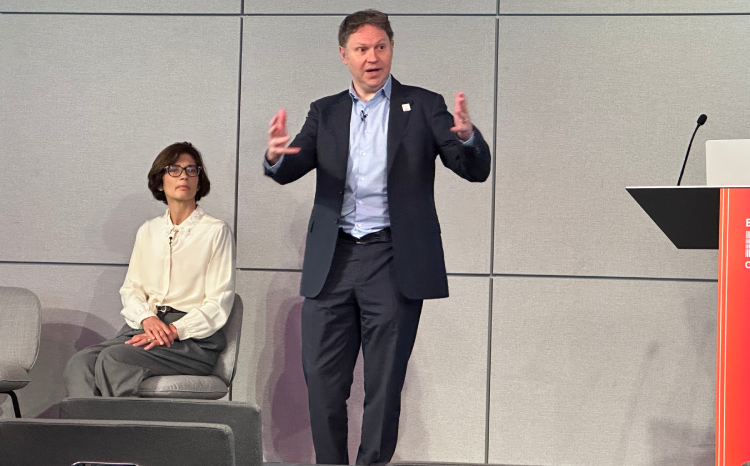
James Freed, deputy director of the NHS Digital Academy, speaking at BMJ Future Health (Credit: Jordan Sollof)
Healthcare staff are quitting the sector because of a lack of digital literacy skills which leads them to struggle with technology, according to James Freed, deputy director of the NHS Digital Academy.
Speaking at the BMJ Future Health conference in London on 6 November 2025, Freed said that poor levels of digital literacy in the NHS are causing poorer patient outcomes, staff burnout and workers to leave the sector.
He said that between 2% and 5% of NHS workers have fundamental digital skills gaps, such as basic IT competence, which can cause them to “leave the NHS when they’re asked to use digital tools for the first time,” while between 60% and 75% of NHS staff have some kind of digital skills gap, such as product knowledge or AI awareness.
“We’re starting to see in high numbers, more than we ever have, digital technology being cited for the reasons why people are choosing to leave healthcare now,” he said.
Freed also highlighted research from Boston Consulting Group which found that 63% of failed digital transformations fail due to cultural, organisational or digital skills reason, rather than the technology itself.
He said that the NHS 10 year health plan and other healthcare strategies over the last three decades, “have majored on digital technology as the magic sauce that would make the NHS more productive and affordable”.
However, he said that despite the 10 year health plan being “full of ambition”, he was concerned that “we’re all a little burnt out on ambition that hasn’t quite met its promise”.
“I would suggest we need to try and do maybe a little bit less, but do a little a lot better,” he said.
The session was chaired by Linda Vernon, head of digital empowerment at NHS England North West, and also featured Marcela Paola Vizcaychipi, chief clinical information officer at Chelsea and Westminster Hospital NHS Foundation Trust.
Both Freed and Vizcaychipi stressed that education and cultures are the real drivers of digital transformation success in the NHS.
Vizcaychipi said that healthcare professionals’ curriculum “should have an element of digital literacy to get a better understanding of what we are introducing so that it’s not new to them”.
She added that we need to start getting “youngsters that were born with a computer under their arms” around NHS executive boards and called for the introduction of “reverse mentorship” guided by younger people who are more tech savvy.
“The older we get, the more afraid we are to say, ‘I don’t know’, we need to start showing vulnerability.
“My approach is [to] engage the youngsters, transform the thinking by educating and of course vulnerability – don’t be afraid of challenge,” she said.
Meanwhile, the Royal College of GPs has warned of a “mass exodus of GPs” leaving the profession after its annual survey found that almost a third of GPs said they were unlikely to still be working in general practice in five years’ time.
Its GP Voice survey of 2,100 members found that 73% felt workload pressures were compromising patient safety and fewer than 30% had enough time with patients during consultations.