In January, Pope Leo XIV warned against “a naive and unquestioning reliance on artificial intelligence as an omniscient ‘friend’, a source of all knowledge, an archive of every memory, an ‘oracle’ of all advice”.
This warning comes amid a proliferation of AI programs designed for companionship, advice and even intimate relationships. These AI are always there, 24/7, and they are always supportive and affectionate. By exploiting our need for relationships, Pope Leo wrote, these apps become “hidden architects of our emotional state”, creating a “world of mirrors around us”. While these programs seemingly fill a need for human relationships, there are others still that are filling a spiritual and religious need.

Pope Leo XIV speaks during an audience at the Paul VI Hall with young people of the Diocese of Rome on 10 January 2026 in Vatican City, Vatican. (Photo by Mario Tomassetti – Vatican Media via Vatican Pool / Getty Images)
People are using AI to talk to God through apps like Chatwithgod, Talkie and Text with Jesus. These facilitate conversation between worshipper and the divine, and can be personalised by choosing prompts for discussion topics, current mood and religious affiliation, for example. Part of the appeal of these uses of AI to talk to God is the fact that it feels highly individualised and immediate.
Unsurprisingly, however, many people exhibit an immediate and hostile reaction to such uses of technology. For them, “technology” and “God” remain worlds apart. There seems something inherently organic and personal about the pursuit of spirituality or a search for connection with the divine. This appears at odds with the cold feel of wires, black boxes and impersonal ones and zeros offered by technology. The last decade has dramatically changed the way people relate to technology. From spiritual chatbots to AI Bibles, we may very well question what these new technologies mean for the future of religion and human spirituality.
It might seem that we are in unprecedented times, that the relationship between technology and religion is radically new. But in reality, technology and god(s) have been partners for thousands of years.
Using technology to connect with God
While religious systems always had various ways to connect with God — prayer, dedication and other rituals — there is a particular allure about getting an answer that’s tailored to you, in the exact moment you need it. This is why ancient Greek oracles were so popular. The most famous was the oracle to Apollo at Delphi, where individuals would travel far and wide to hear a personalised answer to their present predicament. The mouthpiece of the god in that case was human — a young priestess known as the Pythia — but we also have evidence from Greece and Roman-occupied Egypt of oracles delivered through an autophone: a device inserted into a statue that allowed the god to talk directly to the worshipper.

Ancient city of Delphi with ruins of the temple of Apollo. (Gatsi / iStock / Getty Images)
Technology enhancing religious space
Connection with the divine didn’t just happen through words, however. The ancient Greeks experienced proximity to their gods, a sense of epiphany, through seeing the god before them. They applied knowledge of the science of reflection to erect mirrors in their temples that would reflect statues of the god as the worshipper entered the sacred space.
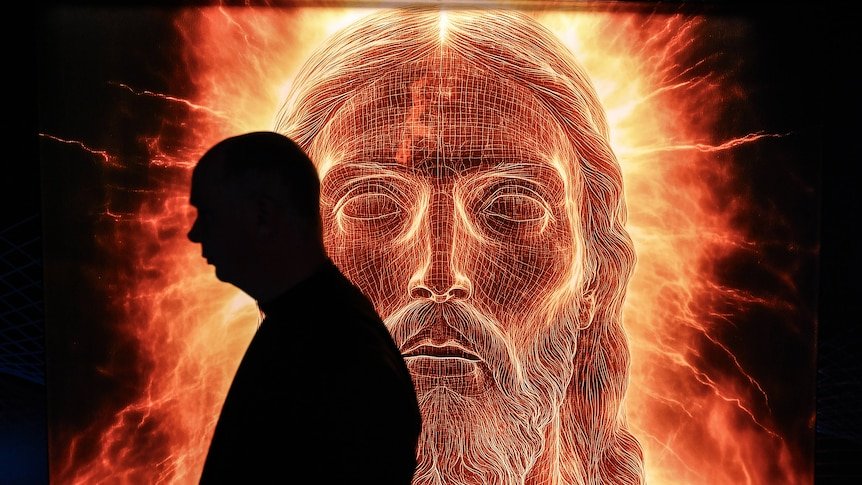
Recently, a small church in Switzerland experimented with installing an AI-powered Jesus within its own walls. An avatar of Jesus, set up in the confessional booth instead of the priest, would speak to worshippers in their preferred language. This humble Swiss church can simultaneously boast being the oldest church in the city of Lucerne, as well as giving room (quite literally) to new spiritual formats.
Technology and religious messaging
Different religions are constantly choosing what sorts of technologies might suit their doctrines, their values and their worshippers. Whether it’s listening to an Islamic sermon on cassette in busy Cairo, or attending a North American megachurch enhanced through high-tech audiovisual effects, or hearing the echo of a priest’s unamplified voice in a cathedral with hymns accompanied by an organ. From the role of the printing press in the Protestant reformation to televangelism, religious technologies have long shaped religious experience and been used to transmit religious messages.
It shouldn’t be surprising, then, that AI is being harnessed to depict biblical stories or to represent God. There has been a proliferation of AI-generated videos from sites such as The AI Bible. Short form videos with titles such as “If Moses had an iPhone?” show AI generated depictions of biblical figures recounting their story as if they were speaking in a TikTok-style video. Another AI-generated video titled “POV: you die and go to heaven” depicts the viewer dying in a car crash, travelling to heaven and being welcomed “home” by an AI version of God. Many more AI-generated videos depict scenes from the Bible often filled with violence, fire and brimstone.

Religious technologies have long shaped religious experience and been used to transmit religious messages. (inkoly / iStock / Getty Images)
In ancient Greece, technology was used to communicate theology to the hundreds of spectators watching ancient drama. Before it was the name of a brand, deus ex machina was a part of ancient Greek theatrical performance. It refers to the use of a mechanical crane to suspend an actor playing a god who interfered in the events of the play. The crane was mostly hidden behind the backstage structure, but when needed a horizontal bar could be raised up and pivoted over the stage, holding the god in the air above the action that was happening below.
In this case, technology was being used to stage a divine epiphany, to bring gods and humans closer, and to bring to life a mythical or religious story. The deus ex machina as a religious technology made the god “look” and “act” a certain way. In effect, it told spectators: You can expect the god to intervene in your lives these sorts of ways, say these sorts of things, offer this sort of advice.
Old and new
The desire to combine old and new, tradition and innovation, is also a longstanding theme in the history of religion. Processions to the gods formed the cornerstone of ancient Greek religious festivals — a time where the city stopped working, came together in worship of a particular deity and walked through the streets of their cities carrying objects of all sorts. The procession usually made its way to the temple of the god or goddess in question and culminated in offering blood sacrifice at the altar.

Votive stele depicting a sacrificial procession to Dionysus and Artemis for the win in a contest of theatre, circa 360 BCE. (Photo by PHAS / Universal Images Group via Getty Images)
From about 300 BCE we hear of individuals who jazzed up this deeply traditional component of ancient Greek religion by commissioning large, self-moving machines to process in the streets alongside worshippers. One was a giant snail that left a trail of slime behind as it went. Another was a statue of a goddess who stood up on her own, poured a liquid offering from a jug she was holding, and sat back down again. Yet another saw a huge ship traverse the streets of Athens.
Watching these impressive, technologically animated objects move of their own accord, Greek worshippers felt confident that the deity was present and participating in the religious occasion. They also felt satisfied that they had built an impressive object worthy of the divine.
To embrace or reject technology?
The tension between old and new, between religious custom and religious innovation, seems to be part of what we’re seeing with religious uses of AI. And, of course, opinion is divided. Just as Pope Leo XIV has recently warned us about the possible dangers of naïve uses of AI — especially for spiritual purposes — ancient Greek literature is full of anxieties about fraudulent or dangerous uses of technology in religion.
In one such instance, an author writes a whole text on the possibility of a human making a fake religion using, for example, a moving, talking snake head to fool gullible worshippers. In fact, using technology to pretend to be a god or godlike is already a theme in ancient Greek myth. Icarus, the son of Daedalus, slipped on a pair of man-made wings and hubristically fell to his death when he flew too close to the sun. Lesser known Salmoneus concocted a machine that allowed him to imitate the thunder of Zeus and was struck down by lightning as a result.
History shows us that technology and religion are not strangers. Technology has long been used to facilitate divine contact, to combine tradition and innovation, and to help spread religious messages. What the historical perspective allows us to see more vividly is what is unique about AI’s interaction with religion. What have we truly not seen before, and what might we do about that particular issue?
AI as divine?
The more radical view doesn’t just use AI to interact with existing gods, it becomes a god in and of itself. Some have written that the obsession with AI looks a lot like religion. Because of its complexity, AI systems can do things which even their designers cannot predict or think possible. These so-called “emergent properties” add to the mystique of AI. Some anticipate a “singularity” point in the future where AI overtakes human intelligence. If we say that a characteristic of a god is something that is all knowing, then this version of AI could at least be considered god-like.
What is perhaps unique with this form of technology is that it shakes loose its connection to the humans who crafted it.
Want the best of Religion & Ethics delivered to your mailbox?
Sign up for our weekly newsletter.
The ancient Greeks never lost sight of the fact that humans made the machines which facilitated divine contact. They acknowledged that a cult statue was made by an excellent sculptor, and nonetheless authenticated it as a god. Where we seem to have parted ways with the ancient Greeks is in this sensitivity around human craftsmanship and technological determinism — where technology, not people, push social change and create the present, and future, we inhabit.
This is perhaps what Pope Leo XIV was warning about when he wrote that AI could turn us into passive consumers of “unthought thoughts and anonymous products”. We’ve now reached a point where AI doesn’t just facilitate divine encounter, but becomes divine and, in doing so, we are uncritically handing over human agency to an extent perhaps never before seen in history.
Tatiana Bur is an ancient Greek cultural historian. She is Lecturer in Classics at the Australian National University, and author of Technologies of the Marvellous in Ancient Greek Religion.
Declan Humphreys is a Lecturer in Cyber Security and Ethics at the University of the Sunshine Coast. He was part of the ABC Top 5 Humanities media residency program in 2025.
Posted , updated