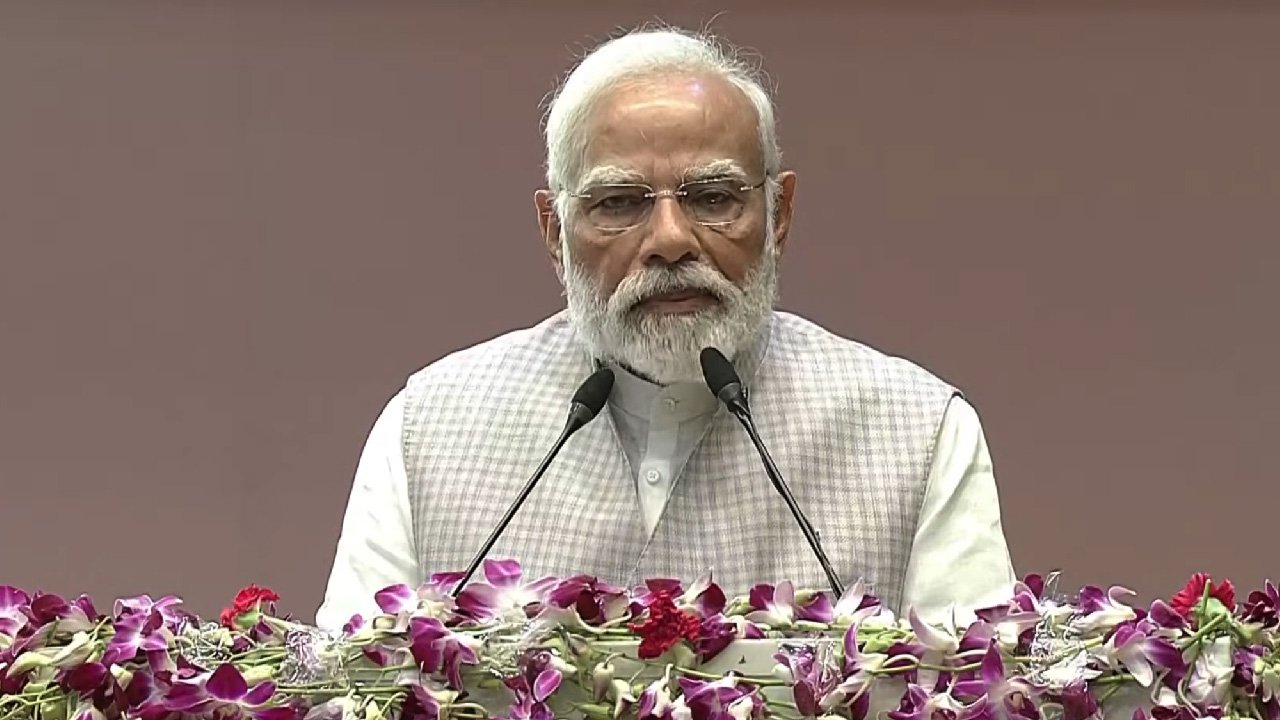
Speaking at an event celebrating the legal aid services, Prime Minister Narendra Modi today said that technology is indisputably a disruptive force, but with a pro-people focus, the same can serve as a tool for democratization.
The PM was addressing the National Conference on “Strengthening Legal Aid Delivery Mechanisms”, a two-day event being organized by the National Legal Services Authority (NALSA) between November 8-9 in celebration of Legal Services Day.
Today, besides PM Modi, the event was graced by Union Law Minister Arjun Ram Meghwal, CJI BR Gavai (Patron-in-Chief, NALSA), Justice Surya Kant (Executive Chairman, NALSA) and Justice Vikram Nath.
In the presence of an esteemed gathering, including judges of the Supreme Court and Delhi High Court, government officials, advocates and others, the PM launched a Community Mediation Training Module.
The event began with an address by Justice Kant, who underlined the significance of free legal aid. “Legal aid converts a constitutional value into pragmatic relief – a means by which the poor, the marginalized and the invisible victims of the system can assert their rights, obtain remedies and be heard”, said the judge.
Justice Kant further stressed that to extend legal aid, technology alone is not enough. Rather, it must be combined with local knowledge and empathy. “Looking ahead, we must make legal aid easier to obtain. That demands both administrative reforms and human practice. Technology does offer real opportunities, but it alone will not suffice. It must be guided by local knowledge, linguistic accessibility and human empathy.”
The judge further said, “strengthening legal aid is not merely about expanding institutional capacity. It is about simplifying the pathway through which a person in distress can access the protection of law”.
Union Minister Meghwal, on his part, lauded NALSA’s efforts to extend free legal aid in the past 3 decades. He impressed on young lawyers that legal aid should be viewed as a citizen-centric service. The Minister further pointed out that in 2015-16, the legal aid budget allocation for NALSA was Rs.68 crores, but in current FY, it stands at Rs.400 crores, out of which Rs.350 crores have been released.
Meghwal also commended NALSA for introducing schemes which benefitted acid attack victims, disaster-struck persons, prisoners, victims of human trafficking, mentally disabled, adivasis, and elderly persons. “There is a lot of work to be done in making the legal system more flexible and sensitive. It is necessary to encourage Pro bono culture through lawyers sensitive towards society, increasing awareness through paralegal volunteers…” he added.
CJI Gavai, on his part, recalled the words of Mahatma Gandhi to opine that when in doubt, one must recall the face of the poorest and the weakest person one has seen, and ask oneself if the step contemplated will be of any use to them. “To me, this idea finds its truest expression in the movement of legal aid and the work of our legal services institutions”, said the CJI.
Appreciating the PM’s presence on the occasion, CJI Gavai said, “The PM’s presence represents the shared responsibility of the executive legislature and judiciary for advancing the cause of Legal aid and access to justice for all”.
The judge further expressed that the true win of legal aid initiatives lies not in statistics, but in the gratitude felt and expressed by citizens in distress who feel heard and seen. In this context, CJI Gavai recalled the Supreme Court judges’ visit to Manipur: “Couple of months ago I along with my colleagues visited a relief camp in Manipur. An elderly woman came forward and met me with folded hands and tears in her eyes and said, “bane raho bhaiya”. To me that moment reminds me that the true reward of legal service does not lie in statistics but in the quiet gratitude and renewed faith of citizens who once felt invisible”.
Stressing that the light of justice shall reach every last person living on margins, the CJI said, “the assurance of justice, social, economic and political – the constitutional promise will be truly fulfilled only when every person, regardless of caste, gender, language or circumstances feels that the system of justice belongs to him.”
Subsequently, PM Modi took to dias and remarked that when justice reaches every individual without looking at their social or financial background, it becomes the foundation of social justice. He highlighted that under the government’s “legal aid defense counsel system”, 8 lakh criminal cases have been disposed of within the last 3 years. Further, he mentioned that under the Jan Vishwas Act, 3400+ offenses have been decriminalized, while archaic laws have been done away with by enacting new laws such as the BNS.
The PM also said that giving hope and help to those who have no representation is the true meaning of the word “service”. Supporting community mediation, he stated that the training module would bring back the old Indian tradition of dispute resolution through discussion and consent.
At one point, PM Modi also warned of adverse effects of technology. But he added that the same can have positive outcomes if it has a pro-people focus. “Technology is indisputably a disruptive force. But if it has pro-people focus, then it can become tool for democratization.”
The PM further asserted that a poor person cannot avail justice until he is aware of his rights and not fearful of the system’s complexities. “That is why, raising legal awareness among the poor, women and elderly is a priority”, he said.
Lastly, the PM applauded the Supreme Court’s initiative to make available over 80000 judgments in 18 different Indian languages. “I am confident that this effort will continue in future at High Court and Zila Parishad level”, he said.