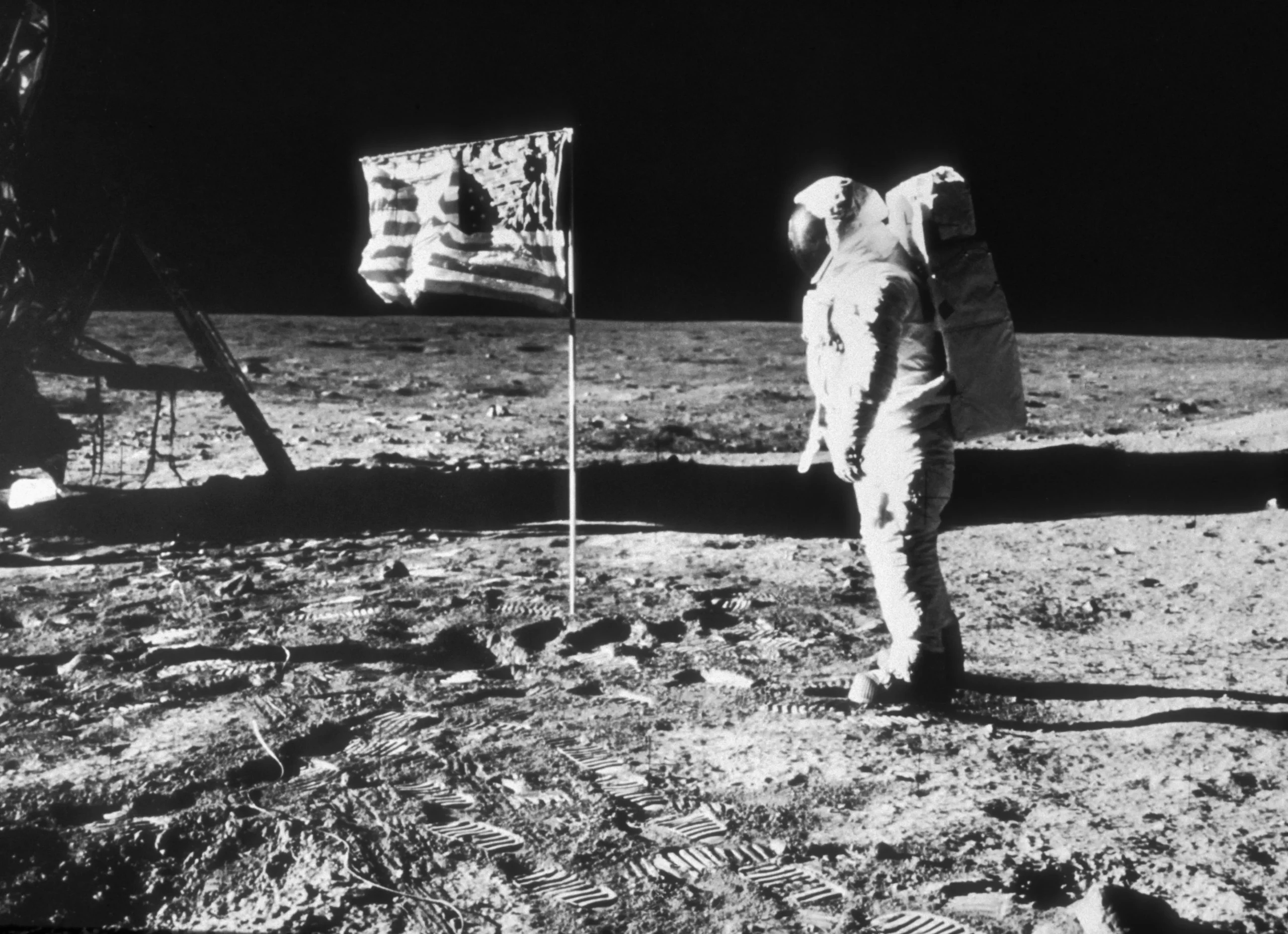
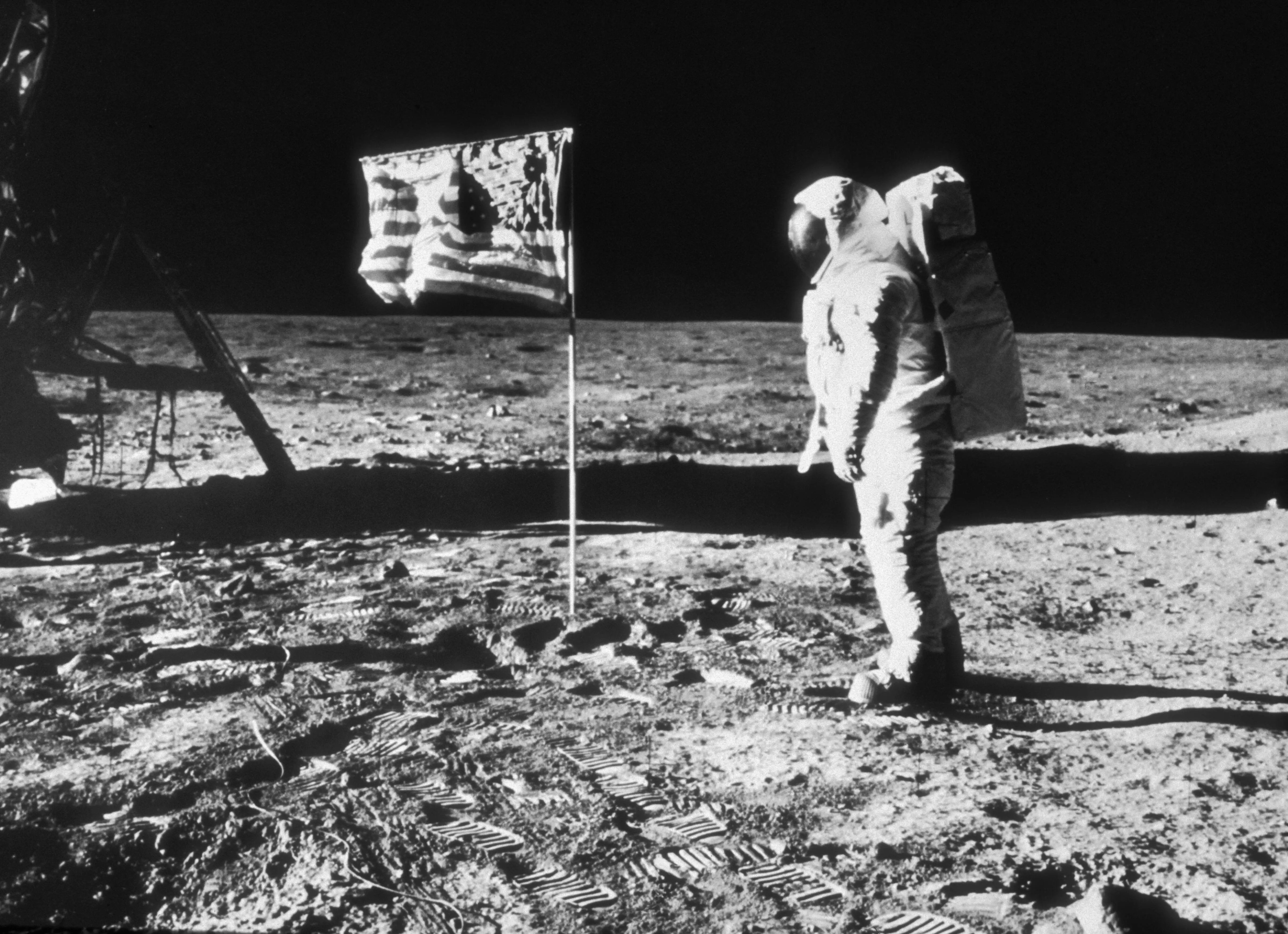
July 1969: American astronaut Edwin ‘Buzz’ Aldrin on the surface of the moon next to the American flag during the NASA Apollo 11 mission. Prints from Aldrin’s spaceboots mark the lunar terrain. Aldrin was the second man to walk on the moon, after Neil Armstrong (Image via Getty)
Lunar mission technology supports next generation housing and robotics by transferring systems developed for Moon exploration into commercial use on Earth.
According to NASA, on January 26, 2026, technologies created to support sustained lunar missions are being licensed through the agency’s Technology Transfer program and documented in Spinoff 2026.
These technologies address challenges such as autonomous construction, material efficiency, and robotic task execution.
The same systems designed to enable astronauts to live and work on the Moon are now being applied to building construction and robotic operations on Earth, supporting housing production and automated labor across multiple industries.
From Lunar Systems to Terrestrial Applications
Technology Transfer From Lunar Missions
NASA develops technologies to support missions that operate far from Earth, including the Artemis lunar program.
Through the Technology Transfer program, these systems are shared with private companies for non-space uses.
Spinoff 2026 marks 50 years of documenting this process, showing how lunar and deep space technologies are adapted for commercial sectors.
According to NASA, the program ensures that federal investments in exploration result in applications that extend beyond mission objectives.
Technologies designed for lunar environments often focus on automation, reduced material use, and remote operation, which align with needs in construction and robotics on Earth.
Spinoff is part of NASA’s Space Technology Mission Directorate, and its Technology Transfer program is responsible for finding broad applications for NASA-developed technologies through partnerships and licensing agreements.
Lunar Habitat Research and Housing Construction
Spinoff 2026 describes two companies that developed equipment for 3D printed habitats intended for planetary surfaces.
One company applies this technology to manufacturing wall panels, cladding, and facades, while another uses additive manufacturing to build housing developments.
Additional details from NASA Spinoff dated January 6, 2026, explain how Branch Technology Inc. adapted its work from the 3D Printed Habitat Challenge into terrestrial construction systems.
The company’s Freeform 3D Printing process produces lattice-based structures that reduce material use while maintaining structural requirements.
Research conducted for lunar habitation informed material selection, nozzle design, and fabrication methods now used in building components on Earth.
According to NASA Spinoff dated January 6, 2026, Branch Technology entered a cooperative agreement in 2021 with NASA’s Marshall Space Flight Center to study manufacturing systems for lunar surface habitation, including autonomously produced interior structures.
Robotics Developed for Lunar Operations
NASA also supports robotic systems intended to assist astronauts by handling routine tasks during lunar missions.
According to Spinoff 2026, two companies received NASA support to develop robotic technologies for these purposes.
One company is commercializing software that enables robots to perform cleaning and construction-related tasks, while another developed a humanoid robot designed for warehouse and assembly line operations.
These systems rely on autonomy and task coordination methods originally designed for remote lunar environments.
The transition of these technologies demonstrates how robotic systems built for space missions can function in industrial and commercial settings on Earth.
NASA envisions robots performing routine maintenance and support tasks during lunar missions, reducing the operational workload required of astronauts.
Ongoing Applications and Commercial Access
NASA states that any agency research effort may result in spinoff technology.
Beyond housing and robotics, Spinoff 2026 documents technologies related to medical devices, food safety procedures, imaging systems, and communication equipment.
The publication also identifies 20 technologies ready for commercialization and references more than 1,300 inventions available through NASA’s Patent Portfolio.
Technology Transfer, part of NASA’s Space Technology Mission Directorate, manages partnerships and licensing agreements to make these systems accessible.
Through this process, lunar mission technologies continue to support housing construction and robotic systems used on Earth.
Stay tuned for more updates.