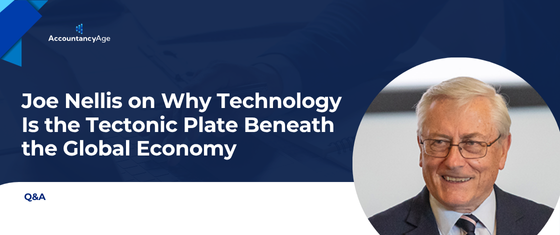
Accountancy Age spoke with Professor Joe Nellis, Economic Adviser at MHA, ahead of his ICAEW Annual Conference session Navigating the World Beyond the Horizon, to discuss the forces shaping the next phase of the global economy. In this conversation, Nellis explained why technology underpins every political and demographic shift, how leaders can turn volatility into strategic foresight, and why finance professionals must serve as the bridge between uncertainty and opportunity. His outlook blends academic precision with pragmatic insight into how businesses can stay resilient in a world being fundamentally rewired.
Accountancy Age (AA): You’ve described the current global landscape as one of unprecedented change. Which of today’s shifts – political, technological, or demographic – do you believe will have the most lasting economic impact?
Joe Nellis: “Technology is the tectonic plate beneath every other shift.” Political moods swing, and demographics evolve slowly, but the compounding power of AI, data analytics, and automation is rewiring productivity, trade, and even geopolitics. Technology is the engine that quietly re-prices everything.
AA: When you analyse global economic dynamics, where do you see the most significant divergence between short-term market sentiment and long-term structural realities?
Short-term optimism sees disinflation and further interest rate cuts on the horizon. But structurally, the world is re-industrialising driven by developments involving AI, clean energy, defence, and supply-chain redundancy.
AA: How do you expect demographic changes, such as ageing populations and migration patterns, to reshape the labour market and productivity across advanced economies?
Ageing population means smaller workforces and higher social and healthcare costs. Migration offsets gaps only if policy keeps up. Productivity will hinge on how fast we embed automation and reskill people. This will require huge investment expenditure – ‘investment is the engine of growth’!
AA: Technological change is often cited as both a disruptor and an enabler. From your perspective, how can business leaders harness innovation without amplifying inequality or instability?
True innovation is not just invention – it is diffusion. That means open standards, digital inclusion, and human-capital investment. The trick is coupling AI with lifelong learning and guardrails that protect fairness, privacy, and competition.
AA: You’ve often spoken about agility and adaptability as key to thriving amid uncertainty. What qualities distinguish leaders who can anticipate rather than react to disruption?
The best leaders act like venture capitalists in their own organisations – running experiments, scanning weak signals, and confronting the ‘What, So What and Now What?’ questions to bring people with them. They design for adaptability, not prediction.
AA: What role should accountants and finance professionals play in helping organisations navigate this period of transformation, particularly in translating economic uncertainty into strategic opportunity?
Finance is the bridge between volatility and strategy. Accountants translate uncertainty into options, make intangibles visible (data, IP, people), and uphold trust through transparent reporting on resilience and sustainability.
AA: Looking ahead to the next decade, what economic signals or emerging trends are you watching most closely as indicators of resilience or risk in the global system?
- The pace of AI diffusion beyond big tech
- Clean-energy deployment rates
- Supply-chain diversification
- Labour retraining and reskilling
- Public sector debt-service ratios
- Cyber security and cyber-loss frequency
- Cross-border investment flows
Together, these show whether the global economy is bending or breaking under transformation.
Join Professor Joe Nellis at the ICAEW Annual Conference 2025 this Friday at 11:45 AM for a session that looks beyond short-term sentiment to the deeper forces redefining global economics.