November 24, 2025
3 min read

AI-based and other digital solutions are beginning to change the way we practice medicine, as I discussed in a recent blog.
But many practices have difficulty implementing new tools because of snags that are sometimes technical but more often related to the humans in the practice adjusting their routines. IOL planning software is a great example because it requires so many parts of the practice, and the surgery center, to participate.

Doctors stuck in their old ways are sometimes the challenge. Some just want to pick lenses on a printout from the biometer. But many times, a well-intentioned staff member will stop using a new system because of an unforeseen roadblock, like trouble logging in, that goes unreported to others. This effectively vetoes the success of the new system.
Across medicine, we see this pattern repeatedly. Even as AI-driven and digital platforms become more advanced, health care adoption lags behind other industries not only because clinicians are unwilling but because human workflows are complex. Change requires rethinking habits and communication and addressing change management.
Here’s an approach we use in my 20-doctor practice that has repeatedly been successful for implementing new technology. First, get buy-in from practice management. Physicians bring lots of ideas to the practice, but they don’t always come at an ideal time to be adopted. Other management initiatives may be more important and more urgent than staff starting to use a new technology. Getting buy-in from the practice administrator is essential before speaking with others.
Next, bring together all the key stakeholders who will interact with the new system. Buy them lunch, and maybe invite a representative from the company selling the service because they can answer more technical questions than you may be prepared for.
When convincing stakeholders to implement a new technology, always start with “why.” In the case of IOL planning software, talk about the benefits in accuracy for patients, the avoidance of manual transcription errors, and the time/cost savings of instantaneous communication to the surgery center, avoiding last-minute lens ordering and high shipping charges (all these are proven benefits). Getting staff’s emotional commitment at the start motivates them to overcome hurdles that will certainly occur.
Implementing new systems is as much an emotional process as a technical one. Staff may fear making mistakes, or doctors may worry about losing efficiency. Addressing these feelings openly, acknowledging that the discomfort of change is normal, builds trust and keeps momentum going when small frustrations arise.
Next, with the group of stakeholders, agree on implementation steps, and put them in order. Ask everyone to be candid about potential roadblocks and collaborate on how to solve them. Create a list of tasks for each step, including who is responsible and what realistic dates each milestone should be delivered. Make sure everyone in the room has a chance to express their concerns without judgment.
We’ve also learned that implementation isn’t a one-time event — it’s a continuous process. A few weeks after launch, revisit how the system is functioning. Ask what’s working well and what still feels clunky. Regular check-ins signal that leadership is listening, and they prevent small frustrations from turning into long-term disengagements.
Finally, finish with a brief restatement of “why” and ask each person to say a couple of words about why they’re excited to make it successful. This final step is helpful in creating accountability. Make it clear that along the pathway, when unforeseen obstacles arise, it’s necessary and perfectly acceptable to call them to the attention of others, so everyone can collaborate on solutions.
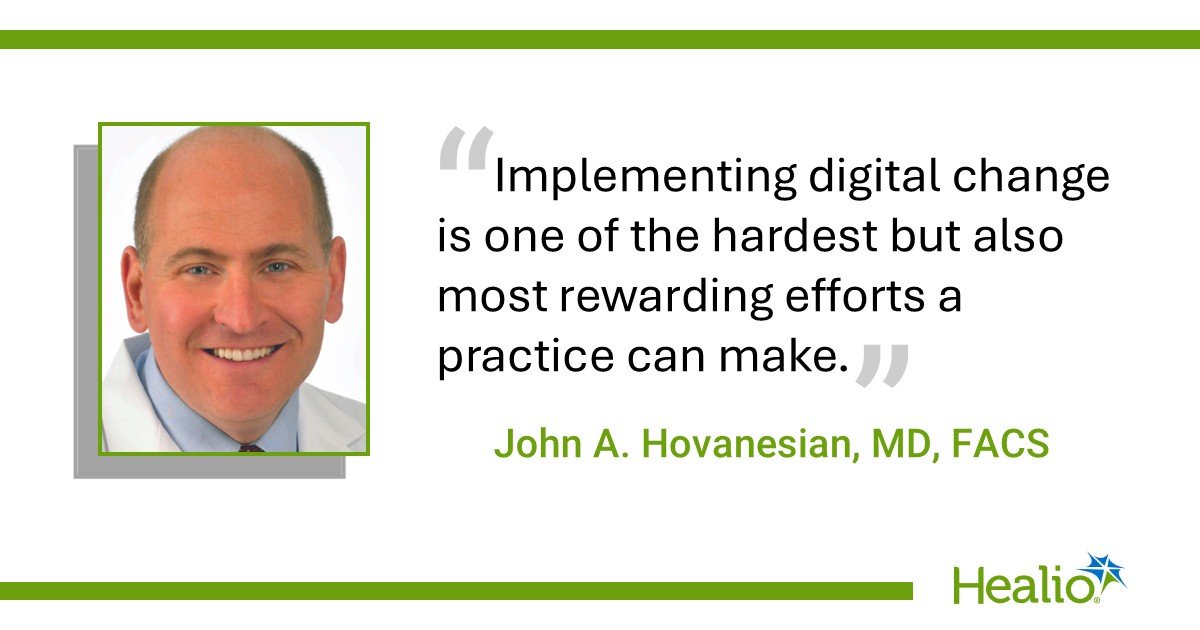
Implementing digital change is one of the hardest but also most rewarding efforts a practice can make. Our group has implemented digital IOL calculation software, patient two-way communication software, check-in and history collection software that prepopulates our medical record, customer relationship management tools, reputation management systems, and others. Each one’s implementation brought new challenges, but overcoming those challenges and realizing the benefits have moved our practice forward and provided much workplace satisfaction.
As AI and data-driven systems continue to integrate into medicine, the true differentiator won’t be who adopts first — it will be who adapts best. Practices that build a culture of curiosity, open communication and shared ownership around innovation will thrive in the digital era. Technology may start the change, but people sustain it.
Follow @ DrHovanesian on Instagram and X and John Hovanesian on LinkedIn.
For more information:
John A. Hovanesian, MD, FACS, an ophthalmologist specializing in cataract, refractive and corneal surgery at Harvard Eye Associates in Laguna Hills, California, can be reached at drhovanesian@harvardeye.com.
Sources/Disclosures
Source:
Expert Submission
Disclosures:
Hovanesian reports being chairman of the ASCRS Digital Clinical Committee and having a financial interest in a number of companies with digital medical solutions. Arsen Grigoryan, CEO of Harvard Eye Associates, assisted in the editing of this blog.

Ask a clinical question and tap into Healio AI’s knowledge base.
- PubMed, enrolling/recruiting trials, guidelines
- Clinical Guidance, Healio CME, FDA news
- Healio’s exclusive daily news coverage of clinical data