Hello and welcome back to Energy Source, coming to you from New York, where bankers and industry chiefs are licking their lips at the prospect of $1tn in investment flowing from Saudi Arabia into the US.
The lavish Oval Office welcome that Donald Trump afforded Saudi Arabia’s Mohammed bin Salman this week was criticised by human rights defenders, who cited the fact US spies concluded the crown prince gave the green light to the murder of journalist Jamal Khashoggi in 2018.
But the laundry list of deals announced during the visit was loudly celebrated at a black-tie dinner hosted by Trump and attended by some of America’s most powerful business and energy chiefs including Elon Musk, Chevron’s Mike Wirth and Bechtel’s Brendan Bechtel.
My colleague Camilla Hodgson has the details here on an interesting deal involving rare earths group MP Materials, the US military and Saudi Arabia’s state mining company. The FT also covered Saudi backing for a $900mn fundraising for US video start-up Luma AI.
Saudi Aramco said it had signed 17 memorandums of understanding, which could be worth more than $30bn, and the US and Saudi Arabia signed a joint co-operation agreement on nuclear technologies. The nuclear pact does not include enrichment, according to US energy secretary Chris Wright, addressing concerns about nuclear proliferation.
We also report today on a US peace plan for Ukraine, which caused oil prices to fall as traders bet this could reduce oil supply risks linked to American sanctions on Russia’s biggest oil companies, Rosneft and Lukoil.
Our main item today looks at an emerging technology that ExxonMobil, BASF and a growing number of start-ups are embracing to produce clean hydrogen.
Thanks for reading, Jamie
Technology breakthroughs boost green hydrogen
It has been a difficult year for the hydrogen industry with disappointing customer demand and a pullback in government support causing some companies to pause high-profile investments.
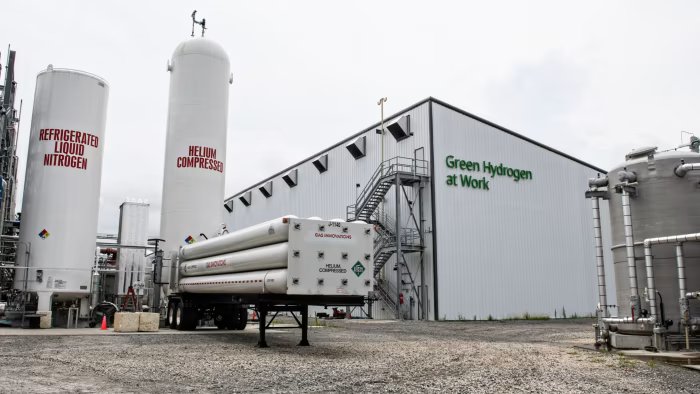
But in a sign that the fuel will have a role to play in decarbonising industry, ExxonMobil and BASF signed a deal this week to collaborate on developing methane pyrolysis, an emerging technology that produces low-emissions hydrogen.
The companies plan to build a demonstration plant in Baytown, Texas, to develop methane pyrolysis at scale, said Mike Zamora, president of Exxon’s technology and engineering group, in a blog post.
“Methane pyrolysis holds real potential, especially in regions where traditional carbon capture and storage solutions are less viable. ExxonMobil brings decades of deep technical knowledge in methane pyrolysis and a shared commitment to innovation.”
Stephan Kothrade, BASF’s chief technology officer, said the German company had worked for more than a decade on the technology and successfully developed a “superior reactor concept” that had already been validated at its test plant in Ludwigshafen, Germany.
“By combining BASF’s process innovation with ExxonMobil’s scale-up expertise we are bringing this cost-efficient low-emission hydrogen solution closer to economically viable industrial deployment,” he said.
Methane pyrolysis works by heating natural gas or other gases, such as biomethane, in an oxygen-free environment to convert it into hydrogen and solid carbon. The hydrogen can be sold as an emissions-free fuel while the solid carbon produced via the process has applications for companies making battery materials, aluminium, steel and other products.
The technology offers some advantages over steam-methane reforming technology, which is the standard process for making hydrogen in the US.
The methane pyrolysis process does not generate CO₂ emissions, which makes it a potentially powerful decarbonisation tool. In contrast, SMR technologies produce about 10 tons of CO₂ for every ton of hydrogen made, when no carbon capture technology is deployed.
Methane pyrolysis will also compete with water electrolysis, a process that is being pursued by companies seeking to use renewable energy to make so-called green hydrogen. Methane pyrolysis uses about seven times less electricity than electrolysis and no water, according to research.
One additional benefit to developing methane pyrolysis is that companies can leverage existing natural gas infrastructure, such as pipelines and refineries, which could reduce the cost of deployment. Low natural gas prices in the US due to the shale revolution make the country an attractive location to develop the technology, say analysts.
Doug Vine, director of energy analysis at the Center for Climate and Energy Solutions, said scaling methane pyrolysis had proved challenging to date due to costs associated with the large amounts of energy required.
But he said there was growing excitement about the number of start-ups developing new catalysts for the process that boost efficiency and the participation of industrial giants, such as Exxon and BASF, which have the muscle to scale the technology.
“Some of the breakthroughs have been fairly recent in terms of identifying catalysts that can reduce the temperature, and therefore the energy needed to make the reaction happen,” Vine said.
He said the dual revenue stream created by the process, and the drive for decarbonisation, made the technology compelling. “It’s often not the hydrogen that’s the valuable commodity. It’s the solid carbon.”
The solid carbon, which is often called carbon black, is used to make tyres, asphalt, plastics and battery materials. It is typically produced through a “furnace process”, which burns heavy hydrocarbon oils. This generates about 2.3 tons of CO₂ per ton of carbon black.
But a growing number of companies are seeking to commercialise methane pyrolysis as a low-carbon alternative.
Molten Industries, a start-up founded in a garage by Stanford University graduates Caleb Boyd and Kevin Bush in 2021, is developing technology that uses high-temperature methane pyrolysis powered by renewable electricity to make battery-grade graphite and clean hydrogen.
“We use electrical resistive heating similar to a toaster [in our reactor] . . . we inject natural gas into that reactor and heat it using electricity and heating like a toaster, and it splits into graphite and hydrogen,” Boyd told Energy Source.
“The really unique thing is that we’re able to control the parameters of that reaction such that we form graphite directly in the process. And then those graphite flakes that come out, it honestly looks like black glitter. It’s very beautiful,” said Boyd, who has a PhD in materials science.

Monolith, a company backed by investors including Warburg Pincus, TPG Rise Climate and Decarbonization Partners, a joint venture between BlackRock and Temasek, is developing a commercial scale plasma pyrolysis process in Nebraska to produce carbon black.
The company signed a collaboration agreement with the global tyre manufacturer Goodyear in 2021, and its solid carbon products have already been embedded in more than 1mn tyres.
But in a sign of the obstacles start-ups face developing emerging technologies in the decarbonisation sector, Monolith has faced funding challenges and project delays. Earlier this year it paused its application for a $1bn conditional loan agreed in 2021 with the US Department of Energy, which has frozen billions of dollars in loans since Trump was inaugurated.
Monolith is raising fresh capital and has scaled back its expansion plans.
“Hydrocarbon pyrolysis isn’t just about cutting emissions — it’s about American resiliency. Carbon black is essential to our auto and defence industries, and the US has been short on domestic supply for decades,” said Rob Hanson, Monolith’s co-founder and chief executive. (Jamie Smyth)
Power Points
-
European diesel prices jumped sharply yesterday as traders anticipated the impact of US sanctions on Russia and after shutdowns at some refineries led to fears of shortages.
-
Iranian scientists and nuclear experts made a second covert visit to Russia last year, in what the US claims has been a push to obtain sensitive technologies with potential nuclear weapons applications.
-
Opinion: Governments must address the fact that imported “embodied” emissions make up a lot of their carbon footprints, writes Laurence Tubiana, CEO of the European Climate Foundation.
Energy Source is written and edited by Jamie Smyth, Martha Muir, Alexandra White, Rachel Millard and Malcolm Moore, with support from the FT’s global team of reporters. Reach us at energy.source@ft.com and follow us on X at @FTEnergy. Catch up on past editions of the newsletter here.
Recommended newsletters for you
Moral Money — Our unmissable newsletter on socially responsible business, sustainable finance and more. Sign up here
The Climate Graphic: Explained — Understanding the most important climate data of the week. Sign up here