Former Scotland star Craig Burley has lost a legal battle with HMRC over a £465,000 unpaid tax bill.
The ex-Celtic and Chelsea midfielder was told by the tax authorities he owed money related to his investments in a film production scheme.
During the hearing, the judge reminded Burley about his World Cup nightmare.
The Scotland player was sent off as Craig Brown’s side were humiliated by Morocco, crashing out of the 1998 tournament in France after a 3-0 defeat.
In his decision published last week, Judge Mark Baldwin said: ‘Mr Burley used to be a professional footballer.
‘[His lawyer] Mr Cannon told us that he played for Scotland in the World Cup, although not how well Scotland fared.’
The hearing was told he was sent demands totalling £465,967 for the tax years 2010-11, 2011-12, 2014-15, 2015-16, and 2016-17.
On the advice of financial advisers, Burley had transferred his interests in two film schemes into a limited liability partnership (LLP) of which he was a member.

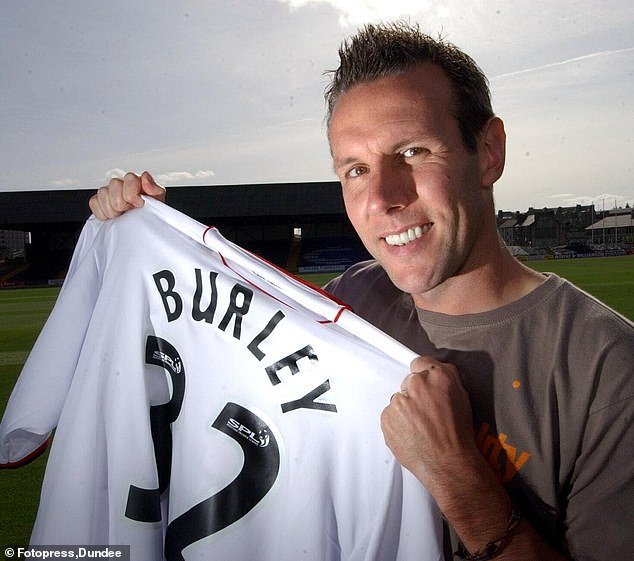
Craig Burley lost a legal battle with HMRC over a £465,000 unpaid tax bill

The former Scotland star now works as a pundit for US broadcaster ESPN
The 53-year-old, who now works as a pundit for US broadcaster ESPN, claimed the move meant he either owed no tax or the lower rate of tax on any profits from the schemes.
However, HMRC disagreed and told the former midfielder he would have to pay the full amount.
Burley challenged the tax closure notices issued to him at the First-Tier Tax Tribunal in London. Following a hearing, Judge Baldwin has now found in HMRC’s favour and said Burley was still personally liable for tax from the film profits.
Burley told the tribunal that around 2001 he was persuaded to invest in two film schemes, which were presented as having the effect of reducing his personal tax liability by making use of government incentives to invest in the film industry.
He could not recall it being made clear to him that, if the films were successful, he would be obliged to pay tax on the proceeds, even though those proceeds were not paid to him but were instead applied in reducing associated bank loans.
He was therefore faced with unexpected tax liabilities when the films returned profits.
He said he and his accountant met with a tax adviser who suggested the interest he had in the film partnerships could be introduced to the LLP and those profits could be attributed to his limited company which would then bear tax at a lower rate.
HMRC’s legal team said it was ‘unrealistic to analyse income within the partnerships as being used to discharge Mr Burley’s personal liabilities without there being any form of income credit to him’.

Craig Burley receiving a red card during a World Cup match against Morocco in 1998
In his ruling, Judge Baldwin said: ‘The security arrangements over the film leasing transactions had been entered into by the partnerships as a collective, and they continued wholly unaffected by the additional, personal arrangements between Mr Burley and the LLP.
‘Mr Burley’s share, through the partnerships, of the film leasing income continued to be applied by the partnerships in the same way as it had been before [and] was paid directly to Mr Burley’s lenders and used by them to discharge his obligations to them.
‘If the use of income in that way meant Mr Burley was entitled to the profits of the partnerships before he executed the assignment in favour of the LLP, it is hard to see why the same analysis did not obtain afterwards, since nothing changed so far as the receipt, use and application of those amounts were concerned.
‘Mr Burley was entitled to the income because the income was being applied for his benefit… it is his income on which he is fully chargeable to income tax.’
Burley, who is now based in the United States, was capped 46 times for Scotland.