When you open an investing app or watch financial news, you often hear about brokers, trading platforms, and market access.
For many beginners, these terms sound complicated, but they describe the system that makes simple modern investing possible.
Brokers and trading platforms work together to help you buy and sell investments safely, whether you are purchasing your first stock or building a long-term portfolio.
Learning how these two parts fit together will give you confidence and control as you start investing. Let’s explore what each does and why they matter.
What a Broker Does
A broker is a licensed professional or company that connects you to the financial markets. Without a broker, you cannot buy or sell investments like stocks, bonds, or exchange-traded funds.
The broker acts as your bridge to the stock exchanges, where all trades take place.
When you place an order to buy a stock, your broker receives the request, checks that everything meets regulatory rules, and then routes it to an exchange such as the New York Stock Exchange or Nasdaq. Once the trade goes through, the broker updates your account to show the new investment.
Brokers also hold your investments safely in what is known as custody. In the United States, most are registered with the Securities and Exchange Commission (SEC) and belong to the Financial Industry Regulatory Authority (FINRA).
These organizations set strict standards for fairness and transparency so investors can trade with confidence.
How Brokers Make Money
Even when a broker advertises commission-free trading, it still earns money in other ways. Some earn interest on the cash that sits in customers’ accounts. Others charge for advanced tools, margin loans, or managed investment services.
A few receive small payments for routing trades through particular market makers, a process called payment for order flow.
These methods are legal and common, but it is good to understand them so you can compare brokers on more than just their fees.
The best choice is usually one that balances low costs, reliable execution, and clear communication about how it operates.
 The Rise of Online Brokers
In the past, investors had to call a stockbroker to make a trade. Each transaction could cost dozens of dollars and take several minutes to complete. The internet changed everything. Today, most brokers operate online, allowing anyone to open an account, fund it electronically, and start investing in minutes.
This shift lowered costs and expanded access. Companies such as Fidelity, Charles Schwab, and TD Ameritrade helped lead the way by introducing self-directed accounts and easy-to-use tools.
More recently, mobile apps like Robinhood and Webull have made investing possible from almost any phone.
Online brokers have made markets more democratic, but they have also made it easy to trade impulsively. New investors should remember that quick trades are not always the best path to long-term success.
What a Trading Platform Is
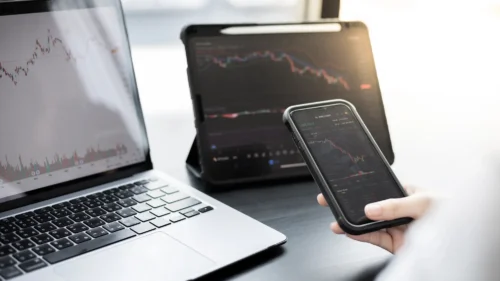
A trading platform is the software or website that lets you see prices and place trades through your broker. Think of it as the control panel for your investing life. The platform displays charts, news, and account information, and it allows you to choose what to buy or sell.
Every broker provides some form of platform. Some build their own, such as Fidelity’s Active Trader Pro or TD Ameritrade’s thinkorswim. Others use third-party systems that connect to many brokers at once.
While the designs differ, the purpose is always the same: to make trading accurate, fast, and easy to understand.
When you tap “buy” or “sell,” the platform sends that instruction to your broker, and your broker executes the order in the market. The two parts—platform and broker—must work seamlessly for your trade to complete in seconds.
How Brokers and Platforms Work Together
Imagine you decide to invest in a company you believe will grow. You open your trading app, enter the ticker symbol, and click “buy.” At that moment, your platform sends your order to your broker.
The broker checks available prices and sends the order to an exchange, where it matches with someone willing to sell. Within moments, the purchase is complete and your account updates to show the new stock.
This process happens millions of times each day. Behind the simple screen you see is a complex network of technology and regulation that keeps the system fair and efficient.
Understanding this relationship helps you see why both brokers and trading platforms are essential pieces of the investing world.
Why They Matter to Everyday Investors
Brokers and platforms do far more than just execute trades. They protect your assets, provide education, and offer research tools to help you make informed choices. Many include stock screeners, analyst ratings, and step-by-step guides for beginners.
They also ensure that every trade follows legal and ethical standards. In the United States, client accounts are usually protected up to $500,000 by the Securities Investor Protection Corporation (SIPC) in the rare event a broker fails.
These safeguards make investing safer.
Choosing a Broker and Platform
Selecting the right broker and platform is one of the first big decisions you will make as an investor. The right fit depends on how you plan to invest and how much guidance you want.
If you like to research and make your own decisions, a discount or online broker may suit you best. These offer strong tools and low costs. If you prefer professional advice or personalized portfolio management, a full-service broker may be worth the higher fees.
Look for clear pricing, responsive customer support, and a platform that feels intuitive. Before you open an account, verify that the firm is registered with FINRA and the SEC. Checking credentials takes only a few minutes but adds peace of mind.
 The Benefits and Challenges of Modern Investing
The digital age has made investing more accessible and affordable than ever. Investors can trade fractional shares, track portfolios from their phones, and learn at their own pace.
Lower fees mean more of your money stays invested, which can make a big difference over time.
But convenience also brings risk. Quick access can tempt people to trade too often, or react emotionally to short-term price changes. The best investors stay patient, do their research, and think in terms of years rather than days. Technology is a tool, not a shortcut.
The Future of Brokers and Trading Platforms
Brokers and platforms continue to evolve as technology advances. Artificial intelligence already helps some investors analyze portfolios and identify opportunities.
Robo-advisors can build and manage diversified portfolios automatically based on your goals and comfort with risk.
In the future, we may see faster trade settlements, deeper integration with banking services, and more educational resources built directly into platforms.
While tools will keep improving, the core principle of investing will stay the same: understanding what you own and why you own it.
Frequently Asked Questions
Do I need a broker to invest?
Yes. A licensed broker connects you to the stock exchanges where trades happen. Without a broker, individuals cannot buy or sell publicly traded investments.
What is the difference between a broker and a trading platform?
A broker is the regulated company that executes your trades. The trading platform is the digital system you use to interact with the broker and place those trades.
Are commission-free brokers truly free?
They do not charge for each trade, but they may earn money from other services such as interest on cash balances or routing orders through specific partners.
How safe is my money with an online broker?
Reputable brokers in the United States follow strict rules set by the SEC and FINRA. Most are also members of the SIPC, which provides limited protection if a firm fails financially.
Can I have accounts with more than one broker?
Yes. Many investors use more than one broker or platform to separate long-term investments from short-term trading or to access different features.
Conclusion
Brokers and trading platforms are the quiet engines that power the investing world. They make it possible for anyone to own a piece of a company, diversify a portfolio, and build wealth over time.
By learning how brokers connect you to the markets and how platforms give you the tools to trade, you gain a clearer view of how your investments work.
With that knowledge, you can approach the market with confidence, patience, and a long-term mindset that turns information into opportunity.