Unlock the Editor’s Digest for free
Roula Khalaf, Editor of the FT, selects her favourite stories in this weekly newsletter.
Lawsuits arising from climate-related disasters in the US are emerging as a rising cost for insurers and policyholders, more than doubling over the past decade as extreme weather damage increases.
Businesses in the US that have ceased operations or lost income in the aftermath of disasters, as well as homeowners with property losses, are increasingly filing lawsuits against insurance carriers, according to data obtained by the Financial Times.
“The biggest driver of business interruption litigation today is climate volatility,” said Adam Masarek, legal marketing manager at Lex Machina, the legal analytics platform of LexisNexis.
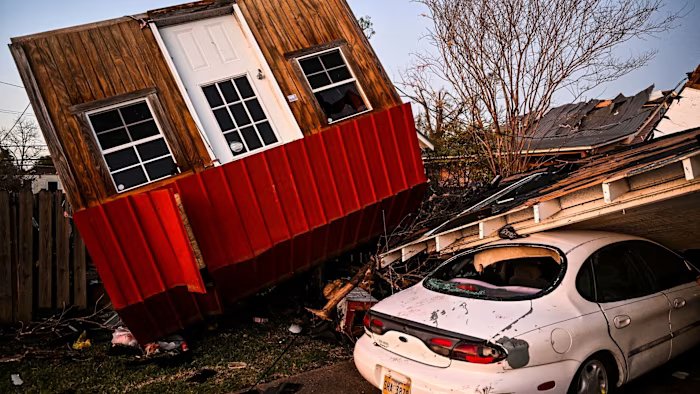
“Traditional perils like fire and thunderstorms, along with severe weather events like hurricanes, deep freezes, tornadoes and sinkholes, are disrupting operations at a scale we didn’t see a decade ago,” he said.
Over the past decade, business interruption lawsuits linked to climate perils — not including hurricanes, which vary widely from year to year — have more than doubled from about 290 to almost 640, the LexisNexis analysis of US federal court filings shows.
Similarly, homeowner insurance disputes related to climate disasters, excluding hurricanes, have risen from about 1,600 filings in 2016 to more than 4,000 court filings in 2025.

Climate hazards, including extreme heat and convective storms, are a growing risk to businesses worldwide and could drive as much as $610bn in fixed-asset losses per year across listed companies by 2035, according to estimates by the World Economic Forum.
A single disaster can result in production delays in a company’s supply chain, inflicting billions of dollars in losses. In 2024, German automaker Porsche cut its sales forecast by more than $1bn after flooding shut down the production facility of an important aluminium supplier in Europe.
Two years earlier, Toyota’s operations were disrupted due to catastrophic floods in South Africa that resulted in more than 400 deaths, prompting the Japanese company to file for damages in a $387mn lawsuit.
These disasters are now increasingly showing up in court cases as policyholders accuse insurers of not fully paying out claims that they believed should be covered.
Business interruption suits run the gamut, from a wedding venue flattened by a tornado to pipes in a rental building that burst after an unusually severe deep freeze in the Pacific Northwest.
Nearly 70 per cent of federal business interruption cases with links to climate disasters over the past decade have likely ended in a settlement, according to Lex Machina. It estimates that just 1 per cent of cases have ended in a claimant or policyholder win, while 10 per cent end with the claim defendant winning.
Settlement amounts are typically private, but some released figures show businesses winning millions of dollars. In 2024, the Baptist University of Florida, which was damaged during Hurricane Michael, won $9.3mn in compensatory damages.

For insurers, the cost of climate risk is well-established and increasing. In the first half of 2025, natural disasters caused losses of about $131bn worldwide, of which $80bn was insured, according to reinsurance giant Munich Re. Though short of a record, both figures are much higher than average for the past 10 years.
Inflation is also squeezing insurers and those recovering from disasters, as construction materials used to repair buildings have become more costly after the coronavirus pandemic, driving up claim amounts.
Litigation overall had become more “adversarial”, said Pillsbury partner Joseph Jean, who has worked on insurance recovery for more than two decades. “There used to be a lot more interaction among the parties, there would be dialogue,” he said. “Now, one party or the other rushes to court much more quickly.”
That has helped make litigation costs one of the “top three concerns of any insurer”, said Sean Kevelighan, head of the Insurance Information Institute, an industry think-tank.
There had been price increases “across the board”, he added, including more real estate development and people moving to places prone to extreme weather disasters, such as Texas. “The price of insurance has to reflect the risk — and risks are increasing.”
Climate Capital

Where climate change meets business, markets and politics. Explore the FT’s coverage here.
Are you curious about the FT’s environmental sustainability commitments? Find out more about our science-based targets here