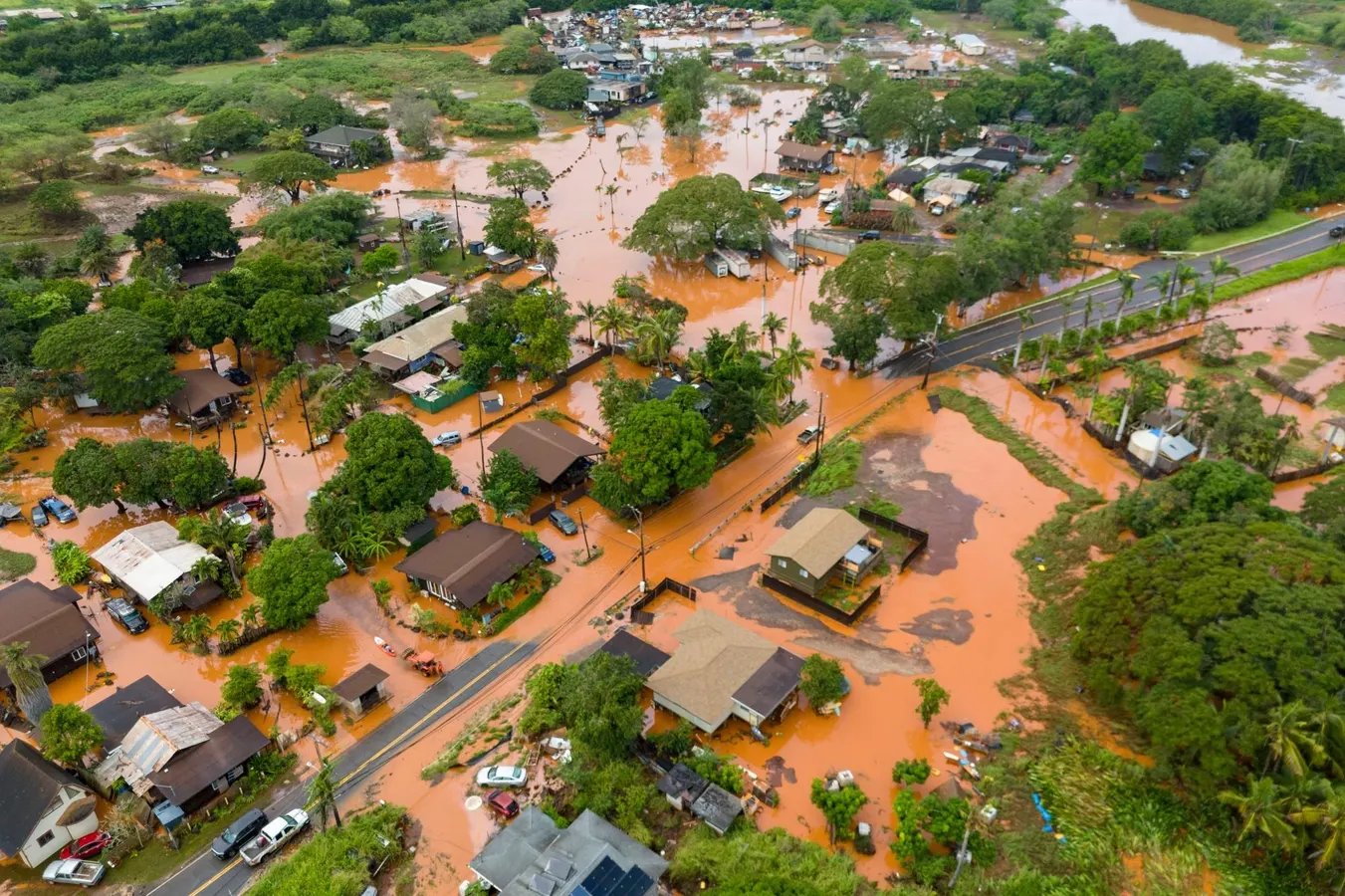

Fooding covers a residential neighborhood in Waialua, Hawaii, Friday, March 20, 2026. (AP Photo/Mengshin Lin)
Copyright 2026 The Associated Press. All rights reserved.
As a mix of climate impacts and aging infrastructure combine, disasters are getting more expensive. The insurance industry has stopped treating that as a surprise. Instead, insurers and reinsurers are rewriting the rules of what gets covered, at what price, and for whom. In effect your ZIP code and income become proxies for exposure to both climate risk and financial risk.
When “record losses” stop being news
In earlier reporting on the growing “protection gap” in climate‑disaster insurance, we discussed how the industry was beginning to experiment with more innovative, equitable coverage models. By 2025, those experiments were happening against a backdrop of staggering numbers: global natural catastrophes caused about 220 billion dollars in economic losses, with roughly 107 billion dollars insured, a level of insured loss that marked the sixth straight year above the 100‑billion‑dollar threshold. What’s changed is not just the size of the losses, but their character. About 92% of 2025’s insured natural catastrophe losses came from so‑called “secondary perils” like wildfires, severe convective storms, and floods, rather than the headline‑grabbing hurricanes and earthquakes. The Los Angeles wildfires alone contributed an estimated 40 billion dollars in insured losses, the largest wildfire event that Swiss Re’s sigma series has ever recorded. As we move through 2026, the insurance market is no longer treating these losses as tail‑risk anomalies—it is building them into the baseline.
What a 100‑billion‑dollar floor means for insurers
Swiss Re now describes more‑than‑100‑billion‑dollar insured catastrophe loss years as the “new normal,” with its sigma research suggesting insured natural catastrophe losses are growing at roughly 5–7% per year in real terms. The same analysis points to a 1‑in‑10 probability that insured losses in a future peak year could reach 300 billion dollars, more than double recent levels. For reinsurers, who are the backstop behind many primary insurance companies, that kind of scenario is not an abstract number; it’s a capital‑planning problem. They are recalculating how much peak risk they can absorb, and at what price, without jeopardizing solvency.
That recalculation is showing up in everyday decisions. Industry sources describe reinsurers tightening terms and conditions, raising the cost of catastrophe reinsurance, and demanding more granular climate‑risk modeling from the insurers they support. Primary insurers, in turn, are passing those pressures along in the form of higher premiums, larger deductibles, more exclusions, and, in some cases, outright withdrawal from the most hazard‑exposed lines and geographies. Catastrophe underwriting is becoming more forward‑looking. Instead of pricing primarily on historical loss data, companies are leaning on scenario analysis that incorporates warming trajectories, land‑use change, and infrastructure vulnerabilities.
For households and small businesses, higher costs and shrinking safety nets
For consumers, this shift is not theoretical; it shows up in the renewal letter. WWF warns that climate change and nature loss are “rapidly eroding the foundations of global insurance markets,” to the point that major economies are developing pockets of uninsurability. In the United States, homeowners’ insurance premiums have risen about 38% since 2019, with some households in hazard‑prone regions facing increases well above that average or struggling to obtain coverage at all. In Europe, only around 20% of natural catastrophe losses are insured, leaving households and businesses to self‑insure or rely on state disaster relief when floods or storms hit. In Australia, one in six households already spends more than a month’s income on insurance premiums, an affordability stress that effectively turns risk transfer into a luxury good.
At the same time, Swiss Re’s data show that about 49% of 2025’s global natural catastrophe economic losses were insured—the highest share on its sigma record. That paradox is central to today’s protection‑gap conversation: aggregate insured shares are rising, especially in wealthier markets, but the remaining gap is becoming more concentrated among those least able to absorb losses. In many emerging economies, 80–90% of catastrophe losses remain uninsured, and even within high‑income countries, low‑income communities and communities of color are often the first to face non‑renewals or unaffordable premium hikes. As insurers retreat or raise prices, governments are increasingly forced to step in as insurers of last resort, with public disaster‑assistance costs climbing in places like the United States and European Union after recent floods, wildfires, and storms. That turns what began as an industry pricing problem into a broader question of fiscal sustainability and equity.
Innovation under pressure: changing risk models versus resilience finance
Underwriting retreat is only one side of the story; the other is a wave of innovation under pressure. Climate‑risk forecasters expect 2026 to accelerate the adoption of parametric insurance, especially for small and medium‑sized enterprises in hazard‑exposed regions. Unlike traditional indemnity policies, parametric products pay out when a defined trigger, such rainfall level, or earthquake magnitude is met. These policies offer faster liquidity for recovery and simpler administration. Development banks, reinsurers, and public‑private partnerships are backing pilots that bundle these products with early‑warning systems and resilience investments, particularly in emerging markets.
At the same time, climate‑resilience technology has become “big business” in disaster recovery. Startups and incumbents alike are deploying satellite imagery, AI‑driven risk models, and geospatial analytics to give insurers and governments a clearer picture of who and what is at risk, down to the parcel level. Financial innovation is also catching up: resilience bonds, catastrophe‑linked instruments, and nature‑based solutions structured as investable assets are gaining traction as tools to both transfer risk and reduce it over time.
But innovation does not automatically equate to justice. Parametric insurance can create basis risk, or the possibility that a household suffers damage without the trigger being met, unless triggers are co‑designed with communities and backed by robust consumer protections. Advanced risk analytics can either democratize information or become a new layer of opaque redlining, depending on how they’re governed. The same technologies and instruments that help insurers manage portfolios can also harden lines around who is deemed “too risky” to cover.
Insurance as a climate policy signal
As the protection gap widens in some places and narrows in others, the insurance system is emerging as a powerful, if blunt, climate‑policy signal. WWF argues that insurance gaps driven by climate change and nature loss now pose a systemic threat to financial stability, and that protecting ecosystems like forests and wetlands often delivers more cost‑effective risk reduction than hard infrastructure alone. Switzerland, for example, estimates that its forests provide about 4.5 billion dollars in annual flood‑protection benefits, illustrating how intact nature functions as infrastructure in its own right. Swiss Re similarly links the viability and affordability of insurance to “sustained and well‑designed adaptation and risk‑mitigation measures,” warning that without them, coverage will become harder to maintain in its current form.
On the mitigation side, the International Association of Insurance Supervisors which helps set standards for the industry, issued an implementation report focused on climate risk. It connects mitigation and risk as well as possible standards for incorporating climate and nature-based hazards into models and strategic development. Given that few insurers are planning beyond disclosure and regulatory compliance, this is an important move.
Outside of the United States, insurers are setting concrete targets to decarbonize investment portfolios, support emissions‑reducing technologies, or condition underwriting on resilience standards. Regulators and central banks are taking note. WWF has urged global leaders at COP30 and beyond to integrate climate and nature into financial‑resilience strategies, including insurance‑sector oversight. That could mean solvency rules, rate regulation, and public‑reinsurance structures that reward investments in mitigation and adaptation, not just risk selection.
In practical terms, where insurance coverage becomes unaffordable or unavailable, it sends a clear market message: the current pattern of land use, infrastructure, and emissions is not compatible with a stable climate. The next challenge for policymakers and industry leaders is that the world is not only underinsured against climate disasters, but it is also unevenly insured, with coverage expanding where capital is abundant and contracting where risk is high, and resources are scarce. It would make sense to develop a response that balances industry balance sheets against the benefits of investing in resilience.