
We analyzed nearly 720 health insurance costs from eight insurers, reviewed complaints, customer satisfaction, metal tiers and the types of plans offered in the marketplace. See our top picks below to find the coverage that matches your needs.
The Best Health Insurance Companies
Kaiser Permanente

Our Expert Take
Kaiser Permanente stands out in our evaluation because it offers the lowest average premium ($501) among the eight companies we analyzed. It also has one of the lowest average silver deductibles ($4,115). That means you won’t pay as much out of pocket compared to other insurers when you need healthcare. We’re also impressed by Kaiser Permanente’s very low complaint level, which can signify high customer satisfaction.
Consumer Sentiment Index
Pros & Cons
- Its integrated health system may reduce claim problems and make healthcare more seamless
- Offers all four metal tiers (bronze, silver, gold, platinum)
- Excellent digital experience, including the ability to manage membership and pay premiums on the website or app
- Only available in eight states and Washington, D.C.
- Because it isn’t accepted in many states, you may have trouble finding an in-network provider if you have an HMO plan
Marketplace Health Plan Availability
- California
- Colorado
- Georgia
- Hawaii
- Virginia
- Maryland
- Oregon
- Washington
- Washington, D.C.
Blue Cross Blue Shield

Our Expert Take
We like that Blue Cross Blue Shield companies have a large provider network of over 1.7 million in-network providers and its plans are accepted in all 50 states. That should make it easier to find an in-network provider, which can save you money.
Blue Cross Blue Shield also lets you pay premiums and manage your account online, which helped it earn the highest digital experience score among companies we analyzed.
Consumer Sentiment Index
Pros & Cons
- Offers all four metal tiers and four types of health plans on the ACA marketplace (HMO, EPO, PPO and POS), though availability can vary by state
- Low level of complaints to state insurance departments
- One of the highest ACA marketplace premiums compared to the competitors we analyzed
- Higher-than-average bronze and gold deductibles
Marketplace Health Plan Availability
All 50 states and Washington, D.C.
Aetna

Our Expert Take
Aetna has the lowest complaint level among the companies we analyzed. That often means members are more satisfied with the claims process and customer service compared to other health insurers.
Consumer Sentiment Index
Pros & Cons
- Lowest bronze deductible and second-lowest deductible for silver and gold plans of the companies we analyzed
- Aetna is owned by CVS Health, which provides members a $25 allowance every three months to shop at CVS Health and a 20% discount on CVS Health brand products
- Highest average premium of the companies we reviewed
- ACA plans offered in only 17 states
Marketplace Health Plan Availability
- Arizona
- California
- Delaware
- Florida
- Georgia
- Illinois
- Indiana
- Kansas
- Maryland
- Missouri
- Ohio
- New Jersey
- North Carolina
- Nevada
- Texas
- Utah
- Virginia
Summary: The Best Health Insurance Companies
How Much Does Health Insurance Cost?
The average cost of an ACA health insurance marketplace plan is $590 a month. That average is for unsubsidized ACA plans.
Health insurance costs vary based on multiple factors, including the metal tier and your age. The average cost by age includes:
Average costs are for unsubsidized plans.
Bronze Plans: Average Monthly Health Insurance Costs
Average costs are for unsubsidized plans.
Silver Plans: Average Monthly Health Insurance Costs
Average costs are for unsubsidized plans.
Gold Plans: Average Monthly Health Insurance Costs
Average costs are for unsubsidized plans.
Platinum Plans: Average Monthly Health Insurance Costs
Average costs are for unsubsidized plans.
What Are the Types of Health Insurance Plans?
Health insurance companies offer multiple types of benefit designs, which affect where you can get care, how much you’ll pay and whether you need a referral to see a specialist.
The four most common types of health insurance plans are:
- Preferred Provider Organization (PPO): Preferred provider organization (PPO) plans offer the most flexibility, but that typically comes with higher premiums than other plan types. A PPO allows you to get out-of-network care (but at a higher cost than in-network care). You also don’t need a primary care provider referral to see specialists.
- Health Maintenance Organization (HMO): Health maintenance organization (HMO) plans are generally cheaper than PPOs, but those lower premiums have more restrictions than a PPO. You typically must name a primary care provider, who oversees your healthcare. Referrals are required to see specialists. An HMO only pays for in-network care.
- Exclusive Provider Organization (EPO): Exclusive provider organization (EPO) plans are similar to HMOs and generally cost about the same. They don’t reimburse for out-of-network care, so you should stay in your provider network. EPOs are different from an HMO in that you don’t need a referral to see a specialist.
- Point of Service (POS): Point of service (POS) plans, which are the least common health plan type, combine elements of an HMO and PPO. A POS may cover out-of-network care, just like a PPO, but you generally need to name a primary care provider and they must write a referral for you to see specialists, which is similar to an HMO.
The ACA health insurance marketplace has four metal tiers: bronze, silver, gold and platinum.
Silver plans are the most common ACA plan. Kaiser Family Foundation estimates that over 11 million plans out of the 21 million ACA plans are silver.
The tiers are divided based on health insurance premiums and out-of-pocket costs like deductibles and coinsurance.
- Bronze plans: The most affordable health insurance plans on the marketplace, bronze plans have low premiums. But they also have the highest out-of-pocket costs when you need care. Bronze plans generally pay 60% of healthcare costs after you reach your deductible, while you pick up the other 40%. A bronze plan might work for you if you don’t expect to need much medical care over the next year.
- Silver plans: Silver plans have higher premiums than bronze plans but lower out-of-pocket costs. Silver plans typically pay 70% of healthcare costs while you pay 30% of healthcare costs after reaching your deductible.
- Gold plans: Gold plans have higher premiums than bronze or silver but lower out-of-pocket costs. Gold plans generally pay 80% of healthcare costs; you pay 20% after reaching your deductible.
- Platinum plans: Platinum plans aren’t offered as commonly as other metal tiers. They have the highest premiums but lowest out-of-pocket costs when you need care. Platinum plans usually pay 90% of healthcare costs, while you pay the remaining 10% after reaching your deductible. A platinum plan may be a good choice if you’re a regular user of healthcare services.
What Does Health Insurance Cover?
Health insurance covers doctor visits, hospital visits, outpatient care, preventive care and prescription drugs.
The Affordable Care Act, sometimes called Obamacare, requires health insurance companies in the ACA marketplace at HealthCare.gov to cover:
- Ambulatory patient services, also called outpatient services
- Emergency services
- Hospitalizations
- Lab services
- Mental health and substance use disorder services
- Pediatric services, including vision and dental care
- Pregnancy, maternity and newborn care
- Prescription drugs
- Preventive and wellness services, as well as chronic disease management
- Rehab and habilitative services and devices
Congress has added other requirements for health insurers beyond the ACA mandate, including birth control coverage and breastfeeding benefits.
Health insurers don’t have to offer dental or vision coverage for adults or medical management programs like weight management, but some insurance companies offer this expanded coverage.
What Does Health Insurance Not Cover?
Health insurance doesn’t cover everything. Services that are often excluded include:
- Alternative treatments, which may include acupuncture
- Care outside of the U.S
- Cosmetic surgery
- Dental care
- Experimental treatments and drugs
- Fertility care
- Hearing aids
- LASIK surgery
- Out-of-network care
- Some prescription drugs
- Sterilization reversal
- Vaccines that you need to travel
- Vision care, though it may cover annual eye exams
- Weight loss programs and surgery
The services that health insurance will not cover (or will only partially cover) depend on the health insurance company and plan type. For instance, a health maintenance organization (HMO) or exclusive provider organization (EPO) plan won’t pay for care outside your provider network, while a preferred provider organization (PPO) plan will cover out-of-network care.
How to Get Health Insurance
Here are common ways to get health insurance.
Health Insurance Complaints by Company
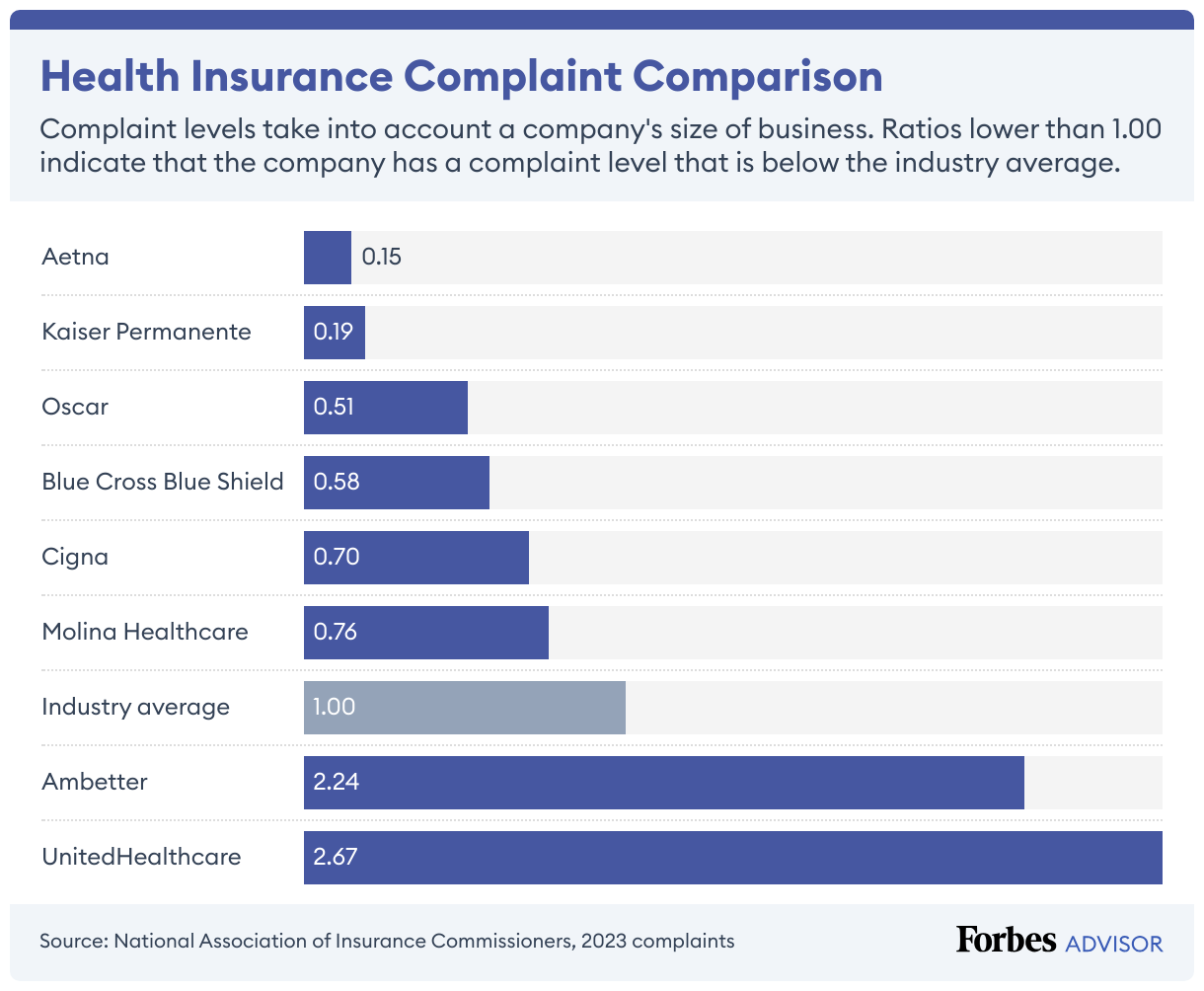
Aetna and Kaiser Permanente have the lowest complaint levels among the eight health insurance companies we reviewed. The National Association of Insurance Commissioners collects complaint data from state insurance departments. A low complaint level can reflect higher customer satisfaction with claims and customer service.
Digital Experience by Health Insurance Company
We evaluated the websites and mobile apps for each health insurance company to gauge the quality of digital experience.
We looked at whether members are able to pay premiums through the website or app, whether they can manage their accounts online and whether insurers clearly let users search for a doctor. Our research also evaluated the search functionality of each site, how simple it is to find ACA plan information, each company’s Facebook account and other online metrics.
How To Choose the Best Health Insurance for You

Mark Fendrick
Advisory Board Member

Les Masterson
Insurance Editor

Ashlee Valentine
Insurance Editor

Jason Metz
Insurance Lead Editor

Michelle Megna
Insurance Lead Editor
Look Beyond the Premium
A low premium may be attractive, but other factors should be considered when choosing a health plan, such as ensuring your trusted clinicians are included in the plan’s network and calculating all of the costs. I’ve found that those who have predictable clinical needs may pay less out of pocket if they enroll in a plan with a higher premium but more generous coverage for needed care.
Make Sure Your Doctors Are In-Network
I suggest calling your doctor’s office directly to ask if they are in your health plan’s network—don’t assume the insurer’s provider directory online is always up-to-date. Paying the in-network rate will help you save significantly.
Go on a Spouse or Parent’s Plan
If you’re eligible for a health plan through your job or a spouse or parent’s job, I’ve found that’s often the cheapest way to get the best health insurance.
Find Out About Your Prescriptions
If you have prescriptions, I would check with the insurance company to confirm that they’re covered and see how much you would have to pay out of pocket. You don’t want to discover later that you have huge out-of-pocket payments for prescriptions that aren’t covered.
Figure Out the Type of Plan You Want
A health plan’s “benefit design” plays an important role in a plan’s flexibility. For instance, an HMO typically costs less than a PPO but an HMO requires primary care referrals to see specialists and you generally must stay within the plan’s network. I suggest considering those factors when deciding on a plan.
We Answer Your Questions
Michelle Megna
Insurance Lead Editor

Penny Gusner
Insurance Senior Writer
Jason Metz
Insurance Lead Editor
Les Masterson
Insurance Editor
How do I find out if a doctor is considered in-network for a health plan?
– Richard G., Burlington, Kansas
I’ve found the best way to find out whether a doctor is in-network is to contact the doctor’s office directly rather than checking with the health insurance company. Insurers often don’t have the most up-to-date provider list on their websites or may even have errors on their provider lists. Checking with the doctor’s office directly is typically the best way to confirm a provider’s network status.
Is a premium or deductible more important for health insurance?
– Catherine T., Raleigh, North Carolina
It depends on how often you use healthcare services. A premium is what you pay for coverage; the deductible is what you pay for healthcare services annually before the health plan begins paying its share. I’ve found that a premium is generally more important but it can vary. For instance, if you regularly exceed your deductible, that cost may be equally or more important. You’ll want to weigh the costs based on your experience.
What is coinsurance?
-Juan T., Orlando, Florida
Coinsurance is the percentage of a healthcare bill that you’re splitting with the health insurance company. Policies usually have an annual deductible, which is what you pay toward healthcare before the health plan begins paying a portion. Once you exceed the deductible, you then pay coinsurance toward healthcare bills. For instance, you may pay 40% of the healthcare bill and the health insurance company picks up the other 60%. I’ve found that the coinsurance amount can play an important role in healthcare costs if you need regular health services.
When can a health insurance company cancel your coverage?
-Fran S., Secaucus, New Jersey
A health insurance company can only cancel your coverage if you don’t pay your health insurance premiums or if you provided false or incomplete information when buying coverage. And in these cases, health insurance companies must give you at least 30 days’ notice when canceling coverage. You have those 30 days to appeal the decision via either an internal appeal or an external appeal.
Find the Best Health Insurance in Your State
Methodology
We analyzed 96 data points related to coverage and quality for eight large insurers to determine the best health insurance companies. Our ratings are based on:
- Average premiums (30% of score): We averaged Affordable Care Act health insurance marketplace rates for ages 21, 27, 30, 40, 50 and 60. Source: HealthCare.gov.
- Complaints made to state insurance departments (20% of score): We used complaint data from the National Association of Insurance Commissioners.
- Average silver plan deductible (20% of score): The deductible is how much you have to pay for healthcare in a year before the health plan begins picking up a portion of the costs. Companies with health plans that had low deductibles got more points. Source: HealthCare.gov.
- Breadth of health plans (10% of score): Health insurance companies may offer up to four types of plan benefit designs (PPO, HMO, EPO and POS). We gave companies that offered more types of plans more points. Source: HealthCare.gov.
- Metal tier offerings (10% of score): The ACA marketplace has four metal tier levels. We gave points to companies that offered more tier plan options. Source: HealthCare.gov.
- Digital experience (5% of score): We analyzed the quality of each company’s mobile app and website. We evaluated health insurers on: the company’s mobile app; if in-network providers are easy to find online; the company’s website’s search functionality; whether the company has a Spanish-language site; if the site includes informative wellness and self-help information; whether you can manage your account online; if information about ACA plans is easy to find; whether you can pay online; and if the website makes it easy for users to find definitions for health insurance terms. Source: Forbes Advisor research.
- Consumer Sentiment Index (5% of score): The Consumer Sentiment Index from Forbes Advisor uses a proprietary weighting system designed by our subject matter experts and it evaluates thousands of consumer insights and reviews from leading online forums to determine customer satisfaction at scale, including claims process, customer service, coverage options and pricing and premiums.
Read more: How Forbes Advisor rates health insurance companies
Best Health Insurance Frequently Asked Questions (FAQs)
When is open enrollment for health insurance?
Open enrollment for the ACA marketplace is from November 1 to January 15 in most states. A handful of states have slightly different open enrollment periods.
Open enrollment is the time when you can buy an ACA plan or make changes to current coverage. The only way you can get marketplace coverage outside of the open enrollment period is if you have a qualifying life event for a special enrollment period. A qualifying life event includes things like getting married, having a child, moving to a new ZIP code or aging out of a parent’s plan when you turn 27.
Why is health insurance so expensive?
Health insurance is expensive because healthcare itself is costly. Blue Cross Blue Shield says medical care accounts for 90% of health insurance spending.
Other factors cited for high health insurance costs include administrative expenses and costly medical technology.
Is it illegal to not have health insurance in the US?
In most states, it is not illegal to have no health insurance.
A handful of states require health insurance: California, Massachusetts, New Jersey, Rhode Island and Vermont, as well as Washington, D.C. All but Vermont have tax penalties for residents who don’t have health insurance. Vermont mandates health insurance but there isn’t a monetary penalty.
Which health insurance companies cover all 50 states?
Aetna, UnitedHealthcare and Blue Cross Blue Shield-affiliated plans offer health insurance to residents in all 50 states.
That doesn’t mean all of these companies offer plans in the Affordable Care Act marketplace, though. For example, UnitedHealthcare sells health insurance in all states but has ACA marketplace plans in only 23 states.
What is the best health insurance for unemployed people?
The best health insurance for unemployed people depends on multiple factors like eligibility and household income. COBRA health insurance extends a former employer’s health coverage but is very expensive. An ACA health insurance marketplace is another option.
A more affordable option is getting added to your spouse’s or parent’s plan, depending on the situation, if they get group health insurance through an employer. If you qualify for Medicaid, that is generally the lowest-cost option. Medicaid bases costs on household income, so if you qualify, you pay little or nothing for Medicaid.