The EU has introduced a new instrument at the URC-2025, the European Flagship Fund, which encourages businesses to actively contribute to Ukraine’s reconstruction. Rebuilding Ukraine is an immense challenge that will require around $524 billion in private capital involvement to facilitate recovery and reconstruction, according to recent estimates.
What is the European Flagship Fund for Ukraine’s reconstruction? What are its goals, priority areas, and opportunities for Ukraine and its partners?
JOIN US ON TELEGRAM
Follow our coverage of the war on the @Kyivpost_official.
The European Flagship Fund for Ukraine’s Recovery is an initiative announced by the EU during the Ukraine Recovery Conference held in Rome, Italy, on 10 July 2025.
European Commission President Ursula von der Leyen described it as “the world’s largest equity fund for reconstruction” noting that it delivers on the EU’s promise, made at URC-2024, to mobilise the private sector for Ukraine’s reconstruction and economic growth.
Objectives and industries in EU funding’s focus
The Fund is designed to support two key objectives:
- Accelerating Ukraine’s recovery;
- Supporting Ukraine’s EU integration.
Priority sectors for investment include:
- Energy, with a strong focus on renewables;
- Infrastructure;
- Digital transformation;
- Industrial modernisation;
- Production of dual-use goods;
- Critical raw materials (CRMs).
Who funds the European Flagship Fund
The European Flagship Fund was launched by the European Commission, together with the governments of four countries – Italy, Germany, France, and Poland — their respective development banks, and the European Investment Bank. Beyond these founding partners, the investor base is expected to expand to include other EU member states, international partners, as well as institutional and private investors from Ukraine and abroad.
Other Topics of Interest
From Aid to Alliances: Why Ukraine’s Future Lies in Business Partnerships, Not Just Recovery
Contrary to popular belief among Americans, Ukraine, is a thriving, innovative tech nation. It doesn’t just need financial support – it needs visibility, credibility, and ties to global markets.
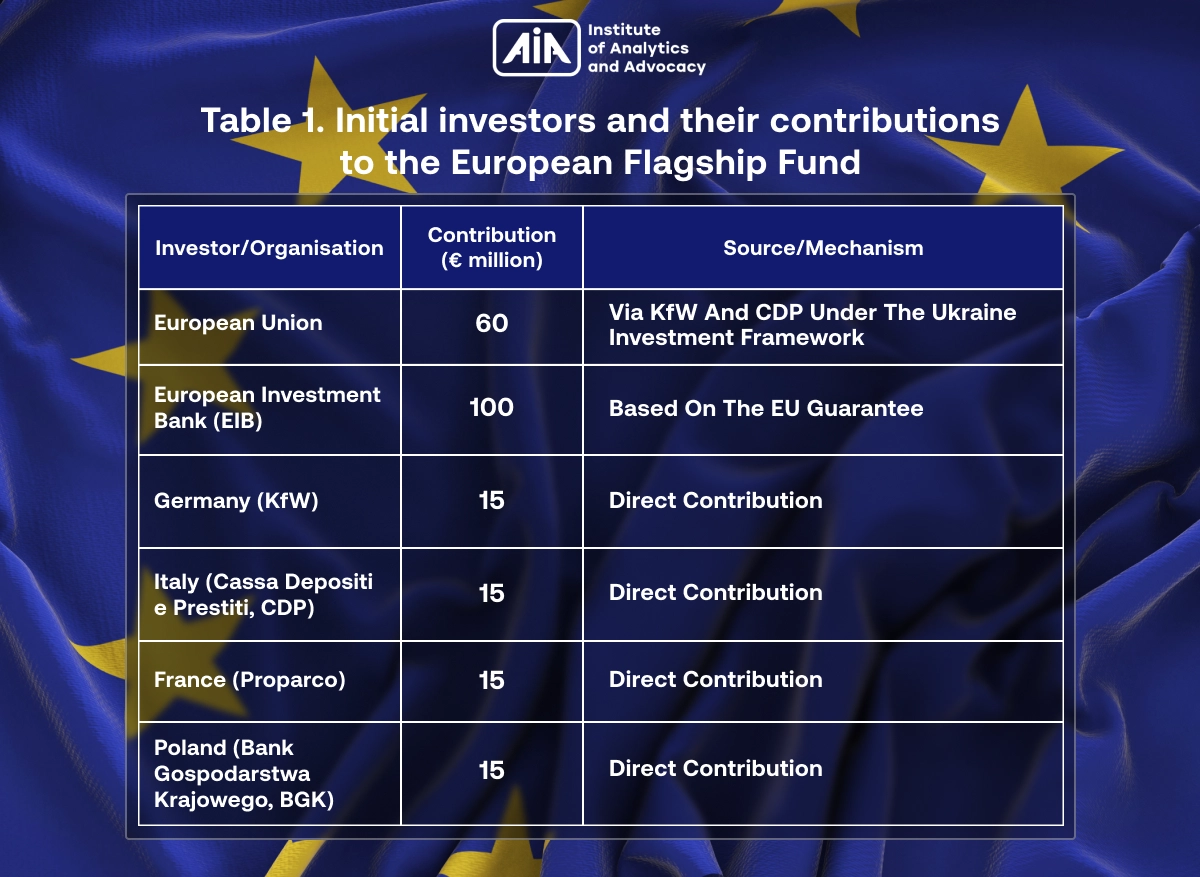
Source: Compiled independently by the authors based on data from KfW.
Total initial capital of the Fund: €220 million
European Flagship Fund’s Main Contributors:
- European Union — via the second component of the Ukraine Facility, the Ukraine Investment Framework
- European Investment Bank (EIB) — €100 million (backed by an EU guarantee)
- Germany — €15 million via KfW
- Italy — €15 million via Cassa Depositi e Prestiti (CDP)
- France — €15 million via Proparco
- Poland — €15 million via Bank Gospodarstwa Krajowego (BGK)
- EU grants — €60 million, channelled through KfW and CDP
These funds are provided by public investors as buffer capital to attract private partners. Contributions from these countries play a dual role:
- Risk protection: In case of project losses, state-provided buffer capital absorbs the initial losses, lowering risks for private investors.
- Anchor investment: Early public investment enhances credibility and trust, encouraging private partners to join.
The Fund will operate on a blended investment model, offering grants, loans, and guarantees. By 2026, it is expected to mobilise up to €500 million for strategic, results-oriented investments. Overall, the Fund’s objective is to attract up to €1 billion in investments by 2027–2028.
European Flagship Fund’s investment design
The Fund will employ several investment models to channel resources into Ukraine’s recovery and growth:
Equity and quasi-equity investments (preferred approach)
The Fund will acquire shares in companies or projects, becoming a co-owner. Quasi-equity capital, which combines elements of debt and equity, may include convertible bonds or debt instruments with an option to convert into equity.
Through this approach, the Fund will invest in projects (e.g., the construction of a power plant) and receive a share of future profits and assets. This enables the Fund to participate in the project’s growth but also entails higher risk.
Fund of funds (FOF)
Instead of investing directly, the Fund will channel resources into other investment funds that finance projects and companies. This approach diversifies risks and attracts more private capital through specialised funds. The advantage of the FOF model lies in its ability to collaborate with multiple smaller funds focused on different sectors (e.g., technology, energy, infrastructure), thereby enhancing private investment mobilisation.
Combined approach
The Fund may apply a hybrid model, allocating part of its resources to direct investments (e.g., infrastructure projects) while also supporting other funds that back start-ups and small businesses.
With a target size of €1 billion, the Fund is expected to generate a multiplier effect of approximately €6-7 billion in overall investments.
Current status and next steps
The process of establishing the Fund is already underway. Between July and October 2025, a competitive procedure will be held to select the Fund’s management company. By the fourth quarter of 2025, the first competition for investment-ready projects may be announced, with initial investments expected to start in the second half of 2026.
The Fund is designed not only as a financing instrument but also as a risk-management mechanism to mobilize substantial private investment.
It will work in synergy with other EU initiatives and programmes supporting the development of Ukraine’s financial markets.
In particular, it will complement the High-Impact Equity programme of the International Finance Corporation (IFC), the efforts of the European Development Finance Institution Management Company (EDFI MC).
The European Flagship Fund will ensure complementarity in cooperation with local private equity and venture capital funds.