Welcome to FT Asset Management, our weekly newsletter on the movers and shakers behind a multitrillion-dollar global industry. This article is an on-site version of the newsletter. Subscribers can sign up here to get it delivered every Monday. Explore all of our newsletters here.
Does the format, content and tone work for you? Let me know: alan.livsey@ft.com
In today’s newsletter:
-
Amundi cuts US assets exposure
-
Has USS’s investment strategy worked?
-
Shares in private equity firm CVC struggle
Amundi to cut US exposure over coming year
Europe’s largest asset manager Amundi will reduce its US dollar assets exposure and turn instead to European and emerging markets, according to its chief executive.
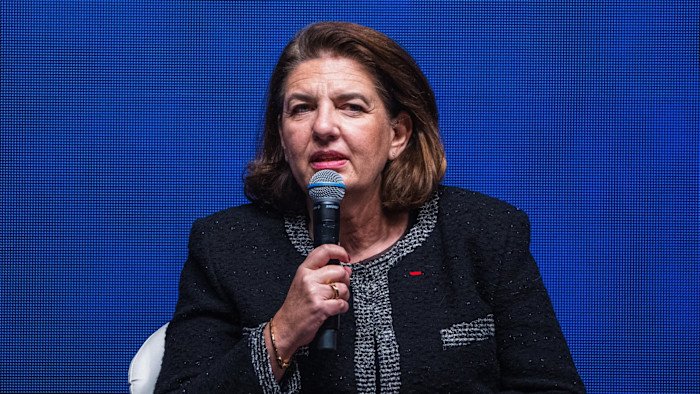
Valérie Baudson, whose firm has €2.4tn of assets under management, said that this coming year Amundi would advise clients to shift away from the greenback, warning that if US economic policy does not change, “we will go on seeing a [weakening] of the dollar”.
“Amundi has been diversifying a lot and has been advising [clients] to diversify a lot . . . over the last 12 to 15 months, and is going on advising its clients to diversify their positions for the year to come,” Baudson said in an interview last week.
Amundi is the latest big investor to say it is looking to cut or hedge its exposure to US assets amid concerns about Donald Trump’s volatile economic policies. The dollar has weakened sharply since the president’s “liberation day” tariff shock last April, a fall given new impetus this year by the US president’s threats against European allies over Greenland and worries about the independence of the Federal Reserve.
Baudson said international investors had initially protected themselves against the fall of the dollar over the past year by buying gold. This explains much of the spectacular rise in the price of bullion during that period, she added.
“What we saw after was a will to diversify from US assets, in order to diversify from the dollar, which was . . . overinvested worldwide,” she added.
Such moves had driven money into European and emerging-market assets, both in fixed income and equities.
Last year, emerging market stocks had their best year since 2017, driven largely by dollar weakness, with gains picking up strongly at the start of 2026.
Has USS’s investment strategy worked?
USS was set up in 1974 to provide pensions for academic and senior administrative staff in the UK university sector. It now has 577,000 members.
It set up its own private markets team in 2007 and illiquid assets now account for about £26bn, a third of the portfolio. The scheme prides itself on investing directly into private assets to lower costs, with about three-quarters of assets managed in-house.
However, in recent years this part of the portfolio has caused USS some headaches.
The insolvency application for broadband provider G.Network last month was yet another blow to the Universities Superannuation Scheme.
The UK’s largest private pension fund had invested close to £300mn in the upstart broadband provider in the depths of the coronavirus pandemic, only to have its equity stake wiped out in a forced sale to a distressed debt specialist five years later.
On the heels of a disastrous billion-pound writedown on its holding in Thames Water, and a failed investment in battery maker Northvolt, questions are now being raised over USS’s push into private markets.
“Nothing ever looks very good in terms of what they’ve invested in,” said one USS member, who declined to be named.
Another said transparency was a “huge issue” for the scheme, making it “tricky” to get a clear picture of how private assets had performed.
While high-profile, the recent losses make little dent on the £77bn scheme or its ability to pay pensions. But the failures have put USS’s strategy under the spotlight at a time when the government is pushing retirement funds to invest more in private markets to help boost Britain’s ailing economy.
Chart of the week

Last September, private equity firm CVC chalked up a rare achievement: a record year for cash returned to investors, while the wider industry limped through a downturn.
Yet far from sparking celebration among the Amsterdam-listed group’s public market investors, shares fell 4 per cent that morning as analysts fretted about sparse detail on how it planned to deliver the big increase in future earnings that the market had priced in.
“It felt like they were holding back,” said one analyst that day. “It might be because they prefer to be conservative . . . they’ve left us a little bit confused.”
That earnings-day disappointment is symbolic of CVC’s conundrum: how to satisfy the demands of two very different types of investor. The firm is revered by its fund investors as a strong private equity performer. But among shareholders — the public market investors — it has received a muted reception.
The group’s shares have for months hovered around the €14 price at which it listed in April 2024.
This month, an industry-wide sell-off sparked by fears about the vulnerability of private capital groups’ software investments to AI pushed CVC’s share price below that level.
The firm dodged the worst of the latest drubbing because it had less exposure to software companies than some of its rivals. But over the past year, CVC’s shares have shed 44 per cent of their value — performance that is at least 10 percentage points worse than most peers.
“I’m as flummoxed as everybody,” said one shareholder of the firm that manages €200bn in assets across private equity, credit and infrastructure. “On the fundamentals they’re absolutely roaring.”
Rokos Capital Management has ended talks with Lord Peter Mandelson over a lucrative advisory role after further revelations about his relationship with the convicted sex offender Jeffrey Epstein.
Canada Pension Plan Investment Board and Ontario Municipal Employees Retirement System plan to sell their stakes in Associated British Ports in a deal that they hope will value the UK’s biggest ports operator at more than £10bn.
Canadian private equity group Brookfield has taken another step in its succession plan for long-term chief Bruce Flatt by promoting Connor Teskey to chief executive of its asset management arm.
Another wealthy financier has decided to quit the UK for a low tax country. The boss of private equity group Permira, Kurt Björklund, has shifted his residency to Switzerland.
Citadel founder Ken Griffin has spoken out this past week about how members of the Trump family are enriching themselves, a rare rebuke by such a prominent figure on Wall Street and important Republican donor.
And finally

Whatever one thinks of Tracey Emin’s art, her unmade bed remains one of the most controversial works ever. You can decide for yourself when My Bed and 40 years of her work go on show at London’s Tate Modern at the end of this month.
Tracey Emin, A Second Life
From February 27
Thanks for reading. If you have friends or colleagues who might enjoy this newsletter, please forward it to them. Sign up here
We would love to hear your feedback and comments about this newsletter. Email me at alan.livsey@ft.com