Unlock the Editor’s Digest for free
Roula Khalaf, Editor of the FT, selects her favourite stories in this weekly newsletter.
Norway’s $2tn wealth fund would lose almost a quarter of its equity portfolio value in the event of climate shocks and more than half would be wiped out by a correction in AI valuations, its latest modelling shows.
The stress test exercise undertaken by Norges Bank Investment Management for the first time featured the hypothetical hit from a climate-related scenario, involving a food supply shock after widespread crop failures.
It was assessed alongside the three other key areas of risk, including an AI boom collapse, debt crises and geopolitical fragmentation.
A severe climate event would knock 24 per cent from the equity portfolio, with a hit of 39 per cent from a debt crisis and 49 per cent from geopolitical fragmentation, while an AI correction would wipe out 53 per cent.

But when fixed income and bond investments in the whole portfolio were taken into account, the top risk became a debt crisis, with an AI correction being positive for bonds.

On a whole portfolio basis, the highest risk remains from economic fragmentation and “sweeping tariffs”, which could wipe off 37 per cent, followed by the effects of an AI correction, geopolitical rupture and climate change.
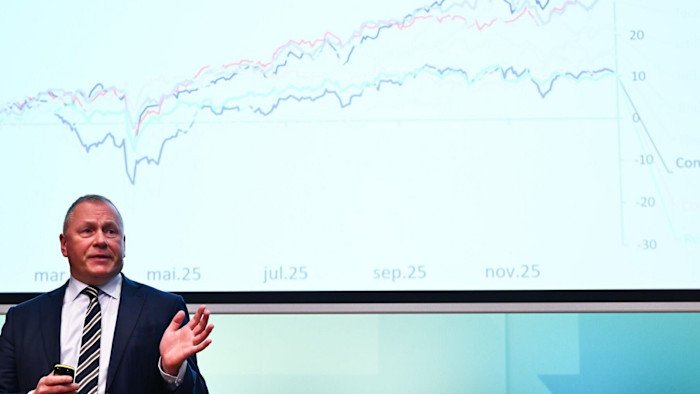
“You should worry about a fragmented world, you should worry about debt levels generally among large countries, and we should also be aware that a lot of the value of the fund is tied into these AI stocks,” Nicolai Tangen, the fund’s chief executive, said on Thursday.

The fund said these varied risks could compound, for example if climate shocks triggered inflationary pressures that left governments less breathing room to deal with fiscal shocks.
It had this year chosen to use a climate scenario in its stress testing, it said, “to highlight how environmental developments increasingly can affect financial markets”.
It deliberately chose high-impact scenarios that were relatively unlikely to transpire. But it said that “hints” of the stressful scenarios it identified had all ended up occurring in minor ways over the past year.
Scientists have warned of irreversible changes to the planet that would jeopardise food systems if the world’s goal of limiting long-term warming to 1.5C is breached.
The fund this month told the FT it believed the trajectory of global warming meant companies in its portfolio should be given leeway to target net zero by 2050 based on emission cuts equating to below 2C of warming, rather than the ideal of 1.5C, as set down in the Paris agreement.
This translates to shallower or slower cuts to greenhouse gases in key industries, from grids to transport, in coming years.
Its head of governance also said that the risk to its investments from fire, floods and heat had increased in the past year.
In the climate-related scenario, the stress test found extreme weather events could dampen global growth expectations and raise inflation expectations by triggering crop failure in two major staple food production areas, as well as supply chain disruption.
The tests, based on December 2025 holdings, map out “extreme market outcomes” for the short to medium term. The report arrives at an expected shortfall estimate by considering historic responses to stress as well as future-looking predictions.
“An important drawback of historical simulations is that future crises may play out differently than in the past,” the fund noted.
Additional reporting by Richard Milne
Climate Capital

Where climate change meets business, markets and politics. Explore the FT’s coverage here.
Are you curious about the FT’s environmental sustainability commitments? Find out more about our science-based targets here