In 2010, MS NOW and UNICEF USA teamed up to deliver desks to classrooms across Malawi. More than 405,000 desks later, the K.I.N.D. (Kids in Need of Desks) Fund has benefitted 1.6 million students, including nearly 38,000 girls who were able to attend high school with a K.I.N.D. scholarship. A look back at the origins of a longstanding and successful partnership that continues to open doors for children in Malawi.

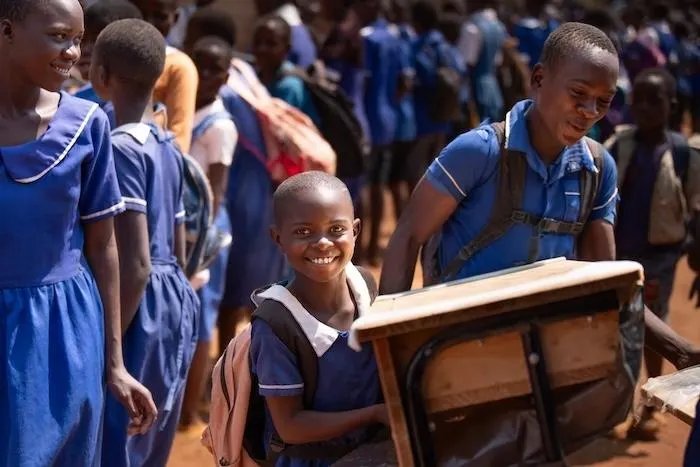
Nine-year-old Khumbo and 15-year-old Blessings help carry a desk to their class at Naluva Primary School in Salima, central Malawi on Oct. 22, 2025. The desks were delivered by the K.I.N.D. Fund, a 15-year collaboration between UNICEF and MS NOW to improve education outcomes for children in Malawi.
© UNICEFUSA/CHIKONDI2025
The K.I.N.D. Fund provides desks for kids in Malawi
It was a schoolteacher friend of MS NOW’s Lawrence O’Donnell who first told him what teachers in Malawi wanted most to help their students learn. It wasn’t textbooks or paper or pencils. It was chairs.
“That wasn’t anywhere on my list of what to expect. They weren’t even thinking about desks. They just wanted something to get kids off the floor,” O’Donnell told UNICEF USA CEO and President Michael Nyenhuis in a conversation earlier this year. “Within moments of hearing that, I found myself saying: ‘Well, we could get them chairs, couldn’t we?’ It just hit me. The deprivation was so extreme that even I felt like I could do something about it.”
Related: Back to School: How the K.I.N.D. Fund Is Transforming Education in Malawi
MS NOW’s Lawrence O’Donnell takes a photo with a KIND Fund Scholarship recipient at Chipoka Secondary School in Salima, southern Malawi on Oct. 21, 2025.
© UNICEFUSA/CHIKONDI2025
O’Donnell, host of “The Last Word” on MS NOW, traveled to Malawi to see the situation for himself. “In the first few days there, I was convinced it was impossible. I thought I would return home and explain to my audience why Malawi’s classrooms didn’t have desks and why they probably never would,” O’Donnell recalls. “Malawi doesn’t have furniture stores or supply chains like we do. You might see roadside makers building couches or tables by hand — but nothing designed for classrooms.”
“In the first few days there, I was convinced it was impossible. I thought I would return home and explain to my audience why Malawi’s classrooms didn’t have desks and why they probably never would.”
O’Donnell’s outlook changed when he met with UNICEF Malawi, and a member of the team introduced him to a small shopkeeper who had built a sample school desk and teacher’s desk, hoping the Ministry of Education might someday place an order.
“I asked if he could make 30 desks by the end of the week. He said yes,” O’Donnell says. “He hired trained carpenters, painters and metal workers who were unemployed, ran three shifts around the clock and delivered all 30 desks on time.”
Learn more: K.I.N.D. Desks Make a Big Difference for Students in Malawi
Fourteen-year-old Haluni and a classmate share a new desk delivered to Chapita Primary School in Salima, central Malawi on Oct. 20, 2025. Students are better able to focus and engage in their learning when they’re seated at desks.
© UNICEFUSA/CHIKONDI2025
K.I.N.D. Fund desks improve learning outcomes for students in Malawi
Those desks were delivered to a school, and the K.I.N.D. (Kids in Need of Desks) Fund was born. Fast forward 15 years: to date, K.I.N.D. has delivered more than 405,000 desks to schools across Malawi, benefitting more than 1.6 million learners.
Each sturdy desk comes with an attached bench, large enough to comfortably fit two or three students. No more jostling for space in a crowded classroom, struggling to concentrate and write legibly. Sitting on the floor is particularly difficult for girls, who worry about keeping their skirts down when they stand up to answer a teacher’s question, then try to reclaim their spot on the ground.
Schools with desks report increased attendance, higher retention rates among girls and greater participation across the board, demonstrating how improved classroom resources strengthen education in Malawi. A $158 donation funds the cost of one desk, which can be used year after year to support young learners.
Eleven-year-old Tadala and classmates sit on the floor in a crowded classroom at Chapita Primary School in Salima, central Malawi before desks were delivered by the K.I.N.D. Fund on Oct. 20, 2025.
© UNICEFUSA/CHIKONDI2025
K.I.N.D. scholarships have helped nearly 38,000 girls complete high school
At first, the K.I.N.D. Fund had one simple mission: outfit classrooms in Malawi with desks. But Victor Chinyama, UNICEF Malawi’s Chief of Communication at the time, pointed out to O’Donnell that the high school graduation rate for boys was double the girls’ graduation rate. Primary school is free in Malawi, but secondary school comes with a price tag that’s out of reach for many families. Many girls drop out of school to marry early.
To give girls the opportunity to complete their educations, the K.I.N.D. Fund began awarding secondary school scholarships. Since then, nearly 38,000 girls have benefitted from K.I.N.D. scholarship support.
“I really don’t take the support that was given to me for granted since it lifted my parents’ burden.”
$265 funds a scholarship that supports one year of secondary education for a girl in Malawi, including tuition, boarding fees, transportation and everything a girl needs to succeed — textbooks, a uniform, school supplies, menstrual hygiene products. Girls also receive mentoring and psychosocial guidance to get the most out of their classes.
Joyce Chisale attended St. Michael’s Girls’ Secondary School in Blantyre with support from a K.I.N.D. Fund scholarship, then enrolled at Kamuzu University of Health Sciences in southern Malawi, where she studied medical library sciences.
“The UNICEF scholarship really helped me throughout my secondary school because my father could not afford to pay for my fees as he was earning a low income and he also had to support my other siblings,” says Joyce, the third of four children. Her merit-based K.I.N.D. scholarship also made it possible for her family to send her younger brother to high school and university. “I really don’t take the support that was given to me for granted since it lifted my parents’ burden.”
A student concentrates on her work after new desks were delivered to Naluva Primary School in Salima, central Malawi on Oct. 22, 2025.
© UNICEFUSA/CHIKONDI2025
Fifteen years of K.I.N.D. helping kids imagine a brighter future
Chinyama, who is retiring this month after 28 years with UNICEF, remembers meeting O’Donnell on his first visit to Malawi. “When [he] first walked into my UNICEF office in Malawi, I never would have guessed that, 15 years on, the dream would still be alive. Honestly, I am amazed at everything that K.I.N.D. has done. It has not just given that young lad from a rural village in Malawi a desk, it has given him a chance to learn and to imagine a future that’s brighter than he ever thought possible.”
Girls who received K.I.N.D. scholarships “are now doctors, they are now teachers and they are nurses,” Chinyama says. “And they are the ones who are building Malawi’s future.”
Investing in chidren’s education transforms lives and brightens futures. Families, communities and economies are strengthened. The K.I.N.D. Fund continues to provide students with the support they need to keep learning and thriving. Help children in Malawi reach their full potential. Please donate today.
K.I.N.D. Fund scholarship beneficiaries at Nsalula Community Day Secondary School in Salima central Malawi on Oct. 22, 2025.
© UNICEFUSA/CHIKONDI2025