JAMESTOWN — The District 12 Republican delegation plans to introduce the Legacy Fund Transparency Act during the next legislative session that will require the State Investment Board to publish every investment in the North Dakota Legacy Fund on its website.
Sen. Cole Conley, R-Jamestown, said the Legacy Fund Transparency Act is important because citizens need to know where money is being invested.
“Every citizen should be able to go online and see where billions of their tax dollars are going,” he said. “It’s a no-brainer in the internet age. The public and the media should not have to file formal open records request to see where their money is being invested all around the world.”
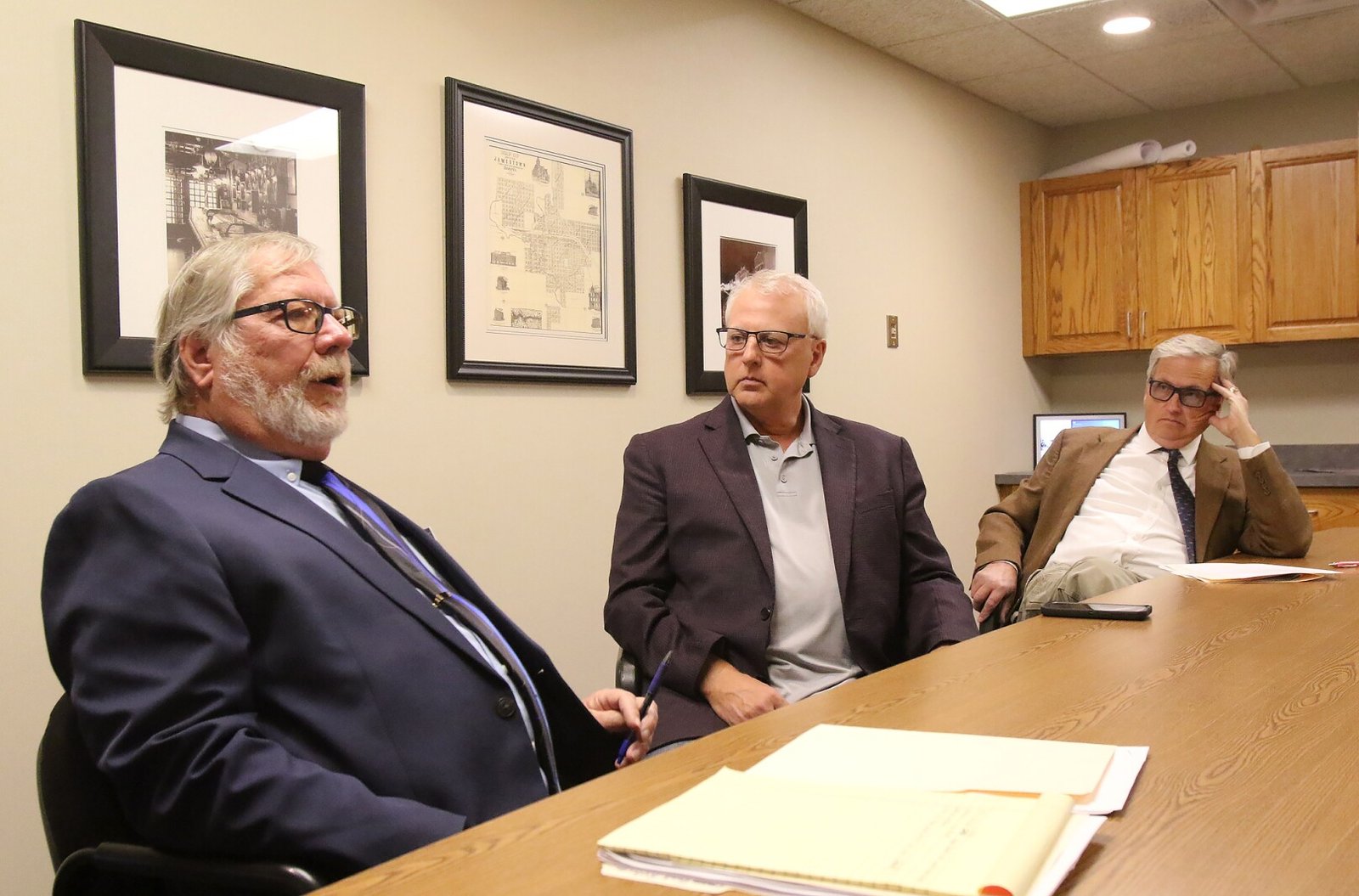
Rep. Bernie Satrom, R-Jamestown, said having more transparency on how Legacy Fund money is being invested is not a new project for the District 12 delegation.
“We’ve been talking about transparency and working towards it for a long time,” he said. “I’ve been very concerned about where the money is being invested.”
Satrom said Legacy Fund money is being invested in more than 60 foreign countries, including Argentina, China and Thailand.
“ … virtually everywhere but North Dakota,” he said. “And most of our colleagues in the Legislature don’t even know.”
Rep. Mitch Ostlie, R-Jamestown, said the District 12 delegation wants to know where the Legacy Fund money is being invested.
“Some people think we want to micromanage it to the point where we are, as legislators, selecting where the dollars should be invested and that’s not necessarily what we are doing, but the need to know is super, super important,” he said.
A poll released by the North Dakota News Cooperative in February found that 84% of eligible state voters want the State Investment Board to publish a list of Legacy Fund investments on its website and/or elsewhere instead of requiring citizens to file a formal request for documentation.
In 2010, North Dakota voters approved a measure that created the Legacy Fund, which is a perpetual source of state revenue from the finite national resources of oil and natural gas, according to the Office of State Treasurer’s website. Thirty percent of the taxes on petroleum produced and extracted in North Dakota are transferred to the Legacy Fund monthly, according to the North Dakota Retirement and Investment Office’s website.
The Legacy fund has over $11.1 billion as of July 31.
Olivia Schloegel, democratic candidate for District 12 Senate, said she is supportive of transparency and accountability.
“There are precedents for people setting values of how you want the money spent in the Legacy Fund and some of those strategic formulas that investors use,” she said. “We have to be mindful … there are tradeoffs between having the highest negotiation power and getting the biggest return on investment in the Legacy Fund.”

Contributed / C Photography
She also said the concerns of some investments from the Legacy Fund are valid.
“It freaks me out that we might be investing in an international entity that I don’t personally agree with,” she said. “The mechanisms for transparency need to be clearly thought out … .”
Ostlie said the North Dakota Retirement and Investment Office has received open record requests about the Legacy Fund.
“They have not shared with those open record requests where these dollars are invested,” he said.
Tory Jackson, a Bismarck attorney, wrote in a column in the North Dakota News Monitor that he requested a list of all foreign and domestic holdings and the investments made by each private money manager hired by the State Investment Board.
“I also asked for investments made by 50 South Capital, a Chicago-based firm that, together with five out-of-state firms it selected, is responsible for the portion of the Legacy fund that is supposed to be invested in North Dakota,” he wrote.
Jackson said in an email to The Jamestown Sun that he requested an opinion from North Dakota Attorney General Drew Wrigley on Feb. 9 on whether the North Dakota Retirement and Investment Office violated the open records law. He said he’s hoping the opinion will be issued soon.
“As of now, I have not received the opinion,” he said. “Opinions on open records violations generally take from 120 to 180 days to complete, according to the attorney general’s website. The wait for this opinion is going on 250 days. I understand and appreciate that the attorney general’s office is a busy place with a lot of competing priorities, and an assistant attorney general has been very responsive to my periodic requests for updates, but it’s still frustrating to wait this long.”
He said the Legacy Fund is nearly twice the state’s biennial general fund budget and taxpayers deserve to know where their money is being invested, “especially in light of revelations that Legacy Fund money has been invested with Russian oligarchs and companies controlled by the Chinese Communist Party.
“I don’t think any North Dakotan would be satisfied with a financial advisor who refused to disclose where their IRA (individual retirement account) or 401(k) is invested,” he said.
In a letter to Lt. Gov. Tammy Miller, chair of the State Investment Board, Conley wrote that Jackson’s request will serve as a “test case” for the Legislature regarding what information can be hidden from public view. Conley asks why Jackson was denied information about foreign investments in categories such as “global region,” “international region” and “emerging markets region” but not for other investments in countries that range from Argentina to Thailand.
“It seems that you disclosed investments made by some money managers but not others,” he wrote.
Conley also wrote that he wants to review the Legacy Fund investments himself as a legislator who has oversight responsibilities of state agencies. He wrote that exemptions under North Dakota Century Code 44-04-18.4 are often used to avoid compliance with open records statutes.
In a response to Conley’s letter, Miller wrote that Jackson was not denied information about foreign investments in categories such as “global region,” “international region” and “emerging markets region.”
“Had Mr. Jackson requested an explanation of these investment categories, he would have learned that when certain investments such as comingled funds have exposure in more than one country of risk they are listed by regional categories because to do otherwise would require RIO to alter the record from its custodian and thus be less transparent,” she wrote. “Further there is significant additional information regarding country of risk exposure of such funds available in reports that RIO publishes on its website.”
Jackson wrote in his column that the list of Legacy Fund investments as of Nov. 30, 2023, contains “a few curious items, including over $160 million invested in the ’emerging markets region,” over $520 million in the ‘global region,’ and nearly $46 million in the “international region.”
The list of those Legacy Fund investments shows no countries that the money managers have invested in and only categorizes the investments being in the “global region,” “international region” and “emerging markets region.” Another $2.3 billion has also been identified where the money manager that received the money is shown but it does not show what they have done with the funds.
There are 11 commingled funds involved with the $800 million. Jan Murtha, executive director of the North Dakota Retirement and Investment Office, wrote in a response to Conley that her office would not be able to provide him with the “holding level data” for the 11 commingled funds. “Holding level data” refers to stocks and bonds the Legacy Fund owns.
A commingled fund is a holding in a portfolio, Murtha wrote.
“In a commingled fund, an investment is the pooling of assets from multiple investors into a single account, while the commingled fund holding is the result of that pooling,” she wrote.
Murtha also cites North Dakota Century Code 44-04-18.4 to deny Conley’s requests for Legacy fund investment data.
“Our assigned Assistant Attorney General had previously opined that there is not an exception under the North Dakota open records and meetings law that permits the disclosure of confidential information to an individual legislator solely based on their status as a legislator,” she wrote. “Therefore, RIO would not be able to provide you with holding level information for the eleven commingled funds beyond the information referred to herein.”