Specialist Report
Climate Response Fund Expected to Grow
with Expansion of Paid Emission Permit Allocation
Management Transferred to Ministry of Climate, Energy and Environment
Calls to Increase Support for Companies and Power Generation Sector Facing Greater Burdens

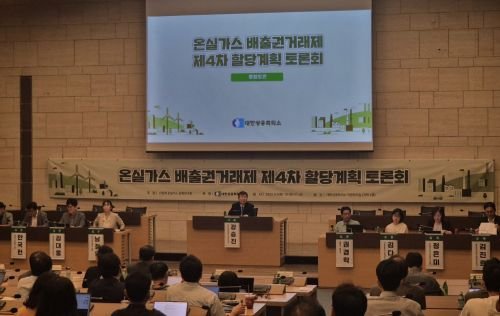
The Korea Chamber of Commerce and Industry is holding a discussion forum on the 4th allocation plan for the greenhouse gas emissions trading system.
With the proportion of paid allocation of emission permits expected to rise significantly during the 4th phase of the Emissions Trading System, the scale of the Climate Response Fund is also projected to grow. There are calls to provide financial support from the fund to companies and the power generation sector, both of which will face increased burdens due to the expanded paid allocation of emission permits.
The Climate Response Fund was established in 2022 based on the “Framework Act on Carbon Neutrality and Green Growth for Climate Crisis Response” (Carbon Neutrality Framework Act). According to the National Assembly Budget Office, the size of the Climate Response Fund under the 2025 plan is 2.6224 trillion won.
The main source of funding is revenue from paid allocation of greenhouse gas emission permits, but this accounts for only 348.7 billion won, a relatively small portion. Instead, the largest share comes from transfers from the general account, which include 7% of revenue from the transportation, energy, and environment tax, totaling 1.3319 trillion won. Other sources include transfers from other special accounts and funds (607.6 billion won), and deposits from the Public Capital Management Fund (319.9 billion won).
There have been ongoing concerns about the stability of the Climate Response Fund’s revenue base. This is due to the annual decline in revenue caused by falling emission permit prices, as well as the scheduled expiration of the transportation, energy, and environment tax, which is a major funding source. However, as the proportion of paid allocation of emission permits increases in the future, the size of the fund is also expected to grow.
According to the recently announced government reorganization plan, management of the Climate Response Fund will be transferred from the Ministry of Economy and Finance to the newly established Ministry of Climate, Energy and Environment. With the same entity now responsible for both managing and executing the fund, policy consistency can be maintained.
The Climate Response Fund has been used for projects such as greenhouse gas reduction, creating a low-carbon ecosystem, just transition, and establishing a carbon-neutral foundation. There have also been criticisms that the fund has been invested in projects with limited greenhouse gas reduction effects.
In the “Study on Effective Operation of the Climate Response Fund,” published by the Korea Environment Institute in November last year, the institute stated, “Projects that are short-term, have minimal greenhouse gas reduction effects, or can be conducted through the general account should be excluded from the Climate Response Fund. Innovation is needed in both project methods and areas to encourage private sector participation.”
Industry stakeholders are calling for the reinvestment of the fund into the power generation sector and companies that face increased burdens due to rising electricity rates. Kim Maru, Director of the Climate Economy Division at the Ministry of Environment, said at a public hearing held on September 12, “Now that the Climate Response Fund can be managed by a single ministry, it can be executed more swiftly. We will consider ways to use the fund to support companies and power generation firms.”
Hot Picks Today

© The Asia Business Daily(www.asiae.co.kr). All rights reserved.