A zero-carbon, emissions-driven electric system with wind as its backbone, partnered by solar, is the government’s vision for 2050. Clean, green energy keeping industry powered, transport running, and homes heated and lit.
Experts predict a different reality though – more mixed and diverse; blended with wind and solar is low-carbon nuclear as baseload energy, natural gas continuing to play a role in a decarbonised economy, and new energies, carbon capture and storage (CCS) and hydrogen fundamental to the mix.
Making the most of what the UK has – natural resources, skilled people and its supply chain – is key to achieving national energy security by 2050, they say, with current world events reinforcing how crucial energy self-sufficiency is rather than reliance on liquified natural gas (LNG) imports.
Multiplying energy demands are bringing new pressures. AI data centres alone risk doubling the UK’s energy use, accelerating demand for renewables build-outs.
Ofgem warned in February that with 140 data centre projects seeking grid connections, Ed Miliband’s target of meeting 95% of Britain’s electricity demand with clean power by 2030 would be undermined.
So, we find ourselves at a crucial 25-year mark – exactly a quarter of a century since the beginning of UK offshore wind, and another quarter century ahead to achieve net zero.
Can full electrification be achieved in that time? And, if it can, what does the next 25 years look like?
John MacAskill, group managing director of renewables at ABL Group (Image: ABL Group)
The backbone
In 2050, UK offshore wind will be 50 years old, and it has a huge role to play as we head towards that milestone.
John MacAskill, wind industry commentator and group managing director of renewables at ABL Group, is positive that the “excellent reset” of AR7 will put offshore wind back on track after a “torrid time” triggered by the 2022 Russian invasion of Ukraine.
This rebuilding phase – with projects moving with more certainty and the supply chain better understanding the pipeline – paves the way for AR8 and AR9, which must happen quickly by the end of the year, he said.
“We have been through a phase where not every market looked as attractive as it did and emerging markets will not develop in the timescale we once thought,” said John.
“Developers are looking at their portfolio, maximising revenue generation and being much more conservative. Is that bad for the industry?
“In UK offshore wind, we have been from price collapse to market reset. But I have a positive narrative. We are in a positive place, which doesn’t mean we won’t trip up.”
AR7 indicated that the government had the Clean Power 2030 (CP2030) targets in mind and wanted buildable projects quickly, focusing on new fields rather than extended fields, like RWE’s Norfolk Vanguard East and Norfolk Vanguard West.
RWE “played a blinder” with its multi-project win – a reward perhaps for its confidence in the UK wind sector, John said.
“We saw some phased mega projects coming in. This gives a lot of confidence for further capacity down the road. What we didn’t see are some of those extension projects coming in, which should technically be more buildable.
“I believe we will see more diversity in AR8 with some of those extension projects. It gave them more time to get prepared.”
Grid upgrades must also be a priority, John added.
Ben Haggerty, head of whole systems development at National Grid Electricity Transmission, said: “While the existing high voltage electricity network has supported the region well to date, growing electricity demand and new generation mean the capacity of the transmission network will need to increase to meet future needs.
Ben Haggerty, head of whole systems development at National Grid Electricity Transmission (Image: Ben Haggerty)
“Our investment plan for the next regulatory period, from 2026 to 2031, aims to double the rate at which we connect new customers, enabling more renewable generation and providing resilience against price shocks. It aims to double the amount of power flowing across the country and increase our overall network length by nearly 10%.”
Wafa Jafri, partner and UK lead for energy and natural resources startegy at KPMG, was part of the team in government that developed the offshore wind Contracts for Difference mechanism.
As well as a massive win for the industry, AR7 was also “a massive challenge”, she said.
“If AR7 has been about restoring confidence after a difficult period in our industry, AR8 will be about proving that confidence translates into delivery, and the industry coming together to make sure they continue that commitment.
“It is now up to the industry to deliver on this to ensure that there is a future trajectory and future build for the offshore wind industry.”
AR7 went a long way to helping the industry get to the 2030 target, attracting about £22bn of investment in the sector. “But this is just for the assets,” said Wafa. “The real challenge is about delivering offshore wind at scale, which demands investment in ports, manufacturing, vessels.
“Alongside this, we need investment in the supply chain to make it sustainable. Auctions don’t build factories or create jobs. Investment does.”
Wafa Jafri, partner and UK lead for energy and natural resources strategy at KPMG (Image: KPMG)
But uncertainty remains, with 5GW of the AR7 assets unlikely to be online until 2030-31, she added.
“Regardless of the outcome of offshore wind, whether we are going to meet the 43-50GW target that has been set by the government, it is highly likely that we will be using more gas than what is envisaged in the government’s Clean Power 2030 Action Plan.
“Gas has a very important role to play even in a decarbonised system,” Wafa concluded.
Homegrown gas
Policy director at Offshore Energies UK (OEUK), Enrique Cornejo, warns a shift in the current balance of 43% homegrown gas, with the same imported from Norway and LNG making up the remaining 14%, could leave the UK vulnerable if domestic gas production declines by government policy, leading to an over reliance on LNG at the expense of energy security.
Enrique said making the most of the UK’s resources – natural and its supply chain – and building integrated CCS and hydrogen systems, alongside pushing offshore wind opportunities, should be priorities.
“We need to ensure that we maximise our homegrown energy resources that enable an energy transition that reduces dependence as much as possible on imported energy, and also imported supply chains, and make sure that we retain that value that we have in this country.”
Enrique was lead author of an OEUK submission to the government in February 2026, which highlighted that untapped UK domestic gas reserves are double the government estimate.
Recoverable gas reserves in the UK Continental Shelf (UKCS) amount to 456 billion cubic metres (bcm), more than six times the UK’s annual need and more than double the NSTA’s production projection of 226 bcm between 2025-2050, according to OEUK.
“Our submission makes clear that the most secure, reliable and lower emission source of gas for the UK is its own domestic production,” said Enrique.
Enrique Cornejo, policy director at OEUK (Image: OEUK)
With continued demand for gas across industry and for domestic heating, uncertainty remained about how it would reduce, and how quickly.
“The government’s approach to no new licenses and the 78% tax rate for oil and gas production means that this decline of 12% per year that we’re seeing is driven by policy, so by 2030 we could have two very different outcomes.
“Without fiscal changes, between now and 2035, we could end up in a situation where we only produce about 176bcm of gas in that period. However, if we unlock an investable regime, our members have demonstrated to us that this figure could be 64% higher in that period, so we could produce an additional 112bcm of gas in the same period.”
Jonathan White, Perenco UK general manager at Perenco (Image: Denise Bradley)
Jonathan White, general manager of Perenco, said there is no logical reason, neither economic nor environmental, to ramp down gas production from our own plentiful UK North Sea supplies while demand exists, bearing in mind we currently produce only half of the gas that we use in the UK.
LNG imports in tankers produces significant carbon emissions during the liquification, transport and regassification processes.
“Simply curbing gas production from the North Sea would, in the medium-term, be counter-productive for the environment,” said Jonathan. “Reducing our own North Sea production would merely lead to us importing more LNG, making us more dependent on foreign sources of gas, and in practice actually increasing (outsourcing) our global carbon footprint.”
Sizewell B (pictured) and the new Sizewell C will play important roles in energy security and decarbonisation (Image: Charlotte Bond)
The baseload
With Sizewell C expected to start generating between 2033 and 2036, Sizewell B also has the potential to play a key role in the mix, and work is underway on the business case to make the £800m investment sustainable to run reliably and safely until 2055.
Caroline Burgess, enablement manager for EDF at Sizewell B, said: “Sizewell B is important for security of supply for net zero as well – we are very low carbon generation.”
Hinkley Point C and Sizewell C will be learning operational experience and excellence from Sizewell B as the UK’s only live water reactor.
Caroline Burgess, enablement manager for EDF at Sizewell B (Image: EDF)
“Generating safely is about experience and skills, and we have those skills to be able to pass that knowledge.”
All areas of generation are needed to meet net zero goals, she said.
“We have put such a focus on renewables, but if the sun doesn’t shine and the wind doesn’t blow, who is turning on your lights at 2am?
“It is probably nuclear and it is also gas. We need to recognise that it takes all sorts in the market. With the SMR (small modular reactor) market coming through as well, what does that look like? And then there is battery storage and tidal – we have got a changing landscape.”
Bacton energy hub
Establishing Bacton gas terminal as a key energy and decarbonisation hub is top of the 2050 wish list for Bill Cattanach, NSTA head of supply chain.
The terminal is prime for repurposing for carbon storage and offshore wind projects, to produce hydrogen and even synthetic fuel, NSTA-commissioned studies have shown.
The Bacton Gas Terminal has huge potential to be repurposed for CCS and hydrogen (Image: Denise Bradley)
In 2050 “the terminal will have gone on processing gas reserves for many more years, contributing to the UK’s energy security and safeguarding jobs, as part of a managed transition,” said Bill.
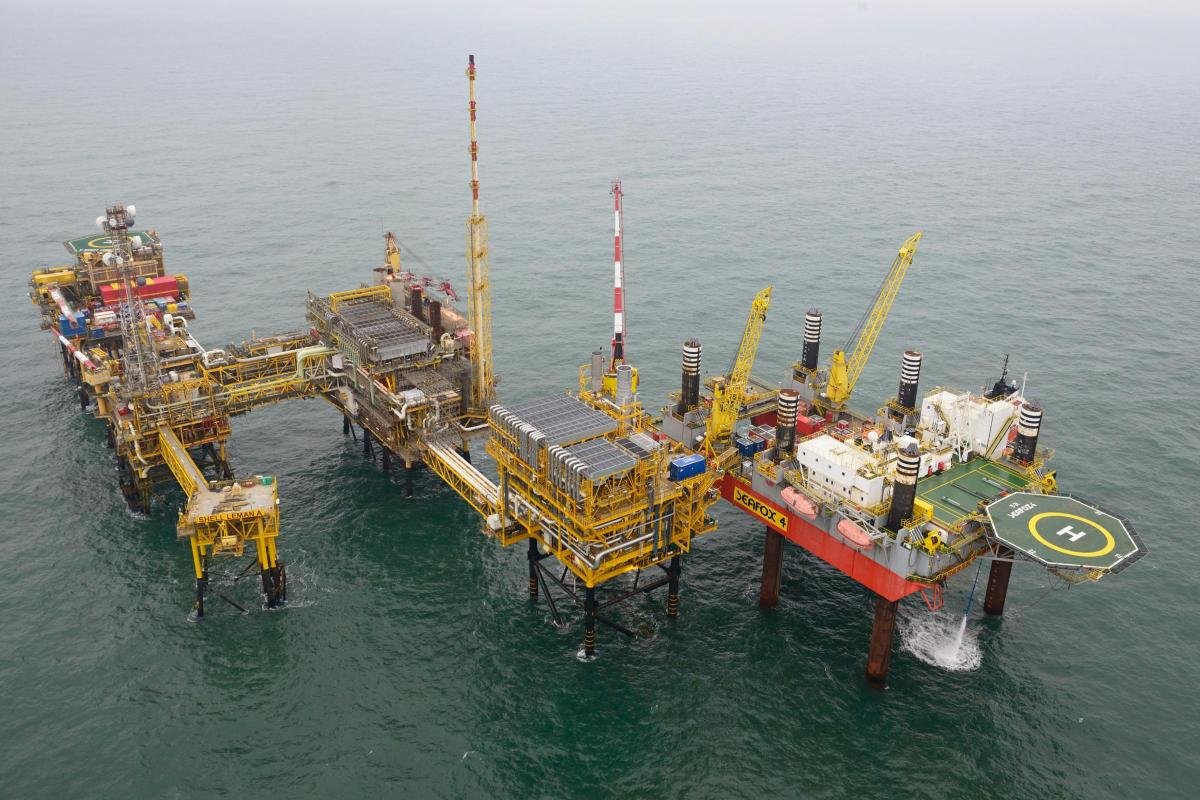
Bacton-based Perenco’s trail-blazing Poseidon CCS project completed one of the world’s biggest injection tests into depleted SNS gas fields with partners Carbon Catalyst and Harbour Energy and is poised for its commercial phase.
Bill Cattanach, head of supply chain at NSTA (Image: NSTA)
Chris Smith, CCS regulation and stakeholder lead at Perenco, said: “We’re at the point of securing our first anchor emitters. If we get the right emitters at the right time with the right volumes, we will be injecting into Poseidon Phase One in late 2029-early 2030.”
While other CCS projects build new pipelines, infrastructure and wells, Perenco reuses old infrastructure, existing skills and supply chain to “switch on little bits of the field bit by bit”.
“As the gas depletes and finishes in a part of the reservoir, we can bring on the CCS so we can leverage the benefits of the operation without needing a huge CCS offering on day one,” said Chris.
“We can slipstream in one or two small emitters and get going. Then you get investability, other people join the party, and we can open more and more of the Leman field because it is massive.
“If you were to draw the field over London, it stretches from London City airport to Heathrow and is deeper than the BT Tower but not quite as deep as the Shard and can be filled with between 800 and 900 million mega tons of CO2.”
This will have a huge impact on the UK and northwest Europe, making CCS “the biggest export opportunity we’ve had in decades,” Chris said.
“It is putting gas and pressure back in the reservoir that always held gas and pressure. There is something beautifully cyclic – the methane and hydrocarbons came out of that reservoir, and we are putting the waste product back in.”
Chris Smith.,CCS regulation and stakeholder lead at Perenco (Image: OEUK)
For Chris, a “really exciting” 2050 North Sea would have wind power providing green hydrogen, blue hydrogen from natural gas, and be self-sustained, ensuring that wherever gas is used, burned and sourced from, the carbon is captured.
“We will have a CO2 storage industry in the North Sea that is fully ramped up in 2050.”
Europe would see that the UK was open for business with pipelines and ships from northern Europe – the Rhine Valley, Belgium, northern France bringing CO2 to our stores.
“It will be a market that works, and you’re still maintaining this wonderful infrastructure: the ports, the heliports and great employment opportunities across the East of England as a result,” said Chris.
Paul Lafferty, CEO of Summit Energy Evolution Ltd, which is behind the plan for Bacton Energy Hub, said hydrogen production remained a strong alternative energy source, and should be a key part of the mix, but no longer the silver bullet it appeared five years ago.
“The challenges are cost and size and scale. Currently blue hydrogen costs between a third and a half of the cost of green hydrogen.
“When we started, we thought it would be a project where we probably blended hydrogen into the grid and reduced the emissions from the gas grid by having hydrogen linked into it. We’ve gone away from that because we don’t think that’s the right use of hydrogen.”
The bH2 Bacton Hydrogen Project is a low-carbon energy initiative aimed at transforming the Bacton Gas Terminal into a hub for both blue and green hydrogen production. Existing terminal infrastructure would be used to transport low-carbon hydrogen along an existing natural gas feeder and create a hydrogen hub in King’s Lynn.
Paul said it was hoped power stations around the area could use hydrogen to help decarbonisation without the need for the installation of expensive carbon capture facilities and complications with storage.
Paul Lafferty, CEO of Summit Energy Evolution Ltd (Image: SEEL)
“We’re 100% backed by Sumitomo Corporation in Tokyo. They really like the way the UK government is doing things when it comes to energy transition. They think that both in the CCS arena and in the hydrogen production arena, the UK leads everybody in respect of the government-backed business models.”
But last year, the government announced it was revising its hydrogen strategy and issuing a Hydrogen to Power business model this year to put the framework in place.
“Everyone is waiting for those two business models to come out,” said Paul. “We’re not going to start spending tens of thousands of pounds on this project to go into engineering and front end engineering design (FEED)until we’ve got some certainty that the government will support hydrogen.
“Unfortunately, it means that the Bacton project might slip slightly. We’re looking at a 2032 operations date, but it’ll probably slip into 33 or 34 and, for the first 15 years or so of hydrogen being a fuel used regularly in the UK, domestic use is where it will pretty much go.”
Focus on ecology
Geophysical specialist Jenni Nicholls of the EPI Group said assets and seabed areas may need sharing to accommodate new technology and future development.
“We’ll continue to see increased diversification, decommissioning of some of our infrastructure and possible reuse of existing infrastructure.
Jenni Nicholls, geophysical specialist at EPI Group (Image: Jenni Nicholls)
“Sharing licenses and seabed infrastructure will become a bigger issue. I think we may also see the investigation of floating energy islands, which are being developed in the Netherlands in land-scarce, water rich areas.”
Jenni also foresees more nature compensation for all sorts of industries, not just wind.
“We’ve seen Equinor involved in oyster restoration, the Kittiwake hotels by other developers,” she said. “I think we will see nature compensation included in the environmental impact assessments at the start of projects.
Nature compensation, such as the kittiwake hotels in Lowestoft, will become more commonplace (Image: Ørsted)
“In the last year, with the mix of energy growth, we have seen a conservative attitude in our approach to diversification, but we need to show confidence.
“The energy demand isn’t going anywhere, we need to have that security in our own backyard – many ways of generating energy and no reliance on any one energy form – but it must be done in a safe, efficient and ecologically sound way.”
Port infrastructure
Ports are central to the energy transition, with the Port of East Anglia at Great Yarmouth announcing plans to invest close to £100m into its site.
Richard Goffin, port director in the South East Division at Peel Ports Group, said its vision for the Port of East Anglia is to establish it as the leading UK hub for multi-energy operations.
Ports will need to evolve and expand to allow for multi-energy operations (Image: Peel Ports)
“The region of East Anglia has supported the southern North Sea for decades, and that heritage gives us a strong foundation. It is one of the reasons we repositioned our Great Yarmouth site to the Port of East Anglia last year – to reflect our group’s growth ambitions in the region and to signal the next phase of development for the port, which is a huge enabler of the UK’s energy transition.
“It’s clear the next 25 years will demand transformation, which is why we’ve already announced plans to invest more than £70m into the site. Our recent investment in a new deep-water terminal and expanded quay infrastructure is about futureproofing the port – ensuring we can accommodate larger vessels, more complex offshore wind construction and high-volume operations and maintenance activity.
Richard Goffin, port director in the South East Division at Peel Ports Group (Image: Peel Ports)
“RWE’s decision to establish its operations and maintenance base here is a major vote of confidence in the port and the region. Likewise, supporting installation activity for ScottishPower Renewables reflects our capability to deliver at scale.
“By 2050, I expect offshore wind to remain central to our business, but we are also planning for growth in emerging sectors including hydrogen, carbon capture and alternative fuels. A facility like the Port of East Anglia must continue to evolve, and that’s why our port group is investing in digitalisation, smarter logistics and automation to improve efficiency, reduce emissions and remain commercially attractive.”
This story is also published in Insight Energy magazine, covering the latest news from the UK’s energy sector. Read the latest edition here.