Piolito Salgan has driven a jeepney in Manila for 27 years, ferrying hundreds of riders every day in one of the Philippines’ iconic public utility vehicles. But with the war in Iran pushing fuel prices to record highs, he is thinking of giving up.
Diesel prices in the Philippines have more than doubled since the start of the war, surging to about 150 pesos ($2.49) per litre — one of the sharpest increases in Asia. That has eaten into the profits for jeepneys, which are the primary mode of public transport in one of the world’s most congested cities. Salgan’s earnings have dropped by nearly half, to 900 pesos a day.
“I will stop when [the diesel price] reaches 200 pesos . . . I will just help my wife sell bread and other food items outside our home,” Salgan, 47, told the FT, as he sat in rush-hour traffic in his jeepney, which is named Misis, Tagalog for “wife”.
Salgan is one of millions facing the brunt of the oil shock from the six-week war in Iran.
The Philippines is particularly vulnerable: the country depends almost entirely on the Middle East for oil and does not cap domestic prices or provide subsidies.


The Philippines has declared a national energy emergency, purchased Russian oil for the first time in five years and implemented a host of fuel-rationing measures that economists warn could weigh on an economy that was already slowing, with growth of just 4.4 per cent last year, its slowest pace since the Covid-19 pandemic.
Manila has also raised the prospect of energy co-operation with Beijing, with which it has been locked in an increasingly fractious maritime dispute in the South China Sea.
The energy crisis in the Philippines is emblematic of how many poorer, import-dependent countries are enduring the sharp end of the conflict in the Middle East half the world away after Iran blocked energy shipments through the Strait of Hormuz.
Tehran has said it would allow “safe passage” through the chokepoint during a two-week ceasefire agreed late on Tuesday, but uncertainty remains about whether the US and Iran will come to a lasting peace.
The crisis has also exposed how Manila’s failure to prepare for an emergency by diversifying its fuel sources and exploring for possible resources — in part due to the tensions with Beijing — has damaged its energy security.
“Despite past crises, our national government has not learnt its lesson,” said Gerry Arances, executive director of the Center for Energy, Ecology and Development. “Our energy security is very vulnerable to international shocks because of the fact that we are so dependent on imports.”

Under President Ferdinand Marcos Jr, Manila has taken an assertive stance against Beijing’s aggressive activity — accusing it of ramming Philippine vessels and firing water cannons — and has strengthened ties with the US.
But in late March, he told Bloomberg that he was open to energy co-operation with China in the disputed waters and that the Middle East conflict could provide the “impetus” to come to an agreement. He added that it was time for a “reset” with China.
Late last month, Manila said it had held “initial exchanges on potential oil and gas co-operation” with China for the first time in four years.
Following the talks, which also covered broader bilateral and territorial issues, Beijing called on the Philippines to take concrete actions to improve ties. Manila said both sides continued to make progress.
Sonny Africa, an economist and executive director of the Ibon Foundation, said the Philippines should build up domestic production, and supported starting talks with China. “In a lot of ways, the Philippines’ energy security strategies have been constrained by foreign policy choices,” he said.
But there is strong domestic opposition to any rapprochement. Rafaela David, president of the progressive opposition Akbayan party, said joint exploration with China was “an act of treachery”.
“By all means, our country must pursue energy security and find sustainable sources of energy, but never at the cost of sovereignty,” she said in a statement.

In addition to the dispute with China, an energy sector requirement for domestic ownership of about 60 per cent has kept foreign oil companies away. Local operators, facing financial constraints, have chosen to import oil rather than undertake capital-intensive exploration.
Some experts say the Philippines would benefit from more state involvement, suggesting the government own an oil refinery and take over a retail chain of petrol stations.
“While other countries are shielding consumers from volatile fuel prices, the Philippines’ deregulated oil industry exposes consumers to fluctuating oil costs,” said Arances at CEED. “Policy in the Philippines favours corporations over consumers.”
Others are calling for a complete nationalisation of the oil industry, which was privatised in the 1990s, or a state takeover of Petron, which runs the country’s only oil refinery and supplies more than 30 per cent of fuel.
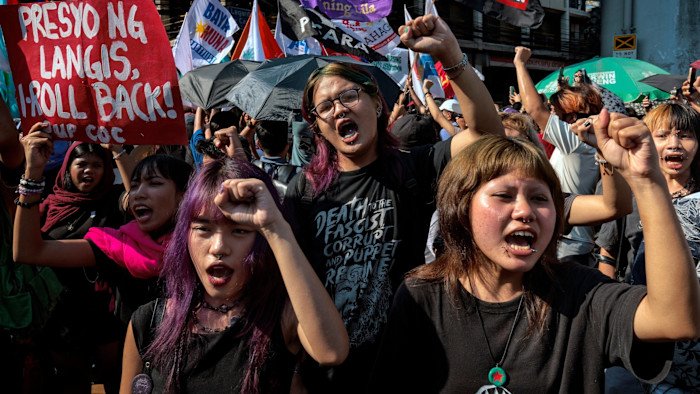
“That way, the government can have more control over prices, and fuel can be sold more cheaply to the public,” said Mody Floranda, the president of Piston, an association of public transport groups. Nearly 10 per cent of jeepney drivers have already stopped driving due to price increases, he said.
Floranda said Piston would organise “continuous nationwide protests” in April until the 1998 oil deregulation law — which removed government control over pricing and trade — was scrapped.

Ramon S Ang, chief executive of Petron and San Miguel Corp, its corporate owner, said late last month that he was open to nationalisation: “If the government believes that Petron under its ownership will better serve the Filipino people especially in times like these, we are ready to sit down and make it happen.”
“The Philippine government has to be more involved,” said Noel Baga, co-convener of the Center for Energy Research and Policy. “Should the fuel prices keep going up, the economy may soon come to a standstill.”
The Philippines was already struggling with rising unemployment and one of the highest poverty rates in south-east Asia.
“We’re not coming from a good place. Things were bad enough to begin with before the crisis,” said Ibon Foundation’s Africa. “We are on the edge of a very bad cost of living crisis.”
Across the country, the energy crunch is already being felt. During the Easter holidays, when many Filipinos return to their home provinces, many this year opted to use public transport instead of driving, or not go at all.
Restaurants are shortening hours, and one food delivery driver said he had switched out meat from his diet for cheaper vegetables.
Salgan has already cut back allowances to his children and scrapped weekly family dinner outings. But it might not be enough.
“I’m hoping to get more cash assistance from the government,” he said. “The government should control the fuel price as it keeps increasing.”
Data visualisation by Haohsiang Ko in Hong Kong. Additional reporting by Guill Ramos in Manila