A Greek case-study aimed at implementing the EU’s energy efficiency first principle offers a blueprint for how member states could meet their heating and cooling needs while still delivering on their obligations for 2050 targets.
The pilot study’s methodology centred on the Energy Efficiency First (EE1st) principle, a framework enshrined in the EU’s recast Energy Efficiency Directive (2023/1791) that requires policymakers to treat energy efficiency and demand-side measures as equal alternatives to supply-side investments.
The pilot is part of the ENEFIRST Plus project, which is also running case studies in Croatia, Italy, and Poland.
The Greek study sought to create heating and cooling strategies along with investment plans at the different administrative levels through the implementation of the EE1st principle. The Greek analysis employed two distinct cost-benefit analyses (CBAs) – a financial CBA reflecting private investors’ perspectives and an economic CBA capturing society’s broader interests, including environmental and social welfare impacts.
The pilot’s findings highlight the installation of aerothermal heat pumps for the coverage of the heating demand has the highest performance compared to the interventions in the building envelope and other alternative systems. Combining aerothermal heat pumps with interventions in the building envelope and PV systems also lead to slightly similar results.
This suggests that upgrading heating equipment alone can yield greater societal benefits than comprehensive renovations, with the two figures below showing that configurations with a ratio higher than one mean they offer a net benefit.
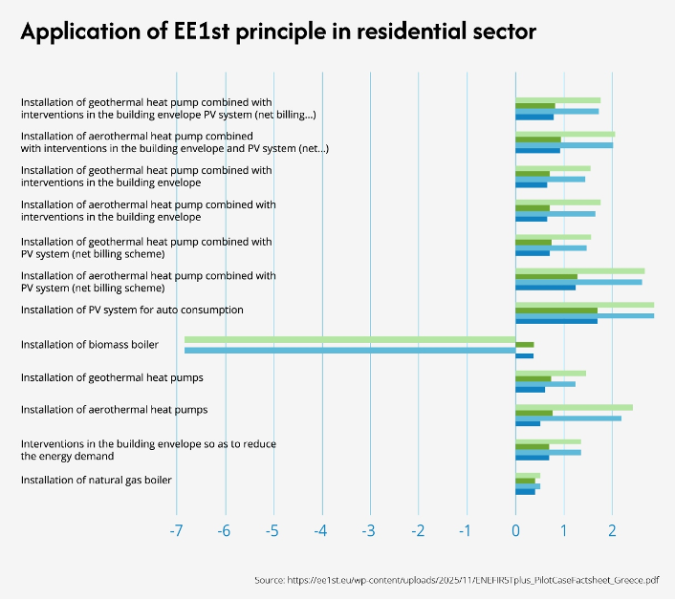
The pilot’s big losers were the biomass and natural gas boilers. In both the residential and tertiary sectors, biomass was the only technology to produce a negative result, suggesting that its cost-effectiveness lags far behind modern electrification and solar options.

For Greek policymakers, the success of these measures could be critical to meeting national energy efficiency targets.
The residential sector is the country’s second-largest energy consumer, accounting for 28% of final energy use in 2022. However, the sector has seen a 1.5% improvement per year in energy efficiency since 2000.
Between 2000 and 2022, total energy savings in the residential sector reached 1.52 million tonnes of oil equivalent (Mtoe). However, this progress was largely offset by a rise in the number of occupied dwellings, larger home sizes, and a 14% increase in the ownership of electrical appliances.
Space heating remains the sector’s primary challenge, representing 58% of total household energy consumption. However, notable efficiency improvements have been achieved since 2000.
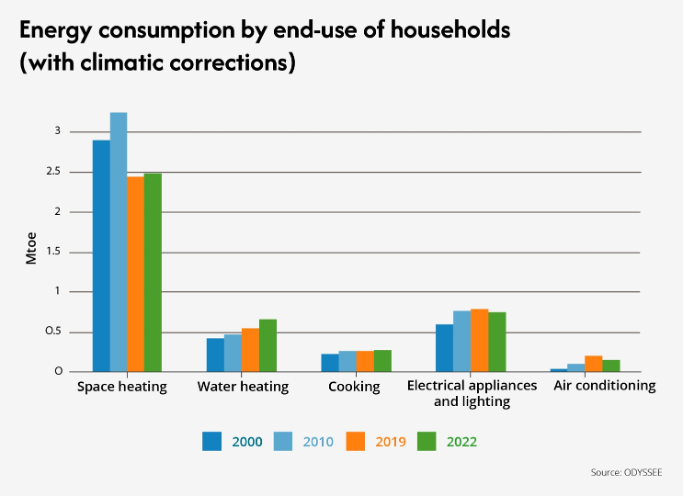
The data compiled by the Odyssee-Mure project reveals a nearly 30% reduction in space heating consumption per household between 2000 and 2022, alongside modest increases in electrical appliance usage and emerging air conditioning needs.
The ambitious road to 2050
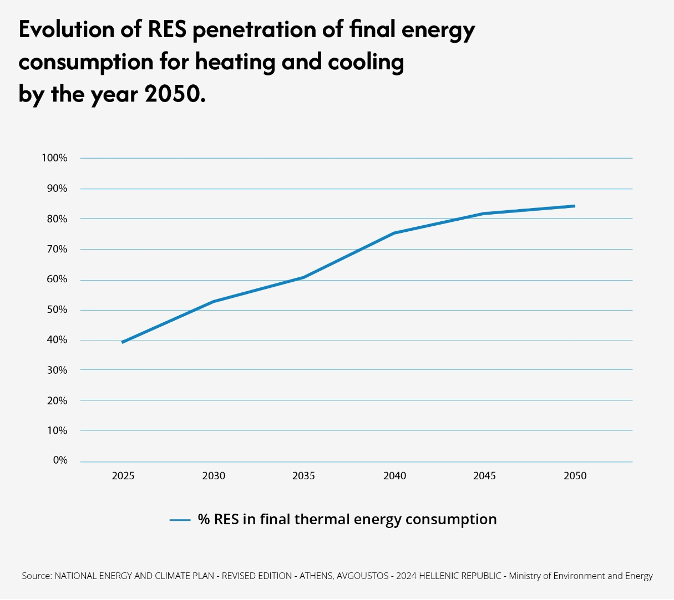
Greece’s National Energy and Climate Plan (NECP) aims for a radical shift in heating and cooling, with renewable energy sources (RES) penetration projected to rise from roughly 40% today to over 80% by 2050.
Greece’s shifting energy landscape
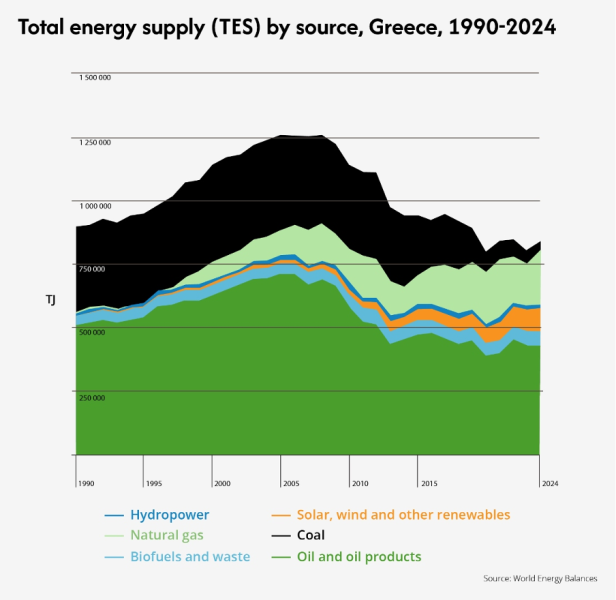
This success could become part of a wider national trend, as Greece’s total energy supply (TES) fell by 25% between 2000 and 2022, driven by the collapse of coal use and the rapid penetration of renewables and natural gas in the power sector.
The ENEFIRST Plus findings provide quantitative justification for this acceleration, that the societal benefits of heat pump and efficiency-oriented strategies exceed conventional alternatives, creating a strong case for the pursuit of EE1st principles and policies.
“In practice, the EE1st principle can reorder investment priorities, guiding households, businesses, and policymakers toward solutions that maximise long-term societal value rather than short-term financial returns,” the Greek Ministry’s energy efficiency head, Vicky Sita, said.
Infographics by Dominica Korczynska
[BM]