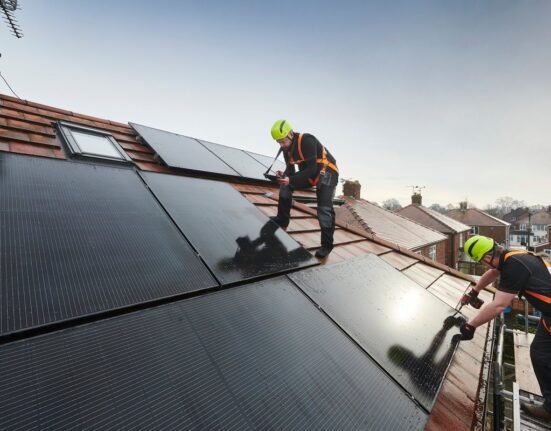
Nations worldwide are racing against time to meet their individual climate targets, as well as the global goal of achieving carbon neutrality by 2050. While many have started strong by investing in and transitioning to renewable energy, such as solar power, they are not foolproof, and Japan can attest to this. Thankfully, Japan’s future in next-generation panels has emerged, bidding goodbye to traditional photovoltaics and all of their associated problems in the country. Its potential is out of this world.
Japan is saying goodbye to traditional photovoltaics, and this is why
Japan has been dedicated to decreasing its greenhouse gas emissions by investing in and expanding its solar capacity. Unfortunately, all good things come to an end. Solar power firms could sell power to power companies at higher fees due to a special feed-in tariff system, and municipalities assisted the uptake of solar panels with their own grants, but according to Nippon, problems began to appear.
Problems of traditional photovoltaics
- Increased concerns by locals due to solar site placements caused friction
- Solar facilities on sloping land have been hit with heavy rain and landslide damage
- Increased complaints of blinding light reflected from the panels
- Limited space for growth due to Japan’s mountainous landscape
The Japanese have not given up hope and still plan on achieving the global mission, as well as its intermediate climate target to increase solar capacity to between 14% and 16% by 2030. They plan on achieving this climate target with next-generation panels comprising a thin and flexible film.
The stone that emerges as the future of energy
Japan believes its future lies in a stone called perovskite. According to the American Chemical Society, it was originally discovered as a natural mineral composed of calcium titanate (CaTiO₃). It comprises a crystal structure called the “perovskite structure,” which can now be applied to synthesized compounds. Japan has been testing this for a long time, and it has had shocking results.
According to Nippon, Japan’s next-generation photovoltaic cells will comprise a power-generating layer consisting of a compound of the perovskite structure. These perovskite cells will be very thin and flexible, and will be nearly a tenth of the weight of traditional silicon solar panels. Both sides of the photovoltaic cells will be covered with protective material.
This type of photovoltaic is extremely beneficial
Perovskite has many benefits, including in the context of radiation. When it is applied to photovoltaic cells, it is to assist the cells to withstand harsh environments, including space radiation. According to Nature, space radiation is a form of ionizing radiation that impacts both human health and the environment. These ultra-thin perovskite films also have great potential in future applications in Japan.
Potential future applications of perovskite photovoltaics in Japan
- Potential applications on the roofs of factories and warehouses, increasing sunlight exposure
- Sekisui Chemical is testing its flexibility by attaching them to curved surfaces at the Tokyo International Cruise Terminal
- A 43-story skyscraper in Uchisaiwaichō in Hibiya, Tokyo, will have thin-film solar cells on its outer walls and will produce nearly 1,000 kW once completed in 2028
- Potential residential applications by adding them to the walls
- Regions with heavy snowfall will benefit from wall-mounted panels
Traditional silicon solar panels have had their glory, but there is a new kid on the block, and it seems as if perovskite photovoltaics is here to stay. At least in Japan, that is. Sekisui Chemical has targeted commercialization of the next-generation cells in 2025, and according to Nippon, it is currently kept busy with responses to a continuous stream of inquiries from companies in different industries and local governments. Soon, buildings all over Japan could be covered in facades comprising perovskite cells.