On Thursday, Glenwood Springs City Council unanimously approved the final draft of its 2024 Energy and Climate Action Plan, an updated version of a 2009 plan by the same name.
The item was presented to city council by Blue Strike Environmental and nonprofit Clean Energy Economy for the Region (CLEER), two consultancies hired by the city of Glenwood Springs to help with the development of the plan.
“The core element of the updated (Energy and Climate Action Plan) is to present strategies for reducing emissions and energy use,” Blue Strike Project Manager Rich Swanson said during the meeting.
The city began working on the updated plan roughly 16 months ago, which focuses exclusively on city facilities and operations. They formed a team made up of the two consultants and a local steering committee, including residents and Glenwood Springs Citizens’ Alliance Vice President Heather McGregor.
“I also helped write the original climate action plan back in 2009, so it’s (been) really great to work with a professional team this time,” McGregor said during the meeting. “The staff is just so enthused about this program, they seem to be so engaged and positive about it … they now stand ready to do the heavy lifting.”
The new plan expands on existing efforts undergone by the city since 2009, such as its numerous actions to reduce greenhouse gas emissions in the community.
Three of the project goals include creating “an ambitious and impactful plan for reducing emissions across city operations,” identifying long- and short-term cost-saving opportunities for the city and aligning the updated plan with existing plans at the regional and state levels.
The city has already achieved a significant reduction in emissions from its purchase of 100% renewable electricity through its contract with the Municipal Energy Agency of Nebraska in 2019. The decision saved city operations nearly 2,100 metric tons of carbon dioxide equivalent annually.
The city has a target to reduce emissions from municipal operations by 60% from now to 2035 and to achieve net-zero municipal emissions by 2050 (excluding landfill emissions), in accordance with scientific guidelines and the objectives of the United Nations’ Paris Agreement, a legally binding treaty that aims to reduce greenhouse gas emissions to limit global temperature increases.
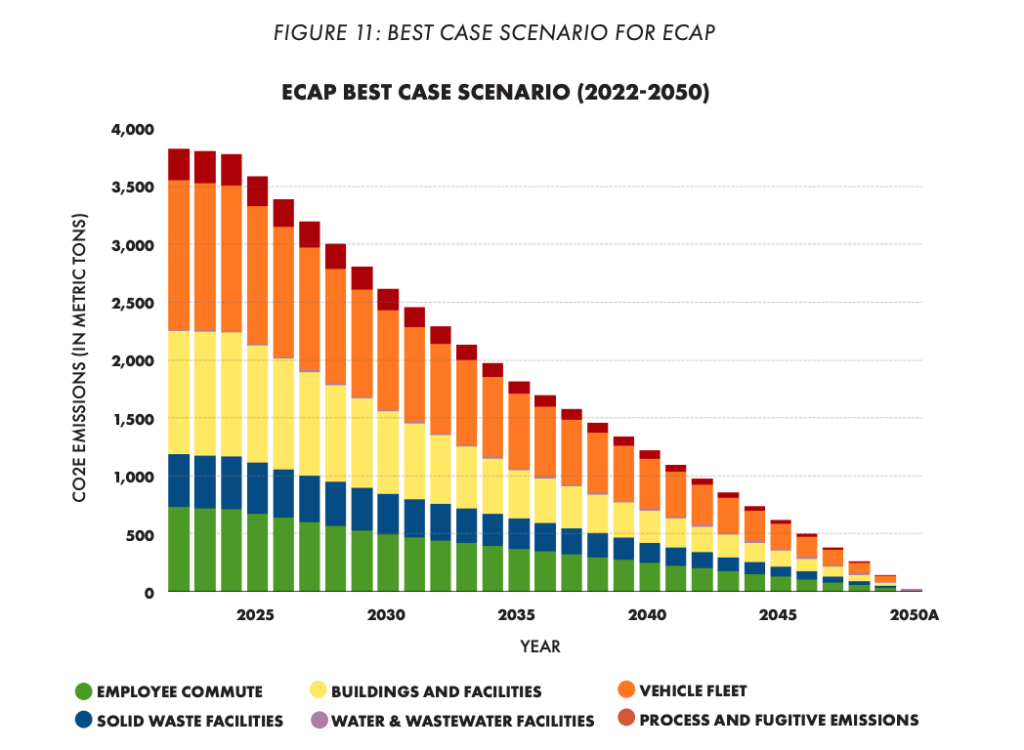
for the city of Glenwood Springs’ municipal operations emissions through 2050. Landfilled mixed solid waste methane emissions are not included in the model.
In order to map out this reduction goal, the Energy and Climate Action Plan provided a strategic roadmap with five focus areas: Energy, buildings, waste management, transportation, and parks & natural systems.
Transportation strategies could involve incentivizing city employees to reduce commute emissions through the addition of bike racks at city facilities and e-bike rebate incentive programs, or expanding awareness of RFTA discounts. On the other hand, building strategies might look like actively monitoring city building energy use through making sure buildings are fully shut down after-hours, and decreasing natural gas use at municipal buildings through regular equipment maintenance.
The implementation plan for each of these strategies identifies which of the city’s departments will take lead on the implementation and a recommended start and completion year.
Blue Strike Project Assistant Andrea Green said the city plans to conduct updates evaluating their progress at a minimum of every two years in order to help “make the Glenwood Springs ECAP a living document.”
The South Canyon landfill makes up close to 90% of the city’s emissions. Methane emissions from the landfill “is the most significant emission source” according to the ECAP report because Methane’s global warming potential is 28 times greater than that of carbon dioxide.
Swanson explained that Blue Strike left landfill numbers out of their presentation to council because the state is already working on some guidance and programs that could be beneficial to landfill management, and because the landfill is currently undergoing methane measurements and other studies that will determine more accurate emission numbers by 2026 (whereas Blue Strike had to use calculated emission numbers in their plan inventory).
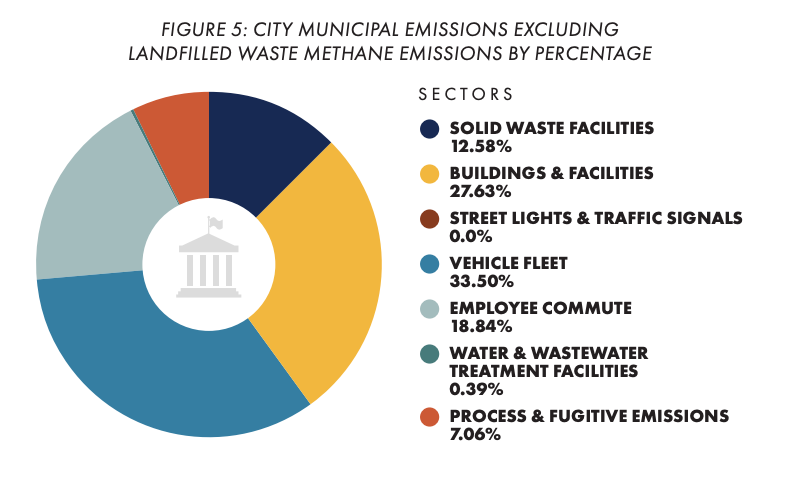
When taking landfilled waste methane emissions into account, city municipal emission sources are divided into the following sectors:
- Solid waste facilities (90%)
- Buildings and facilities (3.2%)
- Street lights and traffic signals (0%)
- Vehicle fleet (3.8%)
- Employee commute (2.1%)
- Water and wastewater treatment facilities (0%)
- Process and fugitive emissions (0.8%)
The city hopes that the impacts of the Energy and Climate Action Plan, however, are not strictly limited to municipal energy use.
“Through this updated (plan), the City is setting a robust set of goals, targets, and strategies that will guide City leaders in actions and policies that will reduce greenhouse gas (GHG) emissions within municipal operations. This update will also inspire businesses, residents, and visitors to reduce their carbon footprints,” a Thursday staff report states.
Achieving net-zero municipal emissions by 2050 is easier said than done, and some residents have identified a few obstacles.
“A quarter of the emissions are from employee commuting, and there’s no discussion of our land use patterns in this report that I could tell,” resident John Houghton said during public comment. “I think the easiest vehicle trip to eliminate is one that isn’t taken. If employees can live where they work, that 25% (reduction goal) shrinks pretty dramatically. I understand it’s a can of works, but no mention of land use patterns, I think, is a glaring omission.”
The final report went through several review periods and is available in its entirety at cogs.us/Archive.aspx?AMID=42.
“This is really important. We need to do our part to make a difference with climate change, and I think that this plan, while it has a few flaws and shortcomings, we can work on that.” McGregor said.
“Thank you all so much. This is not even for us — this is for our children, this is for the future of our community,” Mayor Ingrid Wussow said.