The broker is pairing its enthusiast-car know-how with the insurer’s high-net-worth underwriting muscle – and launching fresh classic car and motorbike policies along the way
If you own a 1960s E-Type, a weekend Porsche and a garage-queen Ferrari, you have probably discovered that mainstream motor insurance was not designed with you in mind. Lockton thinks it has a fix.
The independent broker has struck a deal with Chubb to bring its specialist vehicle offering under one roof in the UK, covering everything from pre-war classics and 1990s ‘young-timers’ to modern supercars and full-blown private collections.
The first fruit of the tie-up is a revamped version of Lockton Performance’s existing Specialist scheme, which is organised around individual marques and owners’ clubs, alongside brand new products for classic car and classic motorcycle owners.
Lockton’s pitch rests on a simple complaint: standard motor products tend to be too broad-brush, and too scattered across different providers, for people whose cars are worth more as heirlooms than as transport. By pairing its specialist range with Chubb’s underwriting, the broker says it can offer that market a single destination.
Lockton Performance already acts for owners’ clubs representing some of the most recognisable names in motoring – Aston Martin, Ferrari, Porsche, Lamborghini and Maserati among them – and Chubb will now work alongside the broker to beef up what those members are offered.
Simon Ambler, partner and head of private clients and Lockton Performance, made no secret of how much the firm is staking on the relationship. The calibre of the carrier behind a niche proposition “really matters”, he said, adding that combining Chubb’s underwriting with Lockton’s ties to the enthusiast community could “have a significant impact on our business”.
For Chubb, the deal is a natural extension of its personal risk services franchise, which has long courted wealthy clients with art, jewellery and multiple homes to protect. Stephen Vaughan, who heads that division across EMEA, said the insurer’s classic and collector cover was built around “rarity, value and preservation” – the three things that keep serious collectors up at night.
Read next: Acrisure launches private client service for UK high-net-worth market
The new classic car and motorcycle policies are aimed squarely at the grassroots end of the hobby as well as the concours crowd. Phil Beck, Lockton Performance’s specialist vehicle consultant and show manager, who has spent more than two decades around the classic scene, said owners often have years of personal investment – emotional as well as financial – tied up in their vehicles, and the products were designed with that bond in mind.
It is also not the first time the two firms have shared a garage. In January, Lockton unveiled a global tie-up with auction house RM Sotheby’s for collectors, with Chubb providing the underwriting – suggesting the latest UK move is part of a broader, deliberate push into the collector market rather than a one-off.
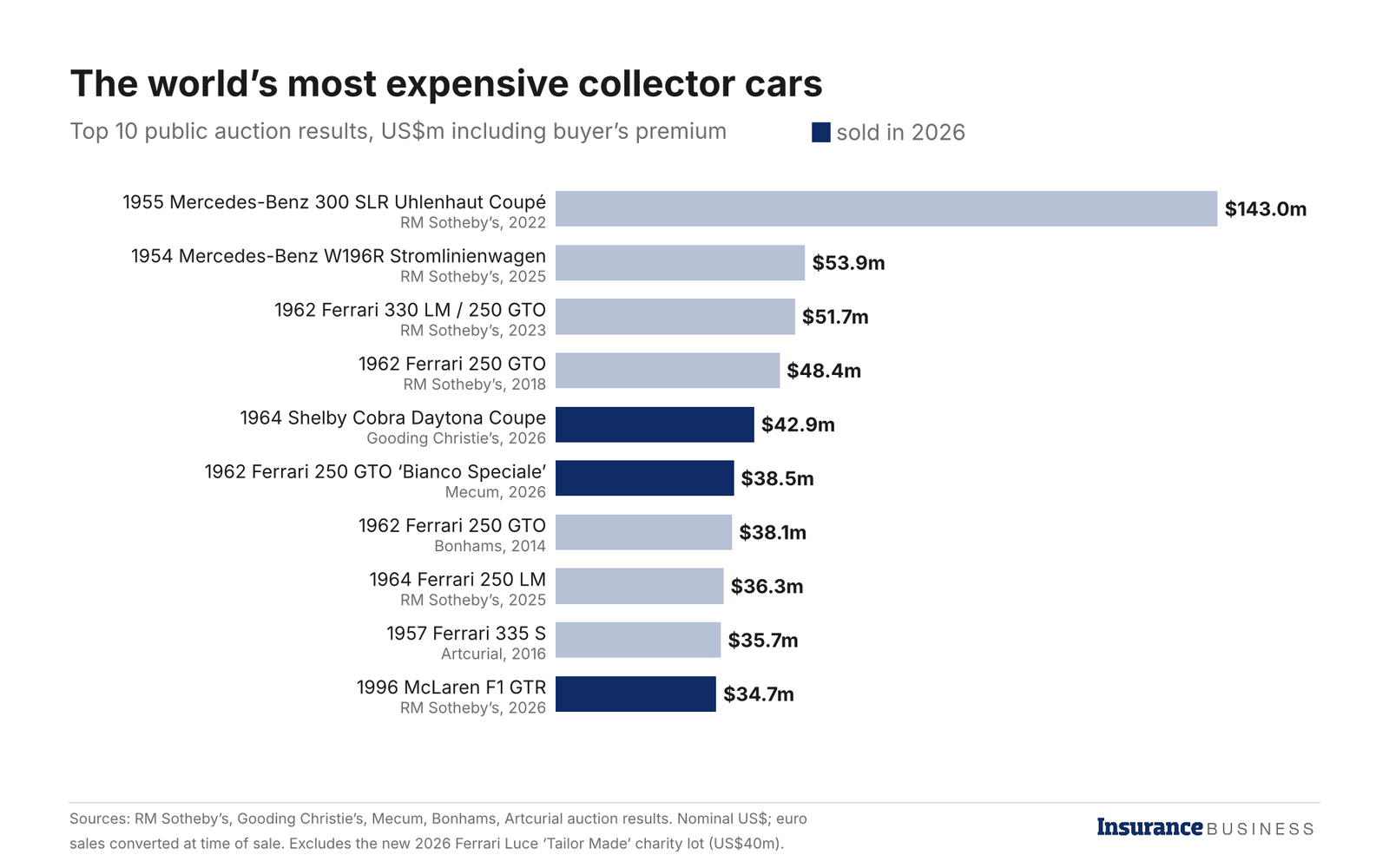
The stakes in that world are eye-watering. The auction record still belongs to a 1955 Mercedes-Benz 300 SLR Uhlenhaut Coupé, which RM Sotheby’s sold for €135m (about US$143m) in 2022, and 2026 alone has produced three classic-car sales above US$34m – led by a 1964 Shelby Cobra Daytona Coupe that fetched US$42.9m at Pebble Beach in August. When a single car can be worth more than a London street, the quality of the paper behind it is not an abstract question.
A £7.3bn hobby with a greying problem
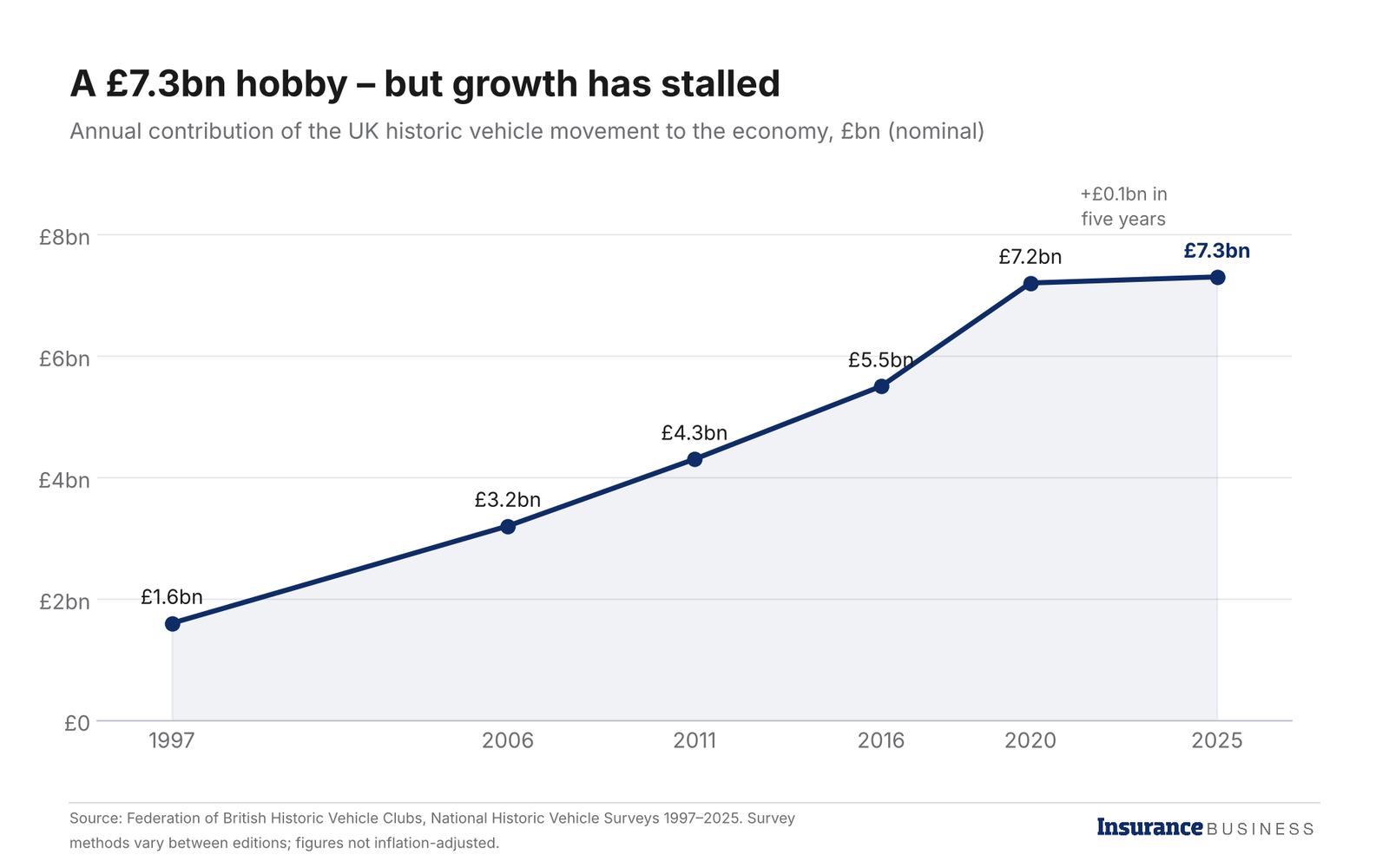
According to the Federation of British Historic Vehicle Clubs’ 2025 National Historic Vehicle Survey, Britain’s historic vehicle movement now contributes a record £7.3bn a year to the economy, with 1,934,178 historic vehicles on the DVLA’s books and an estimated 690,777 owners. Those owners spend an average of £4,567 a year keeping their pride and joy on the road. The headline figure has more than quadrupled since the federation first ran the numbers in 1997, although growth has all but stalled since 2020.
What they don’t do is drive them much. The same survey puts average annual use at just 837 miles per vehicle – about 0.2% of all UK road mileage – which helps explain why underwriters tend to view well-kept classics as a very different risk from the family hatchback.
But there is a demographic sting in the tail. The average historic vehicle owner is now 66, and the federation has been increasingly vocal about the need to bring younger enthusiasts into the fold. Its answer is a new ‘Youngtimer’ category for vehicles aged 20 to 30 years – the same segment Lockton and Chubb have explicitly name-checked. For insurers, that cohort is arguably where tomorrow’s premium pool lies.
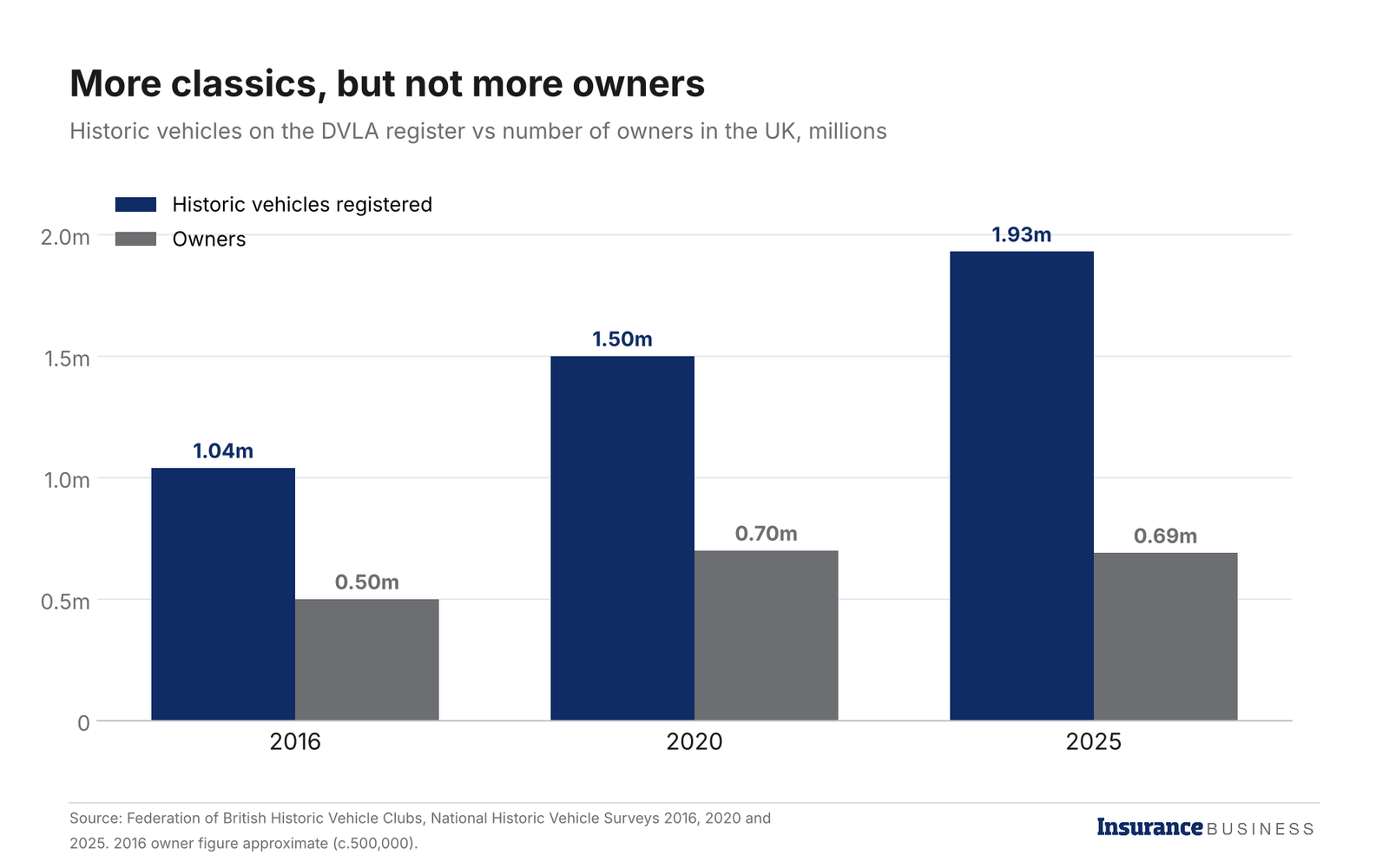
The number of historic vehicles on the register has almost doubled since 2016, but the federation’s 2020 survey put owners at about 700,000 – roughly where they sit today. In other words, existing enthusiasts are adding to their garages faster than new ones are arriving. For insurers, that points to fewer but larger multi-vehicle portfolios per client, which is precisely the collection business Chubb is built to write.
Read next: Lockton launches global Data Centres & Digital Infrastructure Practice
Policy is also nudging more cars into classic territory each year. Under the government’s rolling historic vehicle rules, cars built before 1 January 1986 became eligible for vehicle tax exemption from 1 April 2026, and vehicles built or first registered more than 40 years ago can also escape the annual MOT, provided they have not been substantially altered.
Meanwhile, the wider private client market is getting crowded. Brokers and consolidators have been piling into the UK’s high-net-worth segment, where the number of wealthy individuals is estimated to have risen 7.5% to 474,000 in 2025, according to GlobalData figures – a trend that prompted Acrisure to launch a dedicated Private Office earlier this year.
Read next: Why high-net-worth clients face a growing cyber threat
What it means for the market
For Lockton, this is another niche bet from a firm that has been on a tear. The Kansas City-based broker reported revenue of roughly US$4.5bn for fiscal 2026, its sixth straight year of double-digit organic growth, and has spent the year rolling out specialist practices from data centres to collector cars.
The bigger question for rival specialist motor brokers is whether clubs and collectors will see value in consolidating their cover with one broker-insurer pairing. Club schemes are sticky, relationship-driven business, and the established players will not give them up lightly.
Rising values also raise the spectre of underinsurance. When prices for sought-after models can move sharply between renewals, agreed-value cover and regular revaluations become as important as the premium – and that is exactly where a specialist broker with club connections and auction-market knowledge can earn its fee.
Still, a household-name carrier, a roster of marque clubs and a product range stretching from a 1970s motorbike to a seven-figure collection is a strong hand. If the youngtimer generation does turn into the next wave of classic owners, Lockton and Chubb have made sure they are already in the paddock waiting for them.
Read next: How social media is reshaping high net worth underwriting