Hello and welcome to Energy Source, coming to you from New York where the Trump administration is fighting an economic war with Iran and one of its closest allies, Canada.
“Canada will be treated like a State no longer!” Donald Trump wrote on social media. “On Trade, and in other ways, also, they are among the worst Nations in the World to deal with. They feel entitled, and yet, WE DON’T NEED CANADA, THEY NEED US!”.
The US president said he would increase tariffs on Canadian cars and automotive parts to 50 per cent following the collapse of trade talks at the weekend. Mark Carney, Canada’s prime minister, responded by saying Washington was now “at war” with Ottawa and promised retaliation.
Canada is a big exporter of oil, electricity, uranium, critical minerals and fertiliser to the US, a point highlighted by Doug Ford, premier of Ontario, on Monday when he suggested Canada should “triple” the cost of oil exports to the US.
Energy products were exempted from the previous round of tit-for-tat tariffs, mainly as it would be self-defeating since Canadian oil producers have few alternative suppliers.
In other news, after threatening to launch “the single greatest financial offensive ever marshalled against an adversary” against Iran at the weekend, US Treasury secretary Scott Bessent’s announcement yesterday of the expansion of secondary sanctions on Iran was more timid than some analysts had expected.
Bessent offered no deadline for Tehran’s main trading partners — including China, Turkey and the United Arab Emirates — to comply before Washington imposed measures he said could “blow up” the world’s financial system.
Our main item today takes a look at the threat to energy systems from extreme weather events and asks whether policymakers, businesses and the media need to focus more attention on how climate change will impact energy security.
Thanks for reading, Jamie
How extreme weather threatens energy security
It has been an eventful summer in the energy world due to the war in Iran, which has disrupted flows of oil and gas, causing a price shock for global consumers.
But as policymakers and businesses boost energy security by building pipelines to bypass the Strait of Hormuz or strengthening cyber security to prevent hackers taking power stations offline, they should not forget about the threat posed by climate change.
The human-caused rise in greenhouse gases has increased the frequency and intensity of extreme weather events, according to the UN’s Intergovernmental Panel on Climate Change. And when this combines with naturally occurring phenomena, such as an El Niño weather pattern — which alters ocean currents in the Pacific Ocean and global rainfall and temperatures — the results can be devastating.
Already, surging temperatures this summer have played a role in disrupted shipping, fuelling record-breaking wildfires that knocked out power supplies to tens of thousands of people and creating conditions for swarms of jellyfish that force nuclear power plants to temporarily shut down.
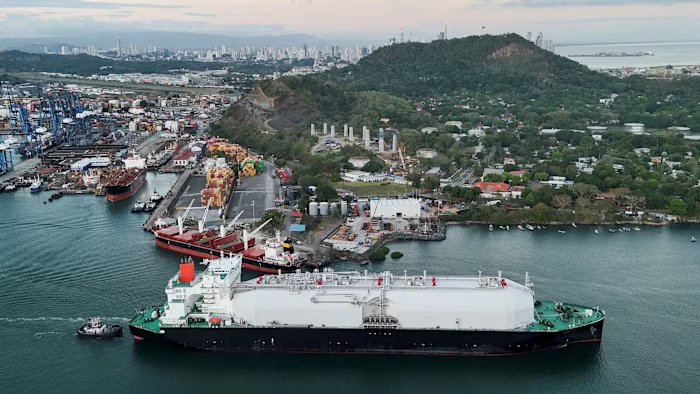
One of the countries in the frontline of the climate challenge is Panama, where the canal is one of the world’s major trade routes. Last week the Panama Canal Authority said it would limit the number of daily ship transits from September because of a lack of rainfall and the threat posed by what some climate scientists have called a “Super El Niño”, due to its unprecedented intensity.
The canal, which connects the Atlantic and Pacific oceans and carries more than 3 per cent of global maritime trade, will allow 32 vessels to pass daily from September 15, compared with the current 36. This follows the enactment of restrictions last month that forced ships to carry less cargo in order to contend with lower water levels.
The canal relies on fresh water to operate its locks and has had less rain than normal.
Not surprisingly, the cost of passage has skyrocketed. Daily auctions for a transit slot in early August through the canal’s commonly used locks have averaged about $1.1mn so far this month, more than 16 times the average price for the same period last year. One empty gas supertanker paid a staggering $4.6mn to pass through the canal last week.
The extra transit costs inevitably flow through to end consumers, as shipping companies add surcharges for their customers. Earlier this month shipping group MSC said it would raise its Panama Canal surcharge to $376 for 45-foot containers from September.
As my FT colleague Alice Hancock recently wrote, this is not just a Latin American problem. Low water levels caused by droughts in Europe have caused water levels in the Rhine, a critical river serving Germany’s heavy industry, to fall perilously low. Freight rates for barges up the Rhine to Cologne, Duisburg, Frankfurt and Karlsruhe have reached their highest levels since 2012.
Rising water temperatures also pose a threat to nuclear power plants, many of which rely on large amounts of fresh water from rivers or seawater to cool their reactors. France’s EDF has temporarily shut down several reactors this summer as a precaution when water temperatures rose above regulatory limits that are designed to safeguard wildlife and vegetation.
This week, global average sea surface temperatures hit a record level of 21.1C, according to the experts at the Copernicus Climate Change Service. This is also posing problems for the nuclear industry because it helps create the conditions for massive jellyfish plumes that can shut down coastal reactors.
Three nuclear reactors at France’s Gravelines nuclear plant were taken offline in early August as a precaution when jellyfish clogged pumping systems that are used to cool them. The incident occurred exactly a year after the same plant was forced to shut down due to a jellyfish plume, prompting authorities to deploy fishing vessels and cameras to try to prevent a recurrence.
The economic damage caused by weather and climate-related extremes cost €822bn in the EU between 1980 and 2024, according to the European Environment Agency. A quarter of those losses came in the past four years.
Despite mounting evidence of threats posed by severe weather, policymakers, business and media, particularly in the US, appear less focused on efforts to mitigate or adapt to climate change than they are on tackling conflict-related threats to energy systems, warn scientists.
“There’s no question that here-and-now crises like the Russia-Ukraine/Iran wars almost always get more media coverage than a longer-term, if larger and more pervasive threat, like climate change. Part of the problem is that climate change is in fact an immediate and acute threat, but it never gets to be framed this way,” says Michael Mann, professor in the Department of Earth and Environmental Science at the University of Pennsylvania.
He says the Russia-Ukraine and Iran wars are symptoms of the world’s problematic reliance on fossil fuels and are the most compelling arguments for rapidly transitioning away from coal, oil and gas.
The Trump administration is continuing to double down on oil and gas, despite catastrophic wildfires in Hawaii and California. But policymakers in Europe and some parts of Asia are making encouraging announcements that suggest the Iran war could act as a catalyst for a faster energy transition.
In April, Brussels published AccelerateEU, a policy blueprint containing more than 40 actions to accelerate the shift to clean and homegrown energy. A month later policymakers from Europe and south-east Asia met in the Philippines, where they pledged to co-operate on the green transition.
“The events of this past summer have driven home the point that the [European] continent’s energy security cannot be achieved simply by doubling down on fossil-fuel production or fossil-fuel access,” says Mark Brownstein, senior vice-president of energy at Environmental Defense Fund, an environmental group.
But he says the business community needs to remind itself about the threat posed by climate change, having backtracked on their commitments as energy demand has surged due to the growth of AI.
“Between the oil and gas industry and the hyperscalers you are increasingly hearing the cry that we have no choice but to produce more and use more fossil fuels . . . but this is not a path to energy security or economic prosperity.”
Power Points
-
Trump’s administration is teaming up with a British company to help it build a fleet of nuclear-powered merchant vessels to challenge China’s shipbuilding dominance.
-
Iran has threatened 46 ships with fines or confiscation in a Strait of Hormuz transit crackdown, claiming vessels violated protocols for travelling across the waterway.
-
Shell has drawn interest from ExxonMobil and LyondellBasell for its multibillion-dollar US chemicals assets, as the UK oil major looks to offload underperforming parts of its operations.
Energy Source is written by Jamie Smyth, Martha Muir, Alexandra White, Rachel Millard, Malcolm Moore, Ryohtaroh Satoh and Stephanie Findlay with support from the FT’s global team of reporters. It is edited by Benjamin Wilhelm. Reach us at [email protected] and follow us on X at @FTEnergy. Catch up on past editions of the newsletter here.
Recommended newsletters for you
Moral Money — Our unmissable newsletter on socially responsible business, sustainable finance and more. Sign up here
The Climate Graphic: Explained — Understanding the most important climate data of the week. Sign up here