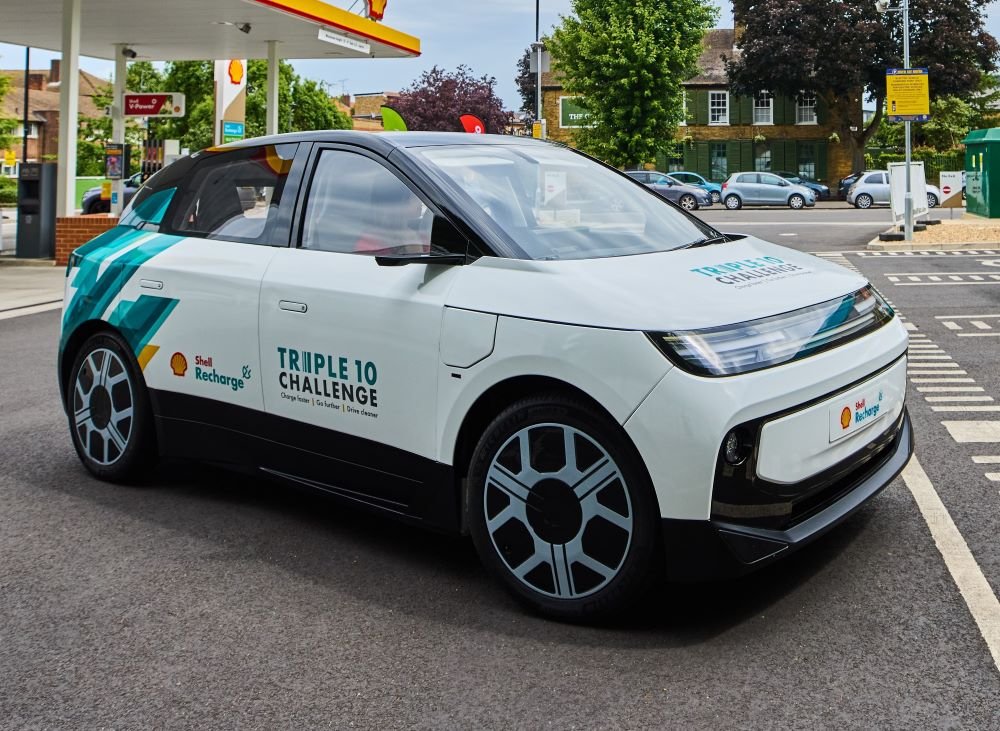
Shell has unveiled a new concept car with technology it claims can improve EV capabilities without needing to resort to ever-bigger batteries.
The Triple 10 Challenge concept is said to have been designed to meet three goals – a charging time of less than 10 minutes, 10km/kWh efficiency, and a 10-tonne CO2e lifecycle footprint.
Shell says this performance can be achieved thanks to its dielectric fluid technology, which it says, unlike traditional cooling systems, allows for direct immersion cooling of the battery and indirect cooling of powertrain components.
Ensure you always get Fleet News insight. Make us a preferred source of news on Google.
Shell says the Triple 10 Challenge concept’s battery, which has a 32kWh usable capacity, can be charged from 10-80% in nine minutes and 54 seconds without compromising thermal stability or lifespan. It adds that this can be achieved using a standard 175kW public charger, rather than a less common ultra-rapid charger, and represents an improvement of almost 90% compared with typical current EVs in terms of range added per minute charging.
Efficiency and emissions goals met
It says that 10km/kWh efficiency is achieved via a smaller, more efficient battery system, claiming a more than 30% efficiency improvement compared with many current-generation EVs.
Shell also says that its lifecycle carbon footprint goal is met via lightweight design, optimized battery capacity, low-carbon and recyclable materials, and 100% renewable electricity for vehicle charging.
In addition, Shell says the concept’s improvements contribute to a battery cost reduction of around 25% compared with a conventional EV.
Partners on the project include RML, Empel Systems and Horiba Mira.
Cara Tredget, VP for mobility and lubricants technology at Shell, said: “With the Triple 10 Challenge concept car, we have unlocked the potential for faster charging, lighter systems and improved lifecycle efficiency by using our advanced thermal fluids.
“Together with our co-engineering partners, we are proud to develop alternative options for sustainable EV development leveraging technologies that are available today and are scalable to support customers into the future.”