
Roughly 3,500 athletes from over 90 National Olympic Committees and 55 National Paralympic Committees competed in the Olympic and Paralympic Winter Games Milano Cortina 2026, the first with Deloitte serving as the Worldwide Technology Integration Partner. Milano Cortina 2026 was truly remarkable and exceeded expectations globally across broadcast, streaming and digital engagement.
Behind each medal moment lies a vast, interconnected digital ecosystem. Results updated instantly. Broadcast feeds transmitted seamlessly. Credentials validated securely. Millions of fan interactions are performed in real-time.
Deloitte is honored to play a role in delivering the Olympic and Paralympic Games magic and in the seamless delivery of the Games technology platform, so the focus remains where it belongs: on the competition and the athletes.
This article is the first in a three-part series exploring Deloitte’s work with the IOC, beginning with the integrated technology powering a secure, resilient and innovative Milano Cortina 2026.
Building the integrated foundation of the Games
Each Olympic and Paralympic Games requires organizers to build and operate the equivalent of a Fortune 500 company— including the energy and infrastructure needed to power an entire temporary global city.
Deloitte is helping advance the IOC’s vision for a new, integrated technology infrastructure and Games platform—one designed to help strengthen, modernize, and secure Olympic and Paralympic Games technology operations for the future.
This effort includes retiring legacy systems, building new platforms, integrating apps, data, and technologies, and embedding AI to help improve efficiency and effectiveness, reduce costs, and deliver personalized experiences for fans, athletes, their teams, volunteers, and IOC ecosystem partners alike.
For Milano Cortina 2026, Deloitte was responsible for the design, development, implementation, and operation of a suite of 20 critical software applications, and the integration of 250 technology services from over 50 technology service providers, enabling agile, transformative delivery of the Games.
The technological heart of Milano Cortina 2026
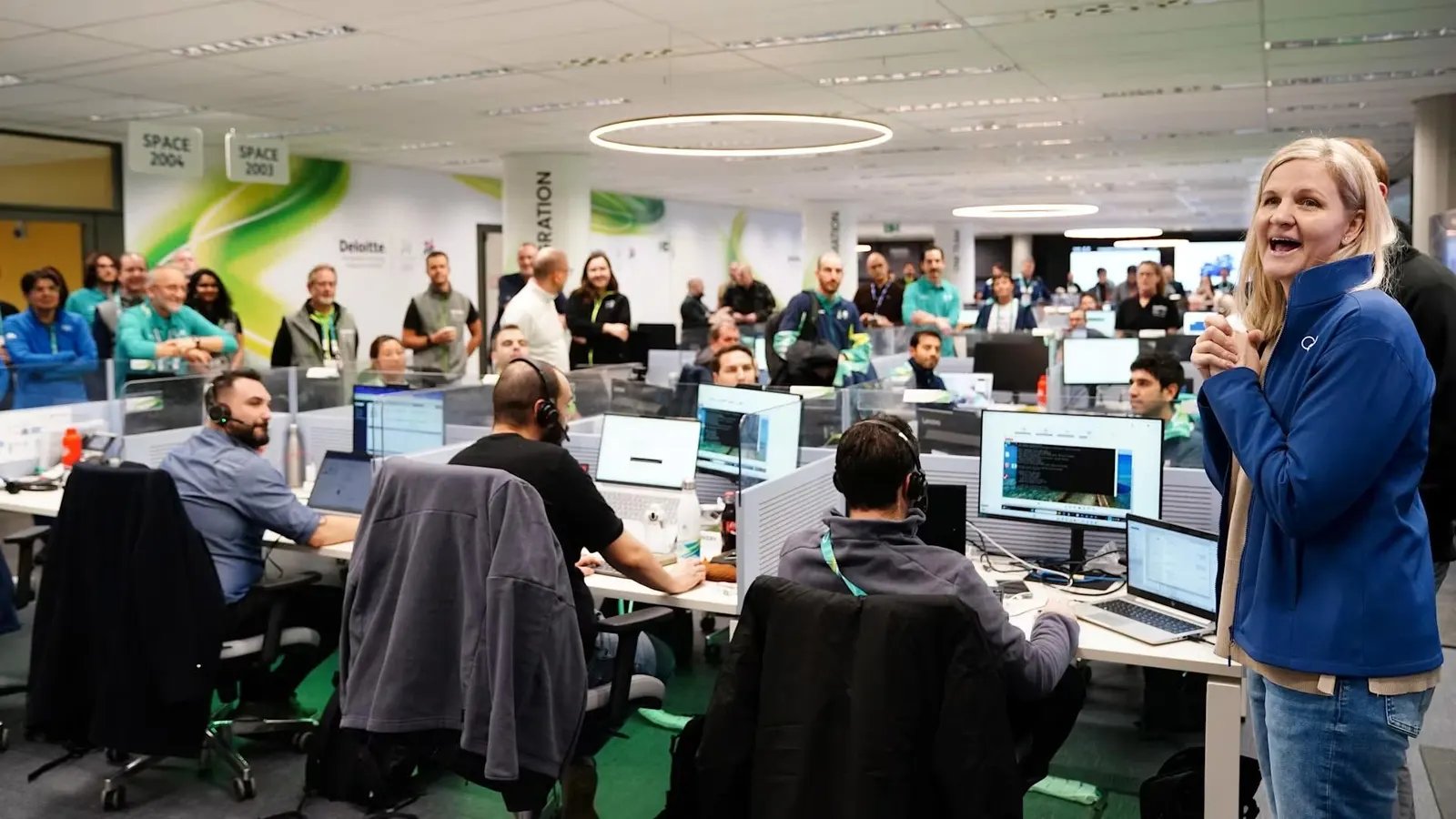
At this year’s Olympic and Paralympic Winter Games, this integrated technology infrastructure came to life in the Technology Operations Center (TOC), which acted as its technological heart and digital engine room.
The operations center was designed and implemented jointly by Deloitte and Milano Cortina 2026, and in close collaboration with other TOP (The Olympic Partners) and TEC partners of the Organizing Committee to run operations during the Olympic Winter Games and strengthen operational resilience.
Within the TOC, humans and machines work together. An incredible group of 1,400 Deloitte staff from 33 geographies worked around the clock to maintain real-time visibility across systems, safeguard data and continuously anticipate, identify and resolve cyber threats from multiple angles and platforms each day. The team managed technology across a 22,000 sq km footprint for 25 competition & non-competition venues and more than 90 facilities, including public (airports, depots, immigration points) and private (hotels, warehouses, forward logistics positions) facilities. The TOC served as a real-time coordination and decision environment—where technical teams aligned, incidents were escalated and resolved, and IOC cross-partner actions were executed under time-sensitive pressure with Deloitte professionals at the center of delivery.
These efforts to help support uninterrupted performance were supported by Remote TOCs (RTOCs), which are off-site technical extensions with teams located outside Italy. These RTOCs extended the capabilities of the central TOC, strengthening local support, enhancing redundancy and enabling continuous operations throughout the Games’ lifecycle.
The collaboration of human effort and technological support is crucial for smooth operations. Deloitte’s support included building a volunteer portal that handled more than 135,000 initial applications from individuals interested in volunteering at the Olympics. In addition, 18,000 volunteers used the application for training and shift scheduling throughout the 250 live events over 19 days. During that time span, terabytes of results data were delivered daily so athletes, their families, and global audiences could follow scoring and other updates in real time. There were over a million hits to the web app per hour. The accreditation system printed over 169,000 passes, and managed approximately 80,000 daily entries, totaling more than 1.5 million scans, with 99.2% of checks returning in under one second across all Olympic venues in Milan and the mountain venues.
After the Winter Olympic Games, these systems and applications pivoted to support the Paralympics, enabling the largest showcase of winter Para sport, surpassing the previous record set at PyeongChang 2018.
In many ways, the TOC is similar to the control centers of modern global enterprises—where integration, cybersecurity, AI, and operational discipline – delivered by hundreds of technology service providers, converge to help drive performance at scale.
Designing a platform that endures
Through its partnership with the IOC, Deloitte is helping empower the Olympic and Paralympic Games to endure and evolve by creating a system that can be customized for each Games edition, driving efficiency, reusability, continuous learning, and improvement. Deloitte is embedding AI across the platform, strengthening cybersecurity, and creating personalized digital experiences for fans, athletes, volunteers, and IOC ecosystem partners.
In doing so, Deloitte is helping advance a shared ambition with the IOC to promote a better world through sport, supported by secure, resilient technology.
Milano Cortina 2026 is not simply a milestone. It is a blueprint for how large-scale, globally distributed events can be delivered securely, resiliently and seamlessly—now and into the future.