From its Italian heritage to its role today as an international technology partner, Tecnau’s story remains above all a story about people. And like every story shaped by knowledge, collaboration, and vision, it continues to evolve.
Tecnau’s story is deeply connected to the place where it began: Ivrea. For decades, this small town in northern Italy was known around the world as the home of Olivetti, a company that demonstrated how technology, design and social vision could coexist. It was an environment where engineering was never separated from human values, and where innovation was understood as a collective effort. Growing within this context meant inheriting a way of thinking about technology that places people at the centre.
Tecnau was founded in 1988 by a small group of engineers who shared a passion for automation and a curiosity for solving complex industrial challenges. In those early days, the projects were varied and demanding, ranging from automated systems for industrial production to the precise assembly of micro-components. Each assignment required creativity, experimentation and a willingness to rethink traditional approaches.
What was being built during those early years was not only technology. It was a culture where engineering meant understanding problems deeply, collaborating across disciplines, and transforming knowledge into practical solutions.
Engineering simplicity
Among the founders who helped shape Tecnau’s direction was Giuliano De Marco. His approach to engineering was guided by a simple but demanding principle: technology should serve the business. Systems did not need to be unnecessarily complex. They needed to be reliable, robust and capable of working consistently in real production environments. That mindset became a cornerstone of Tecnau’s identity.
Stefano De Marco, CEO of Tecnau and Sitma, often reflects on the influence his father had on the company’s culture.
“My father always believed that the best solutions are often the simplest ones. Technology must work for the customer, not the other way around.”
Today, Giuliano De Marco remains actively involved in the company as chairman, continuing to provide insights and guidance based on decades of experience.
Knowledge built together
As digital technologies began transforming the printing industry, Tecnau’s expertise in automation found a natural application in this evolving field. Digital printing introduced new levels of flexibility and speed, but it also created new challenges for production workflows.
Finishing processes often struggled to keep pace with modern printing capabilities. Tecnau approached this challenge with the same engineering mindset that had guided the company from the beginning: observe, understand and design solutions that simplify complexity.
As Tecnau’s expertise grew, so did its international presence. Automation opened new possibilities for production, enabling more flexible workflows and applications such as on-demand book manufacturing. More recently, the acquisition of Sitma extended this vision even further. By combining finishing technologies with expertise in packaging, fulfilment and logistics automation, the organisation can now support multiple stages of the production chain. This evolution reflects a broader philosophy: production processes run on increasingly interconnected systems that benefit from intelligent automation and integration.
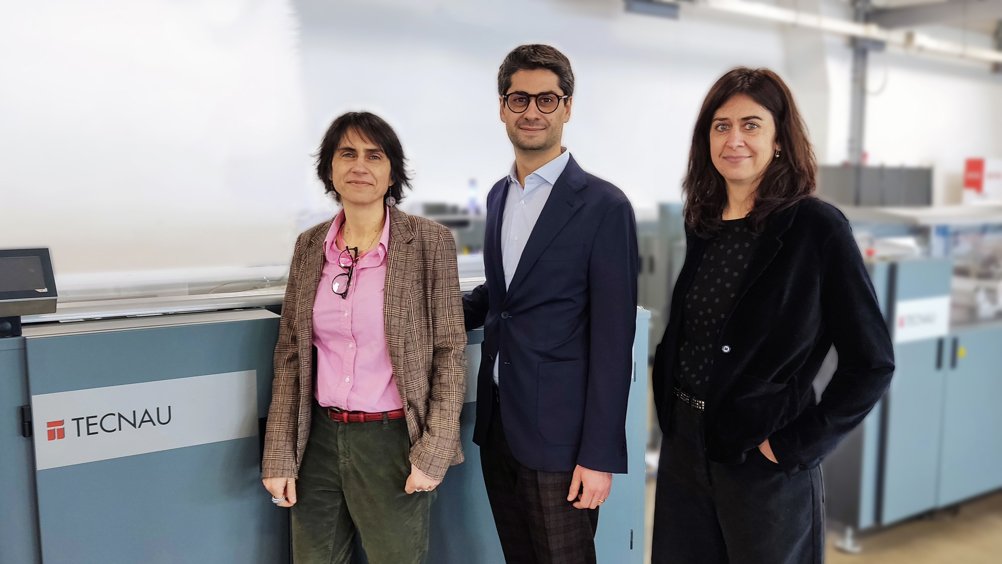
Today, the company is led by Stefano De Marco together with his sisters, Francesca and Emanuela. Emanuela contributes to product development and innovation, while Francesca oversees the financial structure that supports the company’s growth.
For Stefano, this continuity is one of Tecnau’s defining strengths: “What makes Tecnau special is the knowledge that people carry with them. Many of our colleagues have been here for decades. Their experience becomes part of the company’s identity and helps guide future innovation.”
Looking forward
More than three decades after its founding, Tecnau continues to invest in research, automation and technological development. Production environments are becoming more connected, intelligent and data-driven. Engineers constantly explore new ways to improve efficiency, flexibility and sustainability within modern manufacturing processes.
Yet even as technology evolves, the principles that shaped Tecnau from the beginning remain unchanged: Innovation begins with curiosity, it grows through collaboration and it succeeds when knowledge is transformed into solutions that create real value.
As Stefano De Marco often says: “Technology alone is never enough. What really matters is the people behind it, the knowledge they share, the experience they bring, and the passion they put into what they build.”
To discover how Tecnau technology can bring innovation to your business, visit: tecnau.com