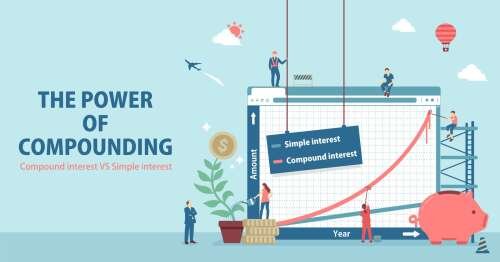
Magical impact: compound interest enables investments to grow exponentially over time (Adobe stock image)
Let’s face it: building wealth long-term can be challenging. Day-to-day expenses constantly erode the dollars we have saved so diligently, especially when prices rise relentlessly while salaries increase at a slower rate. Developing wealth requires discipline, focus, and a willingness to make short-term sacrifices.
However, with persistence and your eye on the prize, your assets can grow substantially over time, particularly if you apply the principle of compound interest.
Compound interest is recognised as one of the most powerful forces in investing. Its significance extends beyond mere wealth growth; it embodies the principle that small, consistent gains can accumulate to deliver profound long-term financial benefits.
Unlike simple interest, which is calculated only on the original principal, compound interest earns returns on both the initial investment and the previously accumulated interest. This self-reinforcing cyclical process creates a “snowball effect”, dramatically amplifying savings and investment returns over extended periods.
For example, consider a principal of $10,000 invested at an annual rate of 5 per cent, compounded annually. After 20 years, it grows to approximately $26,533, far surpassing simple interest’s $20,000 outcome.
The disparity between compound and simple interest expands exponentially with longer time horizons, emphasising time’s critical role in investing.
One of the most compelling benefits of compound interest is its capacity to accelerate wealth accumulation significantly. When interest compounds regularly; whether monthly, quarterly, or annually, the invested amount experiences exponential rather than linear growth. Over time, this acceleration transforms modest investments into substantial sums.
For individuals who begin saving early in life, compound interest converts small, consistent contributions into an impressive pool of wealth. The earlier a person starts, the more pronounced the effects, as compounding has additional periods to exert its influence.
This dynamic further highlights the critical importance of initiating savings and investments as soon as possible, leveraging time to optimise growth.
Another key advantage lies in its role in fostering disciplined saving habits. When people understand that their savings accelerate due to compounding, they become more motivated to contribute regularly.
This insight initiates a virtuous cycle: greater consistency yields faster growth, which reinforces ongoing saving. Such habits empower individuals to build financial security and realise long-term objectives, including retirement planning, home purchases, or funding education.
Additionally, compound interest offers financial leverage, enabling wealth building without proportionally increasing effort or risk, and is known as a passive investment approach. Reinvested earnings act as a multiplier on the principal.
Gradually, this effect elevates even modest initial sums to noteworthy totals, making it an appealing strategy for steady asset expansion. Long-term investors benefit most, as the impact of compounding intensifies with duration.
Furthermore, compound interest can safeguard against inflation, which erodes money’s purchasing power over time. Savers must secure returns exceeding the typical 2 per cent to 3 per cent inflation rate.
Compounding facilitates superior yields, preserving and augmenting real wealth. While inflation diminishes nominal value, the exponential trajectory of compounded returns counters this erosion, ensuring savings retain their practical value.
Another often overlooked benefit is its educational value. Studying compounding instils long-term thinking and financial literacy. Recognising how incremental investments grow fosters superior money management and foresight.
This awareness permeates broader decisions, cultivating responsibility and resilience, and favouring steady gains over one-time investment choices.
Despite all these benefits, realising compound interest’s full potential requires utmost patience and discipline. Growth materialises gradually; short-term market volatility may obscure progress, but a steadfast horizon reveals its strength.
This only reiterates the benefit of starting early, sustaining contributions, and adhering to long-term financial goals.
On the other hand, it is important to note that relying solely on compound interest as an investment strategy is a passive approach to building wealth and should not be the only approach.
While the mathematical principle of earning returns on both your initial capital and your accumulated earnings is profoundly powerful, it is not a strategy in itself. It is merely an effect, a force that works within a chosen strategy.
For compound interest to work meaningfully for wealth creation, it must be applied to productive, growth-oriented assets. This means your core “strategy” must be consistently investing in a diversified portfolio over decades. Compounding then occurs on the market’s average returns, which historically outpace inflation.
It is important to note: Warren Buffett did not become wealthy by relying on “compound interest”; he became wealthy by consistently allocating his money to outstanding businesses whose value compounded over time.
However, the overall best approach is combining the power of compounding with the targeted potential of active investing to create a formidable strategy for wealth accumulation.
The compound interest approach is the essential, non-negotiable foundation. By consistently reinvesting earnings, you harness exponential growth. Time is its greatest ally; starting early and maintaining discipline allows even modest, regular contributions to snowball into significant wealth. This provides a stable, low-cost engine for growth, serving as the reliable bedrock of any long-term portfolio.
An active investing approach complements this by seeking to enhance returns and manage specific risks. Through strategic investment selections and tactical asset allocation, active strategies aim to outperform the broader market.
This allows for capitalising on unique opportunities for potential investment gains, while also enabling tactical adjustments in response to changing economic conditions. The synergy between both strategies mitigates the limitations of either approach in isolation.
From my perspective, this dual strategy of passive and active balances the unwavering maths of compounding with the strategic pursuit of opportunity, creating a holistic and powerful path to accelerated wealth accumulation.
References
Legget, J. (2024) The Life-Changing Magic Of Compound Interest. Forbes Magazine. Available from: https://www.forbes.com/advisor/au/investing/compound-interest-in-australia/ [Accessed 30 January 2026].
• Carla Seely has 26 years of experience in the international financial services, wealth management, and insurance industries. During her career, she has obtained several investment licences through the Canadian Securities Institute. She holds the ACSI qualification through the Chartered Institute for Securities and Investments (UK), the qualified associate financial planner (QAFP) designation through FP Canada, and the associate in insurance (AINS) designation through The Institutes. She also completed a Master’s Degree in Business and Management through University of Essex
• For further inquiries or suggested topics, e-mail: justaskcarla@outlook.com