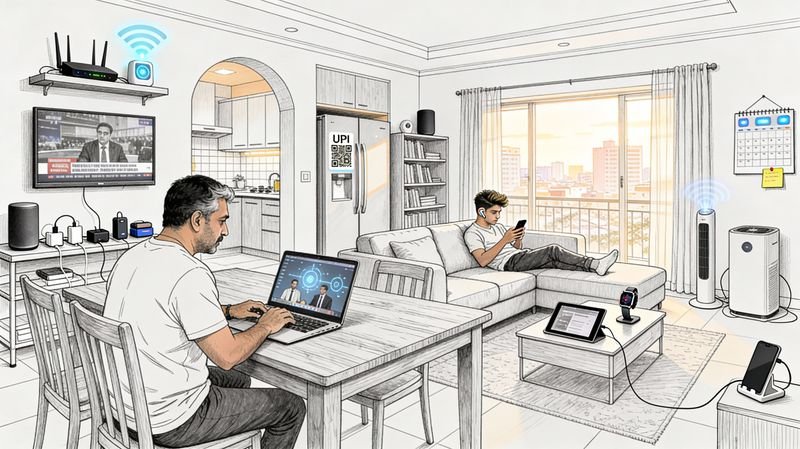
By 2025, a familiar scene played out in households across India and probably elsewhere too: a slightly overwhelmed but curious parent trying to keep up with a world where everything from paani-puri stalls to school fees went through QR codes, and a Gen Z kid for whom constant connectivity felt less like innovation and more like a birthright.
Somewhere along the way, technology underwent a subtle shift. It stopped trying to look cool and instead became the default setting for life. No one gasped at new phones. 5G quietly blended into daily life. Even artificial intelligence didn’t feel magical anymore. Instead of asking “What’s new?”, people began asking a far more demanding question: “Why isn’t this seamless yet?” That question changed everything and it sparked more than a few debates between parents who remember dial-up and kids who’ve never known life without Wi-Fi.
That quiet normalisation looked very different depending on who you asked. For millennials, it felt like technology had settled down. For Gen Z, it felt like tech was finally catching up with expectations. Somewhere between those two views, often at dining tables, in living rooms and during car rides, sat the real story of what shaped technology in 2025 and what it set up for 2026.
One such conversation unfolded on a lazy December afternoon between Rohit Awasthi, a 47-year-old millennial who has lived through every awkward phase of Internet’s evolution, patiently watching loading bars, and his son Ishaan, 21, a full-blown Gen Z native born into the swipe era who treats fast connectivity like oxygen and considers buffering a human rights violation. Rohit sees himself fairly tech-savvy. Ishaan believes that’s adorable.
Relax, dad
Rohit (scrolling through his phone, mildly irritated): I keep reading these tech columns and honestly, they are exhausting. Apparently AI was supposed to change everything in 2025. My life feels… largely the same.
Ishaan (without looking up from his screen): That’s because you were expecting tech to flex with big launches and dramatic glow-ups, something iconic. But 2025 wasn’t that vibe. It was more like a software update that was low-key, unavoidable and permanent.
Rohit: Oh come on. Half of what I saw online was pure rage bait. AI will kill jobs, AI will write novels, AI will overthrow humanity.
Ishaan: Exactly. Noise. The real shift happened off-camera. AI didn’t show off. It went straight to work.
AIcing on the cake
Ishaan: Think about it. Government departments started using AI for document processing and grievance redressal. Banks used it for fraud detection. IT companies slipped it into testing and maintenance. Media houses used it for research, not writing Pulitzer winners. Very low-key, but everywhere.
Rohit: My office does meeting summaries now. Nobody even calls it AI. It’s just… there.
Ishaan: That’s the win. AI in 2025 stopped being a product and became a layer. No flex, no hype, just clean and useful.
Rohit: So the job apocalypse didn’t happen.
Ishaan: Nah. That fear was delulu. What happened instead was skill pressure. Entry-level jobs got tougher, routine work got automated and thinking still stayed human. AI didn’t eat jobs, it ate repetitive nonsense. Big difference.
Emotional atyachaar
Rohit: Funny thing is, some people
are talking to chatbots like they’re people now.
Ishaan: Yeah. Because they listen, reply instantly and never ghost. For some, that’s comforting.
Rohit: That sounds risky.
Ishaan: It can be. Helpful tool, slippery emotional slope. The tech didn’t plan it, but humans got attached.
Boring, the new normal
Rohit: Okay, explain this then. Phones. Nothing exciting happened. Same slabs, same cameras.
Ishaan: Because the smartphone story matured. We crossed 80 crore users. Growth flattened. Innovation shifted from “wow” to “why should I care?” Indian buyers don’t want experiments. They want battery life, good cameras and service centres nearby.
Rohit: And foldables?
Ishaan: Too expensive, too fragile. Niche only. For most people, phones in 2025 were tools for UPI, work, learning and navigation. Not flex machines. A lot of launches this year? Pure slop.
The undisputed OG
Rohit: I admit one thing. UPI runs my life now.
Ishaan: Exactly. Over 18 billion transactions a month. From momo stalls to malls. It’s muscle memory. You don’t think “I’ll use UPI”. You just scan.
Rohit: Credit card link on UPI surprised me.
Ishaan: That’s huge. Especially for younger users. Plus India exporting UPI to Singapore, UAE, Nepal and other countries. That’s digital soft power. If there’s one OG tech story of the decade, it is UPI.
Cybercrime looks legit
Rohit: And yet… that same ease makes me nervous. Why am I getting so many urgent KYC messages? One wrong tap and your money’s gone. India logged over 25 lakh cybercrime cases in 2025, with losses averaging nearly Rs 1,000 crore a month.
Ishaan: Because cybercrime is having a main-character moment right now. Those messages are sus. Big red flag.
Rohit: Yeah, but they look official.
Ishaan: That’s the scammer aura. Clean design, fake drip. If it’s urgent or emotional, it’s probably a scam. Say less.
Rohit: So everyone’s a target?
Ishaan: Facts. Digital payments are iconic, but one careless move and you are done. Stay alert. Awareness is the real glow-up.
Health devices not optional
Rohit: Somewhere along the way, health became tech-enabled.
Ishaan: Because prevention finally became the mood. Wearables aren’t about flexing steps anymore, they
flag stress, bad sleep and weird
heart trends.
Rohit: And air purifiers went from luxury to necessity.
Ishaan: Exactly. When the air outside is questionable, clean indoor air is a green flag. Health tech in 2025 was practical, constant and reassuring.
Next layer of everyday tech
Rohit (after a brief pause): Funny thing is, innovation didn’t stop there. Come to think of it, emerging technology like live-translation earbuds actually impressed me this year.
Ishaan: Real-time translation is basically a superpower. Travel, work, even small talk, it changes the equation.
Rohit: And then there are humanoid robots. Still awkward, but everywhere in demos.
Ishaan: Yeah, very NPC energy for now. But give it a year or two and they’ll be doing warehouse jobs, elder care and maybe even customer service.
Rohit: That’s when things get interesting.
Ishaan: Exactly. Emerging tech isn’t craving for attention anymore. It is about what gets handled automatically and what still needs a human touch.
So, what’s next in 2026?
Rohit: After all this, with AI everywhere, UPI running our lives, scams getting smarter, what does the future actually look like?
Ishaan: Higher expectations. AI will keep handling the boring, high-stakes stuff. Humans will keep the judgement and context.
Rohit: And smartphones?
Ishaan: In 2026, phones will be judged on basics. Battery, security and durability. If something fails, users won’t forgive it. But the real game-changer might be smart AR glasses.
Rohit: UPI being everywhere also raises the stakes.
Ishaan: Exactly. Convenience came with consequences. Digital safety will take prominence and shape every click.
Rohit: And emerging tech?
Ishaan: Automation will take over repetitive human effort at scale. Miss that shift and you are already behind. That’s 2026.
Where this leaves us
Rohit: You know, when I was your age, technology felt aspirational. Now it feels accountable. 2026 will build on the foundations laid in 2025 with deeper integration and higher reliability. That’s growth.
Ishaan: Hainaa. Told you, very OG.