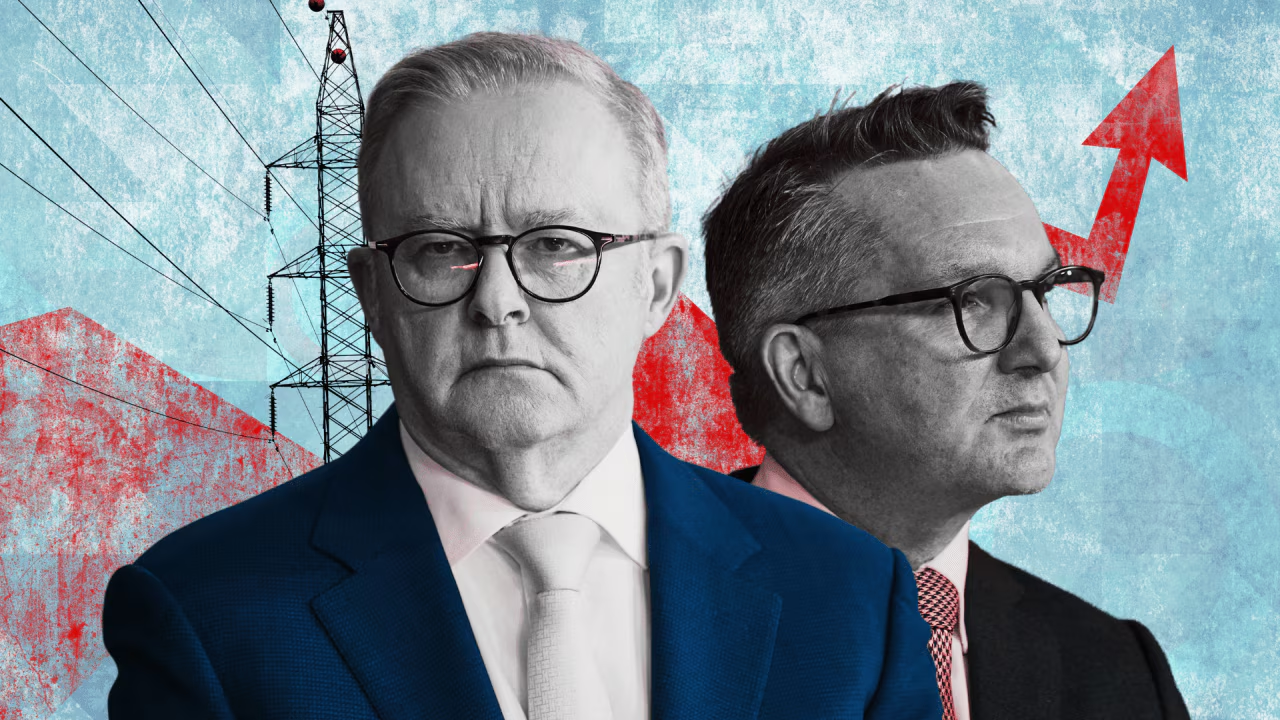
New national data has revealed the number of Australians seeking electricity hardship assistance has surged 50 per cent under the Albanese government.
More than 205,000 households have been struggling to pay their power bills — according to figures released by the Australian Energy Regulator and state regulators.
The number of people enduring electricity hardship and payment-assistance has climbed by 68,000 customers since the Albanese government took office.
This is the equivalent of 440 additional struggling families entering hardship every week.
The AER’s latest report also revealed that power prices had exceeded the Albanese government’s promise to cut power bills by several hundred dollars in every state.
The June 2025-quarter data was the third-highest on record, behind only June 2024 and September 204, both during the Albanese government.
New South Wales hardship rates rose 80 per cent in three years, Queensland rose 67 per cent, South Australia was up 37 per cent and Victoria up 32 per cent.
The hardship numbers tracked customers in financial distress who have been placed on special arrangements to avoid disconnection.
They also coincide with warnings from the Australian Energy Producers association that the government’s new EPBC laws could push up power prices.
Opposition Leader Sussan Ley said the new data showed the Australians were going backwards under the Albanese government’s energy policies.
“These energy hardship payments figures are heartbreaking,” Ms Ley said in a statement on Tuesday.
“Anthony Albanese promised a year of delivery. Well, he has delivered: higher cost of living; higher power prices; higher inflation, and potentially higher interest rates.”
She also attacked on Energy Minister Chris Bowen, saying the country was being run by a “part-time energy minister delivering a part-time energy grid”.
Mr Bowen has been heavily criticised for taking on a dual role to represent climate change efforts for the UN, while supposedly tackling the energy crisis in Australia.
The surge in hardship cases comes despite billions of dollars in federal and state rebates designed to soften the impact of soaring bills.
But the opposition has argued those supports have masked fundamental weaknesses in Labor’s energy policies.
Shadow energy minister Dan Tehan said on Monday that the AER data confirmed the government had “let Australians down”.
“Anthony Albanese and Chris Bowen promised energy prices would be $275 lower by this Christmas. Instead, prices have gone up around $1,300,” he said.
Across AER-regulated states, residential customer debt has also surged, with the share of households with energy debt jumping from 2.5 per cent to 3.1 per cent since 2022.
The average debt in NSW rose $1,046 to $1,402; from $755 to $1,321 in Queensland and $1,321 to $1,754 in South Australia.
The hardship spike comes as the major parties diverge dramatically on energy policy platforms.
The Coalition has dumped its 2050 net-zero target and has campaigned on energy affordability and abundance
The Labor Party has continued to pursue net zero, with an ambition to achieve 82 per cent renewable energy provision by 2030.
AEMO has warned the retirement of the Eraring coal plant in 2027 risks blackouts across the east coast unless replacement capacity is fast-tracked or coal is kept online.
Labor has insisted renewables remain the cheapest form of energy and argues the grid must be rapidly modernised to bring down prices over time.