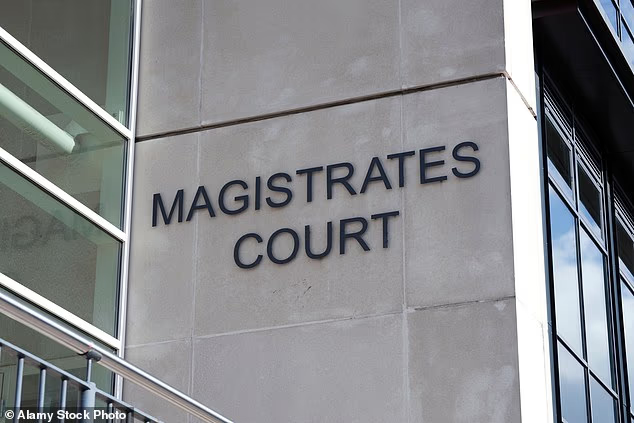
Campaigners have called for the reform of a ‘secretive’ fast track court system after a dementia sufferer received a criminal conviction over £43 of unpaid car tax.
The Single Justice Procedure (SPJ) allows public authorities to bring quick prosecutions in hearings conducted behind closed doors.
Issues have been raised over the scheme for years, including numerous wrongful prosecutions and charges against people who are ill or have died.
Even so, it continues to be heavily used by official bodies, with Transport for London (TfL) alone bringing 748 prosecutions last week.
The latest shocking case relating to the SJP involves an 87-year-old woman with dementia whose car tax expired in February.
She was taken to court by the DVLA for a sum unpaid between then and April.
In response, her son wrote to the court to say the woman’s husband, who previously dealt with bills at their home in Basildon, Essex, had been admitted to a care home last December after developing advanced dementia.
The woman began showing symptoms of dementia herself in July and is now in a care home too.

The Magistrates’ Association held a major intervention to demand an overhaul of the ‘secretive’ SJP (File image)
Despite her son insisting she was ‘very confused’ and unable to deal with the legal action brought under the SPJ, it was not halted – according to court papers seen by the Standard.
Penelope Gibbs, director of Transform Justice, insisted the case was fresh evidence of the need to reform the procedure.
She told the Mail: ‘The single justice procedure is currently an unfair system. The SJP is cheap and speedy for prosecutors, but involves prosecuting hundreds of people on an industrial scale, often for small mistakes.
‘Prosecutors know little about and appear not to care whether defendants intended to break the law.
‘Until prosecutors make the effort to find out who they are charging, vulnerable, ill and disabled people will continue to be prosecuted in error.’
One of the most prolific users of the SJP is Transport for London (TfL).
Out of the 748 prosecutions it brought last week, most were for fare dodging, although one defendant was fined for bringing an e-scooter onto the Tube network.
Previously, another Tube user, 27-year-old John Cejas, was told to pay more than £500 for entering Whitechapel Station in East London on rollerskates.
Ms Gibbs said she was ‘concerned’ by the number of people TfL was prosecuting.
‘There are people who deliberately evade paying fares who definitely need to be apprehended.
‘But there are also people who make mistakes, and very vulnerable people who will also be dragged into the prosecution net.
‘Until TfL finds out more about each defendant they prosecute, there is a risk of miscarriages of justice.’
Concerns have repeatedly been raised about people who are ill or elderly being wrongly targeted under the SJP.
One 82-year-old in sheltered housing was previously convicted after the DVLA found he had not paid a £35 tax bill on his Ford B-Max in September 2024.
He wrote to the court, which heard the case last month, explaining that his wife died on August 6, 2024 and that he was ‘preoccupied’.
‘I paid the tax as soon as I became aware that I had forgotten,’ he added.
Normally, the DVLA could have decided to withdraw the prosecution on the grounds it wasn’t in the public interest.
But because of the fast-track design of the SPJ, this was not considered.
The Magistrates’ Association called last March for an overhaul of the ‘secretive’ SJP.
The organisation said ‘there are concerns’ that cases are being brought before magistrates without prosecutors, such as the DVLA or TV Licensing, reading mitigations.
A TfL spokesperson said: ‘Our priority is the safety of our passengers and staff, which is why we take a proactive approach to preventing and reducing offending across our network.
‘We are committed to ensuring that the prosecution process is fair, proportionate and transparent. Before any legal action is taken, we always contact the individual involved to offer them the opportunity to explain the circumstances and provide any mitigating information.
‘We include safeguards to ensure vulnerable individuals are not unfairly penalised. Each case is assessed individually, and many factors are taken into account when deciding whether prosecution is appropriate.’
The DVLA has been contacted for comment.