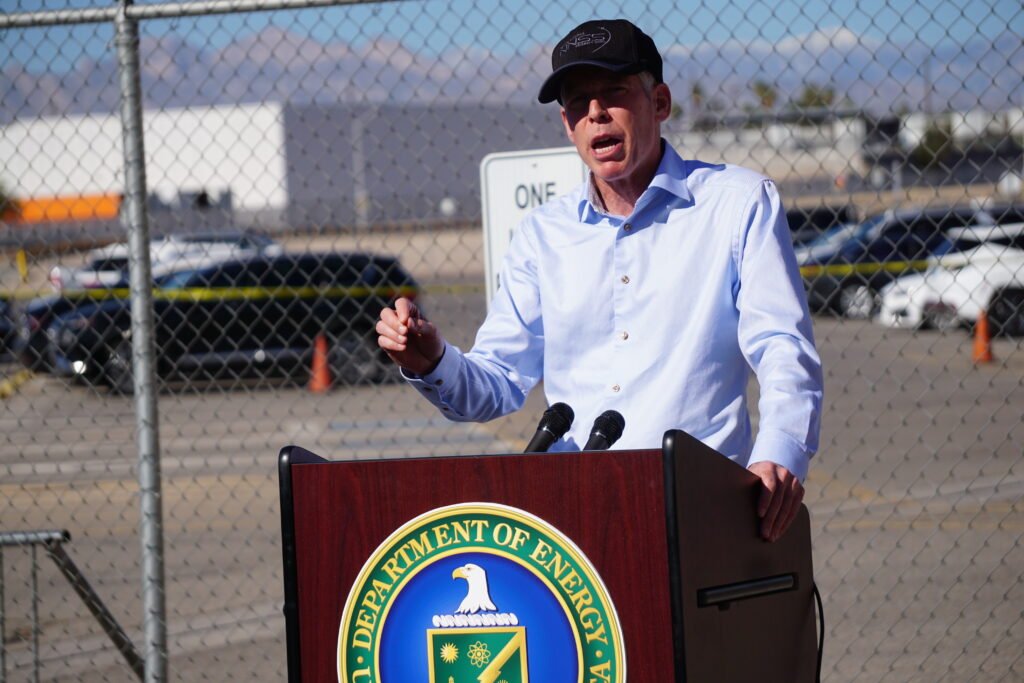
Energy Secretary Chris Wright visits Nevada National Security Site to highlight the shutdown’s impact on U.S. National Nuclear Security Administration. (Photo: Jeniffer Solis)
U.S. Energy Secretary Chris Wright visited the Nevada National Security Site Monday to highlight the shutdown’s impact on the federal agency tasked with managing and modernizing America’s nuclear weapons.
The U.S. National Nuclear Security Administration, which falls under the Energy Department, furloughed a majority of its workforce on Monday as the government shutdown dragged into its third week. It’s the first time since the agency’s creation in 2000 that workers have been furloughed.
“We did everything we could to keep our federal workers here employed as long as possible. But unfortunately, today is the day our ability to deploy funds to pay those workers ended,” Wright said at a press conference Monday.
Nationally, about 1,400 employees were sent home Monday, leaving fewer than 400 to safeguard the U.S. nuclear stockpile. In Nevada, all 68 federal employees at the Nevada National Security Site were furloughed.
While the agency doesn’t directly handle U.S. nuclear weapons, the department is tasked with improving national security by safeguarding the US nuclear stockpile and preventing the proliferation of nuclear weapons across the globe. The agency is also responsible for overseeing the transportation of nuclear weapons and materials.
Wright said NNSA’s Office of Secure Transportation, which transports nuclear weapons and materials within the U.S., had enough funding to operate until Oct. 27. Wright also said the agency had enough funding “to keep our contractors employed at least through the end of the month.”
Unlike federal employees, contractors can’t be paid back for the time they spent furloughed. Only four contractors remained working at the Nevada National Security Site.
“If they’re furloughed, they’re not going to get paid. If that continues on for weeks more – they’ve got families to support – they’re going to go get jobs elsewhere. But the federal government, we can’t afford to lose those workers. We need them,” Wright said.
At the press conference, Wright said there was no immediate national security threat as a result of the furloughs and “a certain number of mission critical folks…are still working.”
However, Wright said the furloughed employees are “among the most critical workers in our country.”
“They test, maintain, and ultimately construct a modernized version of our nuclear stock. We need to take that deathly serious. We’ve never had to furlough in this area before. We need to end this as soon as possible,” Wright said.
A press secretary for the Department of Energy said the difference this year from prior federal shutdowns was a reduction in carryover funding by the Biden administration last year before he left office, so there isn’t as much of a financial cushion as in prior shutdowns.
“They instructed them to reduce the carryover funding because they thought it was too large. So that’s why we’re in a different situation,” said Ben Dietderich, press secretary and chief spokesperson for the U.S. Department of Energy.
Wright blamed Democrats like Senate Minority Leader Chuck Schumer for the continued shutdown, but he also thanked Nevada’s Democratic Sen. Catherine Cortez Masto for being one of only two Democrats to vote for a Republican stopgap spending bill that would end the shutdown.
“I thank her for her courage and for standing with our workers here in Nevada and with our country’s national security,” Wright said.
The overwhelming majority of Cortez Masto’s Democratic colleagues in both the Senate and the U.S. House opposed the Republican spending bill because it failed to restore Affordable Care Act subsidies that congressional Republicans and the Trump administration curtailed earlier this year. Health insurance premiums are projected to increase substantially as a result.
Wright called on Democrats to support the Republican-led spending bill, describing it as “a clean spending bill that just continues the spending levels exactly as they were before.”
Earlier this month, Nevada Democratic Sen. Jacky Rosen said Democrats would have to be “naive” to vote for a Republican funding plan to reopen the government without first obtaining firm commitments that Republicans will reverse course and extend health insurance subsidies so as to prevent skyrocketing premiums.
Wright said Rosen abstaining from a vote to reopen the government earlier this month was a sign that more Democrats may do as Cortez Masto has and vote with the Republicans.
“Last vote she abstained. I think she wants to vote with us. I think she’s going to be part of reopening the government,” Wright said.
A spokesperson for Rosen’s office said Nevada’s junior senator missed the vote because of “significant flight delays outside of her control that led her to miss two votes a couple of weeks ago,” adding that “Rosen would have opposed the Republican resolution that does nothing to fix the health care crisis.”
“Donald Trump and Washington Republicans control Congress and the White House – and it’s on them to end this government shutdown and take action to prevent a spike in health care costs for hardworking families,” Rosen said in a statement Monday.
“The Trump Administration would rather continue this shutdown and furlough federal workers, including at the Nevada National Security Site, than work across party lines to extend the Affordable Care Act’s enhanced premium tax credits that families rely on to keep their health care affordable,” Rosen said.
Republican House Speaker Mike Johnson predicted this could become the longest government shutdown in American history as negotiations between Republicans and Democrats remain at an impasse.
The current shutdown has already exceeded the historical average of eight days for government shutdowns dating back to the late 1970s. The longest shutdown on record lasted 35 days during President Donald Trump’s first term, resulting in $11 billion in lost economic productivity, according to the nonpartisan Congressional Budget Office.