A sprawling bill passed at the eleventh hour by California lawmakers a week ago to address energy affordability included a massive infusion to the state’s wildfire restitution fund, established in 2019 to help pay damages to victims of fires sparked by investor-owned utilities.
Northern California fire survivors, whose plight inspired the fund and who have yet to be made whole for their losses in the 2017 North Bay firestorm and 2018 Camp Fire, among others, had recently been pushing lawmakers to be included in the fund, but no such provision was part of the last-minute deal, which Gov. Gavin Newsom signed into law Friday.
The $21 billion California Wildfire Fund was created after Pacific Gas & Electric Co.’s bankruptcy in 2019 as liabilities for catastrophic fires tied to its equipment soared. Funded in equal parts by ratepayers and utility shareholders, the pool of money was the state’s answer to a new era of utility-sparked and climate-driven wildfires that have leveled communities and threatened to topple the state’s giant energy providers as they confront legal claims from thousands of fire survivors.
The wind-driven Los Angeles firestorm in January, however, established a new high mark, with more than 16,000 homes, businesses and other structures destroyed and 31 people killed — making for what is likely to be one of the costliest disasters in U.S. history.
In one of those infernos, the Eaton Fire near Pasadena, Southern California Edison has indicated its equipment may be tied to the origin in the foothills of Altadena, with investigations ongoing.
Ahead of any determination, many worried that if the utility is found at fault, the claims against the state fund, which has remained largely untouched since its creation, could drain it, sparking lawmakers to push for its replenishment. The provision added by lawmakers to Senate Bill 254, at Newsom’s request, extends the fund by 10 years with an additional $18 billion influx, split again from money drawn from ratepayers and utility shareholders.
A wide variety of environmental, business, consumer and utility organizations endorsed the 361-page bill, which includes an array of mandates to streamline utilities’ wildfire prevention work and reduce the cost burden on ratepayers. It was passed Sept. 13 along with a package of other bills to expand oil production and extend the state’s landmark carbon cap-and-trade program.
Senate President Pro Tem Mike McGuire of Healdsburg hailed the package as the “largest energy reform” in state history, according to Politico.
However, the Utility Wildfire Survivor Coalition, a grassroots group of Northern California fire victims, opposed the bill because it failed to address their call to make prior fire victims whole in their claims.
“We must not push aside our commitments to Northern California fire victims while we look to support Southern California fire victims, our utilities and our utility investors,” the coalition said in a statement. “We must ensure that this bill provides equitable relief for all utility-caused wildfire survivors including those in Northern California that still suffer awaiting their full compensation.”
-
Abraham Fuentes/For The Press Democrat
Then-Santa Rosa City Council member Chris Rogers speaks during a Catholic Charities event at Caritas Center in Santa Rosa on Aug. 15, 2024. Rogers was elected to the state Assembly in November 2024. (Abraham Fuentes/For The Press Democrat)


Abraham Fuentes/For The Press Democrat
1 of 6
Then-Santa Rosa City Council member Chris Rogers speaks during a Catholic Charities event at Caritas Center in Santa Rosa on Aug. 15, 2024. Rogers was elected to the state Assembly in November 2024. (Abraham Fuentes/For The Press Democrat)
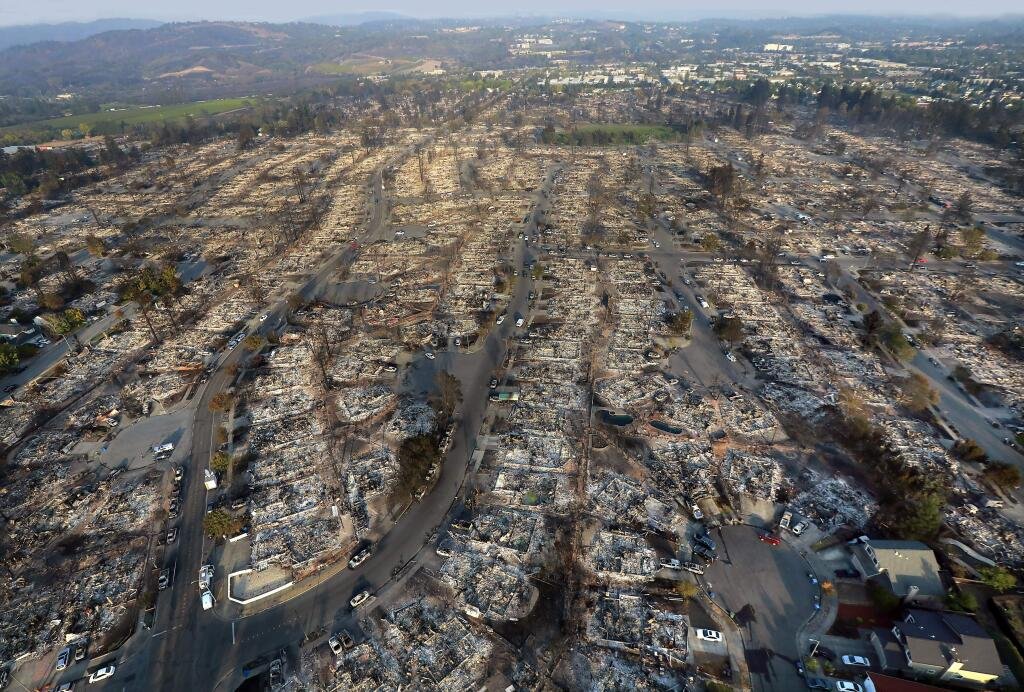
During a Sept. 12 committee hearing, Assembly member Chris Rogers of Santa Rosa voted in favor of SB 254 but voiced frustration on behalf of fire victims from his district. He was a Santa Rosa council member in 2017 when the Tubbs Fire laid waste to about 3,000 homes in the city, part of a wind-whipped firestorm that destroyed more than 6,000 homes across four counties in the region and killed 40 people – the most destructive inferno in state history at the time.
“I like to bring into these conversations for folks who weren’t a part of the history that our survivors… were compensated very differently than how the state has moved since then,” Rogers said.
“A look back to Tubbs and to other disasters,” he continued, “to say we got it wrong, and – if we are actually serious about trying to make our communities whole — in keeping the commitment that every politician made when they came to my city and stood in the burned down neighborhoods and said we are going to be here until you rebuild.”
That “didn’t happen,” he said.
After vying for compensation with other creditors in PG&E’s bankruptcy, some 70,000 victims from fires between 2015 and 2018 agreed to a $13.5 billion settlement with PG&E in 2020 and ended up with 70 cents on the dollar for their claims, minus a significant chunk to attorneys — payments that are just now wrapping up. Some survivors have yet to rebuild, especially in Butte County’s Paradise area, where the 2018 Camp Fire killed 85 people and destroyed more than 18,000 structures.
“They are still struggling to pay medical bills. They are still awaiting final payments,” said Will Abrams, who lost his home in the Tubbs Fire and leads the Utility Wildfire Survivor Coalition’s efforts. “How is it that we are bypassing these victims?”
While PG&E’s rebounding stock eventually allowed for more than $14 billion in payments to those victims, it took years to get there and was still $6 billion short of claimants’ assessed damages.
Many felt in retrospect that the settlement deal they accepted — half stock, half cash — was in part the result of pressure and assurances of full compensation that accompanied the hurried political wrangling to pass the 2019 legislation, Assembly Bill 1054, which established the wildfire fund.
Thus was born their longshot campaign to be retroactively admitted to the wildfire fund, to which they are looking for their remaining 30% in restitution.
When the Assembly committee took up considered terms for the latest legislation, SB 254, Ann Patterson, a senior Newsom adviser, framed the extension of the wildfire fund as an interim fix while lawmakers determine a more sustainable long-term solution.
But, she insisted the wildfire fund has been an effective response to an unprecedented challenge and a way for future fire victims to avoid the experience of Northern California home and business owners.
Once a utility goes into bankruptcy, “the state has no control” over compensation, she said, and the legislation that created the wildfire fund put new accountability measures in place for energy providers and required PG&E emerge from bankruptcy within a year, when otherwise it could have been a much longer process.
“Nobody ever wants to see a fire victim have to go through that again. That was a horrible situation,” Patterson said.
Still, she signaled little interest in opening up the fund to pay the remainder of those survivors’ claims.
“I think because those are settled in bankruptcy court, they are put away in bankruptcy court,” she said. With the wildfire fund, ratepayers and utilities are “insuring future risk. They are not willing to go back and pay for the liabilities of any individual company that existed beforehand, and that makes sense.”
But at least one stakeholder, Mark Toney, the executive director of The Utility Reform Network, or TURN, a ratepayer advocacy group involved in shaping some of the language in the new legislation, made a small commitment. Toney said during the hearing that he would push for the Northern California fire victims to be considered in the report assessing the wildfire fund’s durability.
McGuire did not respond to a request for comment on his position.
“I will support moving this forward,” Rogers said during his committee comments, but “I will continue to ask my colleagues when I stretch for you to address issues in your community, just remember we are missing a golden opportunity to make good on the promises that were made to mine.”
You can reach senior reporter Marisa Endicott at 707-521-5470 or marisa.endicott@pressdemocrat.com. On X (formerly Twitter) @marisaendicott and Facebook @InYourCornerTPD.
Originally Published: