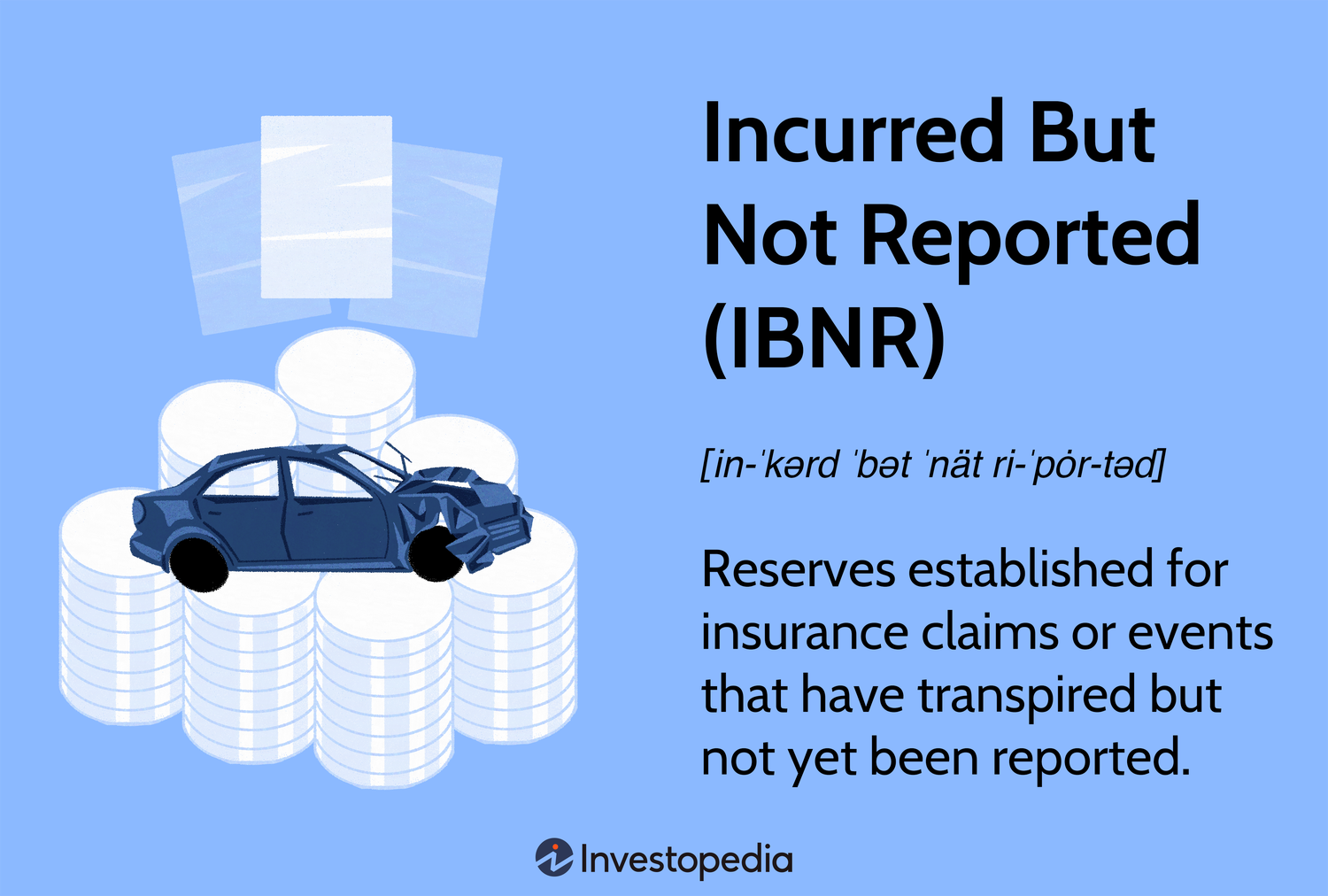
What Is Incurred But Not Reported (IBNR)?
Incurred But Not Reported (IBNR) are reserves used by insurers to manage claims involving events that have occurred but are not yet reported. Actuaries calculate these reserves to allocate funds for potential losses, accounting for delays in reporting due to various factors like bureaucratic processes. Understanding IBNR is crucial because it affects the financial health and performance of an insurance company, particularly in scenarios involving natural disasters, occupational diseases, and product liabilities.
In IBNR cases, an actuary estimates potential damages, and the insurer might set up reserves for expected losses. Actuaries refer to these events and losses as incurred but not reported.
Key Takeaways
- Incurred but not reported (IBNR) reserves are funds set aside by insurance companies to cover claims that have occurred but have not yet been filed.
- IBNR is critical for insurance companies to manage latent liabilities and ensure they have the necessary funds to cover potential claims.
- Actuaries play a crucial role in estimating potential damages and determining the necessary IBNR reserves.
- Delayed reporting of claims due to bureaucratic processes is a common reason for establishing IBNR reserves.
- Properly calculating IBNR is essential for accurately assessing an insurance company’s financial health and stability.
Understanding the Mechanism Behind IBNR
Insurers often use IBNR, especially on the East and Gulf Coasts of the U.S., where hurricanes are common. After a storm hits, actuaries estimate the potential damage to infrastructure and the claims that may be anticipated. After analysis, money is set aside in a reserve to pay for claims. Again, in this example, the actual losses have been incurred, but have not officially been reported.
There are numerous scenarios that can conspire and make it necessary for insurance companies to maintain funding provisions for IBNR claims.
Slowly developing occupational disease claims can impact workers’ compensation claims. Such examples include silicosis, asbestosis, and certain cancers determined to be related to occupational exposures. Defective product claims, like those involving lead paint or asbestos, often face delayed reporting.
Poor environmental practices can delay reporting of environmental liability claims. Finally, short-term workers compensation injuries and healthcare claims to a group healthcare plan can experience delayed reporting.
Important
It is very important to understand how insurance carriers use IBNR to calculate your account’s performance.
Delayed reporting impacts several types of insurance coverages, which require an IBNR calculation. These include workers’ compensation, environmental/pollution, healthcare, general liability, and products liability.
Calculating IBNR: The Factors and Challenges
Determining the right and proper formula for calculating an appropriate IBNR has always been one of the toughest challenges of the insurance industry. Insurance claim variables are non-normally distributed, which makes estimating them problematic–and not getting it right is not without consequence. Inaccurate estimates can project an incorrect view of an insurer’s health and may result in action being taken that could be detrimental to the company.
At a minimum, an actuary would likely use this client data to calculate IBNR:
- Claim amount
- Claim number
- Claim paid dates
- Claim settlement expense
- Class of business
- Intimation date
- Loss date
- Policy from date
- Policy number
- Policy to date
- Product type
- Reinsurance paid – a share of the claim amount
- Reinsurance paid – a share of claim settlement expenses
The Bottom Line
The Bottom Line: Incurred but not reported (IBNR) reserves are a critical component of the insurance industry, helping companies prepare for claims that have yet to be reported. By setting aside funds for potential claims, insurers protect themselves from the financial impact of these latent liabilities. Accurate estimation of IBNR amounts is essential; errors can misrepresent a company’s financial health and lead to poor decision-making. Key data that actuaries use in these estimations include claim amounts, dates, and reinsurance settlements. Understanding IBNR calculations is vital for stakeholders to assess the performance and stability of insurance entities.