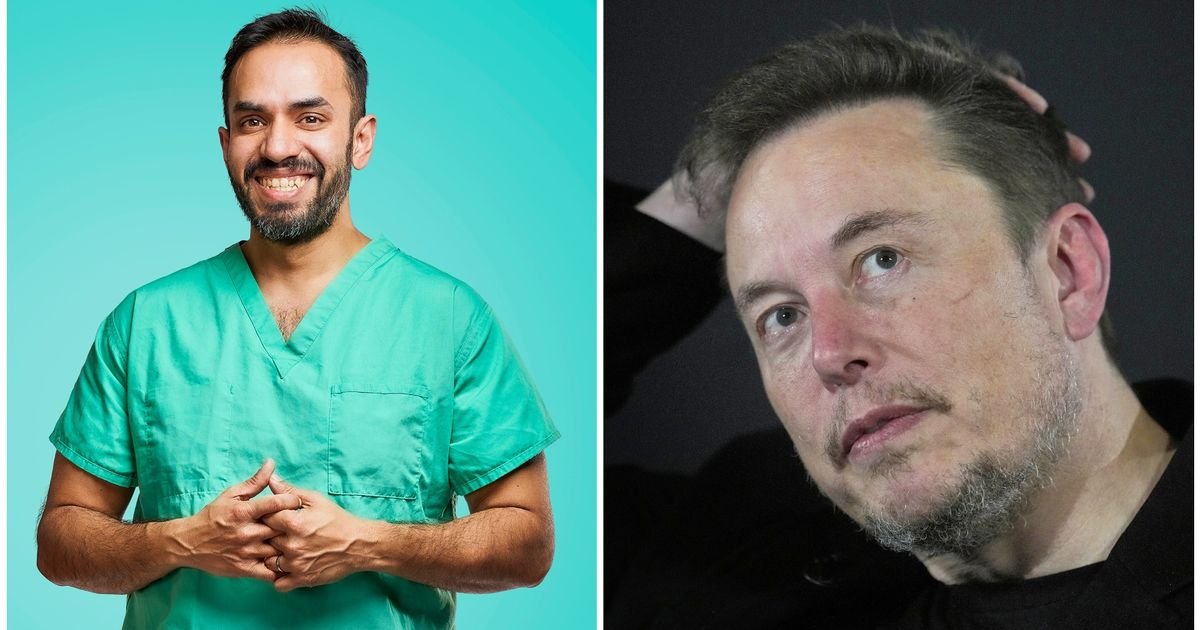
The Newcastle Hospitals NHS Trust is one of two hospitals set to trial the N1 Neuralink implant.

Brain implants created by Elon Musk‘s Neuralink firm will be trialled in Newcastle, it has been announced. The firm has launched a new clinical trial and the Newcastle Hospitals NHS Trust has been named as one of two centres in the UK to be part of research looking at the use of such an implant – the “size of a 10p piece” – which would allow people to control technology using their minds.
The idea is hoped to benefit those with signifcant neurological impairment including conditions such as motor neurone disease (MND) where they have “limited or no ability to use both hands”. The implants are placed in the brain using a robot – and a trial is already ongoing in the US.
Now the Newcastle Hospitals NHS Trust – which runs the Freeman and the Royal Victoria Infirmary hospitals – has been chosen along with the University College London Hospitals NHS Trust to run the first trial in the UK. This comes as the trial which will evaluate the safety of what Neuralink called its “wireless brain-computer interface”. The implant itself is named the N1.
Consultant functional neurosurgeon Mr Akbar Hussain is overseeing the trial in Newcastle, supported by hospital research teams and the National Institute for Health and Care Research. He said: “Losing the ability to walk or move is obviously life-changing, having a significant impact on quality of life and independence. This study marks a milestone in the development of technology which has the potential to restore function, independence, and communication in patients with a neurological condition.
“We’re always looking at ways to further develop or enhance care for patients and are very pleased to have this opportunity to explore how technology could improve autonomy and health for people with conditions where current treatment options are limited.”
Our ChronicleLive Daily newsletter is free. You can sign up to receive it here. It will keep you up to date with all the latest breaking news and top stories from the North East.
Dr Luke Bashford, a neuroscience neurotechnology lecturer at Newcastle University is also involved in the study. He said: “Supporting this study at Newcastle reflects our expertise in brain-computer interface research, passion, and commitment to neurotechnologies more broadly.
“This clinical investigation will further expand our portfolio of academic and clinical studies in the field, accelerating the development and delivery of treatments for people living with severe neurological conditions.”
In its announcement online, Neuralink said: “We are thrilled to announce that we have received approvals from the Medicines and Healthcare products Regulatory Agency (MHRA), the Health Research Authority (HRA) and Health and Care Research Wales (HCRW), and the London – Camberwell St Giles Research Ethics Committee (REC) to launch GB-PRIME, our first clinical study in Great Britain.
“This clinical study for our fully-implantable, wireless brain-computer interface (BCI) is launching at University College London Hospitals NHS Foundation Trust and The Newcastle upon Tyne Hospitals NHS Foundation Trust, building upon the successes of our ongoing PRIME trial in the United States.
“This marks an important step towards developing innovative BCI technology that has the potential to transform the lives of individuals with neurological disorders around the world.”
The hospital trust has described the implant as “around the size of a ten-pence piece” adding: “[It] records brain signals through over 1,000 electrodes distributed across ultra-thin threads. These threads are each finer than a human hair and precisely placed within key areas of the brain using robot assistance (Neuralink’s R1 robot), under the supervision of a neurosurgeon.
“The study builds on Neuralink’s clinical trials in the United States, where several patients have received the N1 implant and are using it to control useful devices in their daily lives, such as computers, smartphones, and robotic arms.”
To find out more about the trial or sign up if you think you may be eligible, visit Neuralink’s patient registry page here.
ChronicleLive has created a dedicated WhatsApp community for breaking news and our biggest stories. You can join this WhatsApp community here. It will keep you up-to-date with news as it breaks and our top stories of the day sent directly to your phone.