Anderson County Council approved the final reading of the proposed one percent sales tax on August 5.
The proposed one-percent capital project sales tax referendum will fund road and bridge improvements if approved by voters, according to officials.
Voters will decide its fate as it will be included on the November ballot.
If approved by voters, the tax would generate 35% of the revenue coming from visitors, and is projected to generate approximately $352 million.

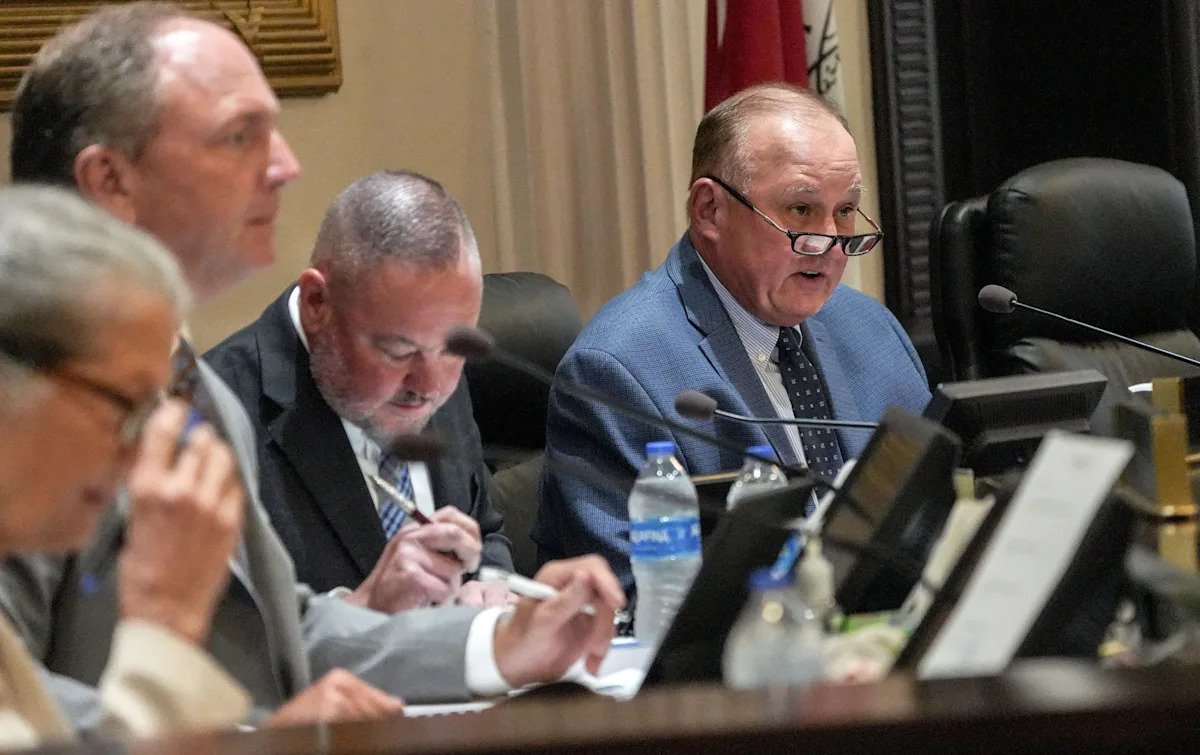
Chairman Tommy Dunn, Anderson County Council District 5, speaks before the council approved the third reading of the proposed 1% Capital Projects Sales Tax in the Historic Anderson County Courthouse in Downtown Anderson, S.C. Tuesday, August 5, 2025.
The proposed ballot question would ask voters if they approve a special one percent sales tax in Anderson County.
The following items will be exempted:
-
Unprepared foods and groceries.
-
Prescription drugs and medicines
If the penny sales tax passes, the tax will be in effect from May 2026 until April 2034.
Additionally, if the county council approves a bond for the program, repaving projects could start as early as the summer of 2026.
However, if the bond is not approved, the repaving would not begin until the spring of 2027.
Anderson County: Penny Sales Tax
Since its introduction, the penny sales tax has faced significant opposition from Anderson County residents.
Here is a brief overview of past capital sales tax initiatives that voters rejected.

Anderson County Council listened to the third hearing for the Penny Sales Tax Tuesday, August 6, 2024.
-
In 2006, Anderson County voters rejected a similar 1% capital sales tax referendum, which included a broader range of projects beyond just road and bridge improvements.
Previous proposals have faced significant opposition, often due to concerns about increased financial burdens for residents.
Penny sales tax versus community support
“I voted no for the penny sales tax last November. I believe it’s unfair to add another tax, especially when South Carolina is already one of the most heavily taxed states in the southeast,” said Anderson resident Steven Lupee, who has lived along Midway Road for one year.
Residents are concerned about the financial impact on current taxpayers, retirees, and middle-class families, as well as the overall cost of living, he said.
He suggested alternative funding methods, such as new construction impact fees, to alleviate this burden.

Rusty Burns, Anderson County Administrator, listens to a presentation before the council approved the third reading of the proposed 1% Capital Projects Sales Tax in the Historic Anderson County Courthouse in Downtown Anderson, S.C. Tuesday, August 5, 2025.
“With ongoing multimillion-dollar developments in the area, these fees could potentially generate sufficient revenue for roadway improvements without affecting existing taxpayers,” he said.
Many residents are also concerned that funds may not be allocated effectively.
Linda Symborski, who resides on Cherry Street Extension in Pendleton, echoed similar concerns about fund distribution.
“Most of the roads on this list are county and municipal roads, primarily located in subdivisions,” she said. “These roads are in better condition than my driveway. I don’t understand why they are prioritized.”
Additionally, Symborski expressed concerns that funds might be allocated to public facilities, recreation areas, and water and sewer projects instead of focusing solely on road improvements.

Brett Sanders, Anderson County Council District 4 listens to a presentation before the council approved the third reading of the proposed 1% Capital Projects Sales Tax in the Historic Anderson County Courthouse in Downtown Anderson, S.C. Tuesday, August 5, 2025.
Despite the defeat of previous proposals, County officials are hopeful that the revised proposal, with a clear focus on specific projects and a capital sales tax commission, will gain more support.
According to Matt Hogan, Deputy County Administrator, roads and bridges are integral to safety, commerce, and quality of life.
As he explained, failing infrastructure increases travel time and vehicle wear and tear, but also elevates accident risk.
“Additionally, deferred maintenance only leads to higher costs down the road as issues become more severe and complex,” Hogan said. “However, having a dedicated funding source will help Anderson County rebuild its transportation network before minor issues become costly emergencies.”
Hogan is urging the public to support this Anderson County initiative.
Commission supports penny sales tax
The newly established capital projects sales tax commission which includes Joey Black, Jamie Cantrell, Richard Dorn, Michael Mance, Matt Reeves, and Trey Thomas, has been working to address infrastructure challenges with key county officials, including Jonathan Fox, the road and bridge manager, and Hogan, to ensure funds are allocated appropriately to improve county infrastructure.
Throughout three meetings in June, the commission finalized a list of proposed road and bridge projects aimed at improving the county’s transportation network.
The total number of proposed projects amounts to 306, with approximately 180 miles of roads and bridges slated for improvements across the county.
-
The highest single project cost estimate is nearly $8 million for repairing and repaving Firetower Road between SC 81 and SC 88.
-
The lowest single project estimate is almost $26,000 to rehabilitate and repave Gantt Street in Pendleton.
As Fox explained, project phasing is based on the condition of roads and bridges, with a focus on ensuring that phase one projects are ready to proceed to contract shortly after the tax’s implementation.
“Grouping projects into phases allows work to be underway on an entire phase simultaneously rather than tackling one project at a time,” Fox said. “This approach enables savings by allowing contractors to group geographically close projects while remaining true to citizens’ priorities.”
What to know about Anderson County transportation network
Anderson County is home to 1,337 miles of South Carolina Department of Transportation roads.
These roads are maintained and improved through federal gas tax and state gas tax initiatives.
Additionally, there are 1,553 miles of county roads and approximately 196 miles of municipal streets.
Many of these state roads are in varying states of disrepair, posing significant challenges to both daily commuters and commercial traffic.
According to Fox, the county road network scored 64.5/100 two years ago and has since declined further.
“A simple asphalt overlay today would become expensive road reconstruction,” Fox said. “This process could involve digging up large areas of the road and rebuilding it from the dirt up, leading to significantly higher costs in the foreseeable future.”

Rusty Burns, left, Administrator, talks with deputy administrator Matt Hogan, right, before the Anderson County Council Meeting Tuesday, March 4, 2025.
Hogan explained that steady economic and population growth in Anderson County has led to increased demand for transportation infrastructure, and existing funding sources are insufficient to meet the rising needs.
Anderson County’s estimated 2025 population has reached 219,924, with a growth rate of 1.58% in the past year.
Anderson County roadway maintenance: What to know
Road maintenance responsibilities are shared between the Roads and Bridges Department and the Anderson County Transportation Committee.
While the Roads and Bridges Department handles the day-to-day maintenance of county roads, the Anderson County Transportation Committee focuses on long-term planning and funding for transportation projects and improvements.
According to Anderson County Council Chairman Tommy Dunn, Anderson County is one of only two counties in South Carolina that incurs a 10% charge for managing funds.

Chairman Tommy Dunn speaks on the night when Anderson County Council approved the third reading of the proposed 1% Capital Projects Sales Tax in the Historic Anderson County Courthouse in Downtown Anderson, S.C. Tuesday, August 5, 2025.
Dunn explained that the County Council does not have direct control over transportation project funding allocation.
“The Anderson Transportation Committee isn’t part of the County Council representation,” he said. “We can request funding, but ultimately it’s up to the delegation to approve or deny our requests.”
The committee receives about $5 million annually, but only $3 million can be allocated to county or municipal roads.
The Anderson Transportation Committee accepts project requests from all municipalities in the county.
Given that paving the worst roads costs approximately $1 million per mile, the committee is limited to paving only a few miles each year.
This budget limitation highlights the challenges faced in maintaining the county’s infrastructure.
To determine which projects to present to the County Transportation Committee, the Anderson County Roads and Bridges Department collaborates with the South Carolina Department of Transportation, according to Public Works Director Brittany Burdette.
“Upon receiving these requests, the County Transportation Committee reviews and approves them, ensuring that the selected projects follow the region’s financial and infrastructure goals,” Burdette said.
How are Anderson County Transportation Committee projects financed?
Anderson County Transportation Committee projects are financed through the C-Fund program, a partnership between SCDOT and the counties to fund local transportation projects, as well as improvements to state, county, and city roads.
The program specifies the types of projects eligible for C funds and requires that the County Transportation Committee allocate 33% of annual funds to state road maintenance.

Asphalt workers from the Rogers Group Inc., a privately owned construction aggregate group out of Knoxville, Tennessee, works near Lebanon Road on State Highway 178 above Interstate 85 in Anderson in March.
C Funds come from 3.99 cents per gallon of the state gasoline tax distributed to each of the 46 counties based on population, land area, and rural road mileage.
By law, counties must spend at least 25 percent of their C Funds on the state highway system for construction, improvements, and maintenance.
Travis Rose covers Anderson County for the Independent Mail. Reach him via email at trose@gannett.com.
This article originally appeared on Anderson Independent Mail: What to know about Anderson County’s proposed penny sales tax