The U.S. military keeps finding more components from China in its systems. Experts believe America’s strength is threatened by its dependencies on Chinese goods and minerals – and that it could take decades to find alternatives.

Hardly anything symbolizes American military might as much as its aircraft carriers. They project strength around the globe and signal to America’s adversaries – such as Iran, Russia and China – that the U.S. is always ready to take action.
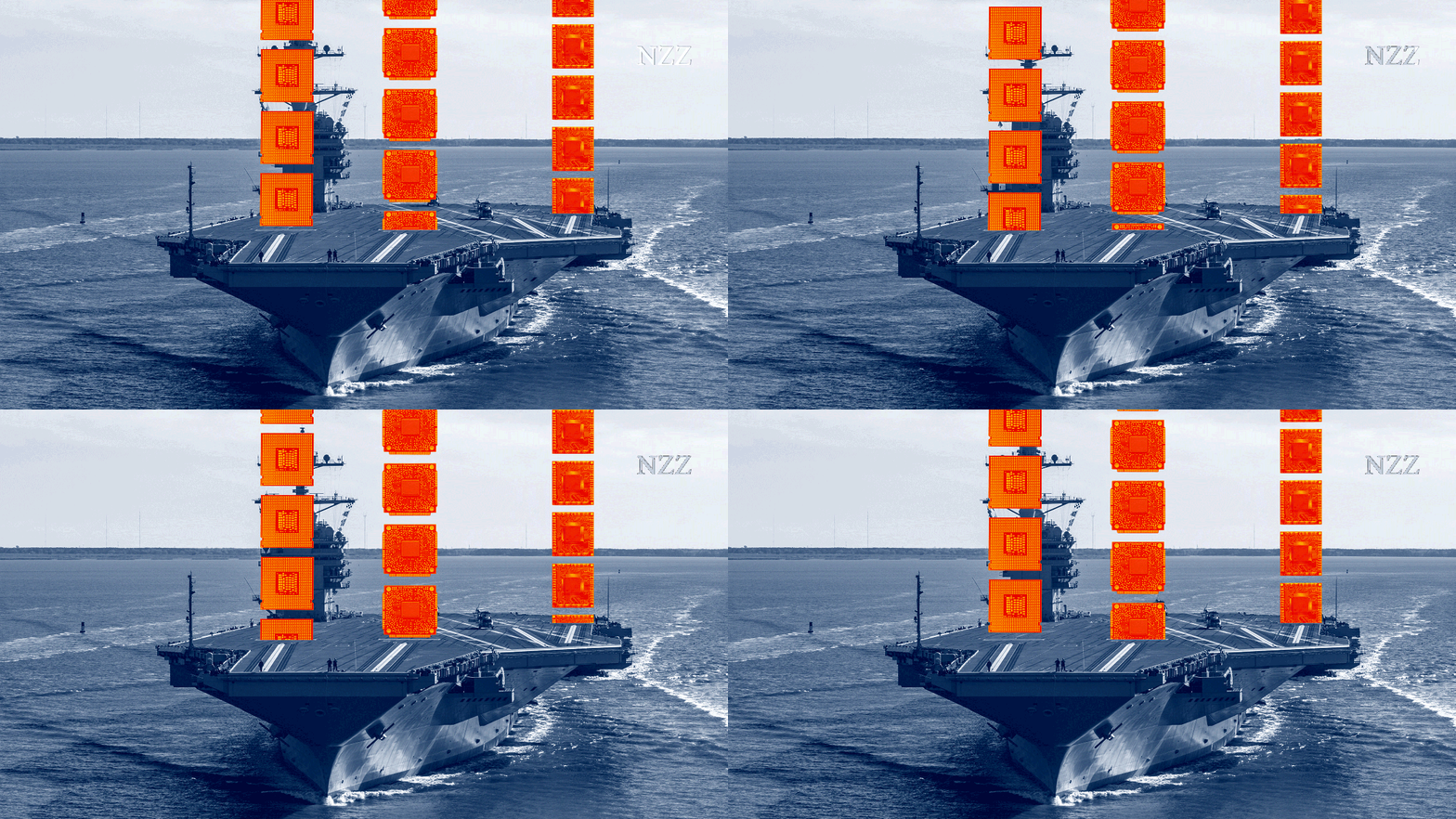
There is, for example, the aircraft carrier USS Gerald R. Ford, the most advanced aircraft carrier ever built. It carries more than 75 fighter jets, displaces 100,000 tons of water when fully loaded, and is powered by two nuclear reactors. The ship was built using 70,000 tons of steel and over 6,500 computer chips from China.
In other words, the USS Gerald R. Ford contains thousands of components from one of the countries that the aircraft carrier is actually supposed to deter.
On top of this, aircraft carriers are just one of many American weapons systems that contain Chinese-made components. Other examples include the F-35 fighter jet as well as cruise and other missiles.
Why does the U.S. rely on components from its adversary to maintain its military superiority? And could China exploit this dependency?
The analysis of supply chains has only just begun
Bryan Clark heads the Center for Defense Concepts and Technology at the Hudson Institute in Washington. He says that the U.S. Department of Defense buys ready-made weapon systems. In the past, he continues, Chinese components were mostly used in low-end manufacturing, and they were bought from suppliers of the suppliers of the actual defense companies that sell the finished systems to the U.S. military. Until recently, he adds, the Department of Defense did not systematically review these low levels of manufacturing. «For a long time, the Department of Defense simply had no information about which weapons contained Chinese components,» Clark says.
Politicians only recently recognized the problem. Two years ago, then-U.S. President Joe Biden ordered U.S. agencies to stop purchasing systems containing Chinese-made components. Companies like Govini, a Virginia-based maker of defense acquisition software, now systematically analyze the supply chains of all American weapons systems and the origins of their components on behalf of the Department of Defense. It was also Govini that concluded that over 6,500 Chinese chips are installed in the USS Gerald R. Ford.
Tracking down all Chinese components in American systems is one thing. But becoming independent of China is another. «That could take decades,» Clark says.
Could China sabotage a submarine with defective chips?
Experts see two scenarios in which China could exploit America’s dependence. First, Chinese manufacturers could deliver manipulated or shoddy hardware. Chip expert Chris Miller pointed out this possibility in a guest contribution to the Financial Times. It is conceivable, he writes, that Chinese chips could collect data that is supposed to be kept secret, or that the components could be particularly poorly manufactured, meaning they would break down more quickly and, for example, that American submarines would have to be docked for repairs more often than is regularly scheduled. And these submarines could then be out of action in places like in the Indo-Pacific, for example.
Clark from the Hudson Institute sees the scenario outlined by Miller as merely a theoretical danger. This is because the Chinese chips used in American weapon systems are also used in civilian applications, such as cars and electrical appliances. And because the manufacturer of the chips doesn’t know where they will ultimately be used. Clark says that China would therefore be unable to deliberately place manipulated or low-quality chips in American weapon systems.
In any case, Clark assumes that Chinese chips in submarines or aircraft carriers are not «system critical,» as strict regulations have long been in place for nuclear propulsion and flight safety.
Delivery stoppages pose greatest threat to the U.S.
That is why Clark sees a much greater danger for the U.S. in the second scenario. In this scenario, China could impose a ban on the supply of chips, but also on rare earths or permanent magnets. The U.S. is dependent on China for chips, magnets and rare earths, all three of which are essential for multiple weapons systems. Rare earths are found in high-performance chips, drones and night-vision devices, among other things. Permanent magnets are components of engines, generators and sensors, for example.
However, the dependencies on rare earths and permanent magnets are more problematic than those on computer chips. In fact, China had imposed a two-month ban on exports of rare earths and magnets to the U.S. during the recent trade dispute, but the ban was lifted in June.
At least there are alternatives to China for chips. The suppliers of American defense companies are gradually having their chips made in the West, albeit at higher prices. However, there are hardly any facilities for processing rare earths in the West and no production sites for permanent magnets at all.
Clark estimates that it could take a decade before rare earths are processed and permanent magnets are manufactured in the U.S. again. To at least partially counteract these dependencies, the U.S. military has built up stockpiles of particularly critical components. However, Clark is not allowed to say exactly which ones these are or in which weapon systems they are integrated.
China is also dependent on Western components
But it is not only the U.S. that is dependent on its greatest adversary, as this is also the case with China. For example, the country cannot manufacture aircraft engines without American components. The blades and parts of the housing of such engines come from the U.S. In addition, the Chinese are dependent on European components for their guided missiles.
According to Clark, dependence is less of a problem for China than it is for the U.S. While China needs some highly specialized components, he explains, the U.S. has to import large quantities of conventional components and rare earths from China. As he sees it, it would therefore be much more difficult for the U.S. to turn away from Chinese suppliers completely than vice versa – and it will therefore likely be several years before an U.S. aircraft carrier can flex American military muscle around the globe without any Chinese components.
Latest articles
NZZ Geopolitics – The independent Swiss view
Standing outside the American media establishment, the NZZ offers distinctive insights that challenge the polarized narratives often found in U.S. coverage. Our goal is to provide in-depth, nuanced reporting on global affairs, including developments in the United States, Europe, China and beyond. Taking a nonpartisan stance, we approach events with a sober and critical eye. Backed by a trusted network of international correspondents and expert reporters based in Switzerland, we deliver sharp analysis and a deeper understanding of geopolitics and the global economy.
Sign up for our free newsletter or follow us on Twitter, Facebook or WhatsApp.